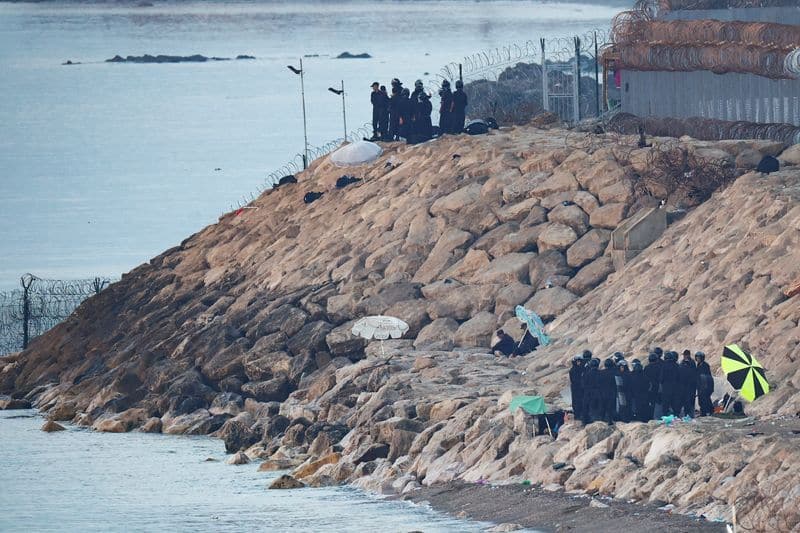
CEUTA, Spain, Aug 15 (Reuters) - In the weeks before a rush of more than 70,000 migrants into the Spanish enclave of Ceuta, border workers warned Spain’s central government that more people, spurred on by social media, were arriving by sea, adding they feared an escalation.
Spain’s government did not heed their warnings and took little action, they told Reuters.
A Spanish court ruling, published on June 29, stated migrants could only be immediately pushed back from entering Ceuta if they crossed a physical barrier, specifying that anyone swimming to the enclave did not.
News of this ruling and videos of migrants successfully entering Ceuta encouraged more and more to try their luck.
Spain’s government blamed the deadly rush of July 29-30 on misinformation about the ruling spread by criminal networks.
However, public and private warnings issued by trade unions representing border workers, seen by Reuters, highlight that Spanish authorities were warned weeks earlier that arrivals to the enclave in North Africa could escalate and urged to act fast.
Spanish authorities say 80 people died in the rush and Moroccan authorities said 14 bodies were recovered in their territory, putting the number of confirmed deaths at 94. Human rights groups say more remain missing and the number could be higher.
‘AN EXPLOSIVE COCKTAIL’
Rachid Sbihi, spokesperson for Spain’s Civil Guard police trade union AUGC in Ceuta, said no one could have imagined the scale of what eventually took place on July 30.
“[But] we understood the ruling would trigger more arrivals. The ruling, the criminal gangs, and social media networks were an explosive cocktail,” he told Reuters.
Asked about comments that Spain did not act in time, a Spanish Interior Ministry spokesperson said authorities had studied various options after the court ruling before installing a floating barrier on the ocean on August 1.
“This prior assessment and analysis work allowed the floating barrier to be put in place just 48 hours after the decision to install it was made, following the massive arrival on July 30,” they said in a written statement to Reuters.
‘A LEGAL LOOPHOLE’
Reuters reviewed six instances of written statements and letters to the national government representative in Ceuta and the enclave’s police chief from Spanish border unions calling for guidance and action from government after the court ruling.
“[The ruling] has opened a legal loophole which only well-defined protocols can close,” the AUGC Civil Guard union said in an online statement on July 10. Until a physical barrier is installed at sea, “the ball is in the court of those who must provide clear instructions to agents at the border every night,” it said.
“Criminal gangs analyse every normative and legal change and adapt their routes and methods when they notice return procedures have become slower or more complex,” warned police union SUP three days later on X, calling for reinforcement of their numbers and a “coherent and effective” immigration policy to avoid the ruling being exploited.
In a letter to Ceuta’s police chief dated July 23 and seen by Reuters, the union flagged “constant arrivals by sea with direct repercussions on staff which conventional police infrastructure is not conceived to handle” and called for the establishment of a temporary reception centre.
Spain’s Interior Ministry, responsible for police, did not respond while the government delegate offered an appointment weeks later, according to spokespeople from unions AUGC and SUP.
There is no link between the rising arrivals before July 29-30 and the mass crossing that followed, a spokesperson for the delegate to Ceuta said. The delegate was unable to attend meetings requested by the unions but was in constant communication with the police and Civil Guard, they added.
Spokespeople for the police and Civil Guard declined to confirm what discussions were held with the delegate. Police unions said if any meetings had taken place, no fresh instructions resulted from them.
THE PULL FACTOR
Morocco is one of several North African countries the European Union pays to help police its borders. Rabat received €152 million ($176 million) in 2023.
Morocco says it spends around €500 million a year on border control in the north and it steps up frontier checks when calls for collective crossings are detected on social media, according to analysts.
Although Spanish and Moroccan border staff flagged more crossing attempts from mid-July, more stringent measures in Morocco - such as bus and train station checks - only began one to two days before the mass crossing. Only when the surge of arrivals spiralled into the tens of thousands on July 29 did Morocco send significant reinforcements, according to media reports, testimonies from NGOs and a Reuters witness.
“They didn’t do anything proactive. That strikes me as a policy failure,” said Riccardo Fabiani, North Africa project director at International Crisis Group.
In Morocco, a senior government official said they had asked Spanish counterparts after the ruling if it would generate problems. They did not disclose what Spain answered. Tackling the consequences was Spain’s responsibility, added the official, who declined to be named.
Increasing the numbers of security forces would have achieved nothing, the senior Moroccan government official told journalists on August 3, noting the pull factor was too strong.
EU URGED TO DO MORE TO DETER MIGRANTS
The border rush, and Madrid and Rabat’s stance in the weeks before, raise questions about Europe’s reliance on other countries to police its borders. Nevertheless, Spain and Morocco have praised their cooperation, and the EU said it could provide more financial support. The European Commission said in a statement it would continue to work with both Spain and Morocco to strengthen the border, and the two countries were investigating last month’s events at the frontier.
Moroccan officials however have also stressed Europe must do better at deterring migrants in the first place.
Spain’s government has set itself apart on migration from many peers, urging a more humanitarian approach and registering undocumented migrants to allow them to work and support its fast-growing economy.
“If Spain announces that it is willing to receive all immigrants, why are we forcing people to jump the fences and throw themselves into the sea?” Moroccan Justice Minister Abdellatif Ouahbi said this week in an interview with Spain’s EFE agency. “Let’s open the borders… If you are going to receive them, why are we stopping them?”
($1 = 0.8636 euros)
(Reporting by Victoria Waldersee and Ahmed Eljechtimi, Additional reporting by Aislinn Laing; Editing by Alexandra Hudson)