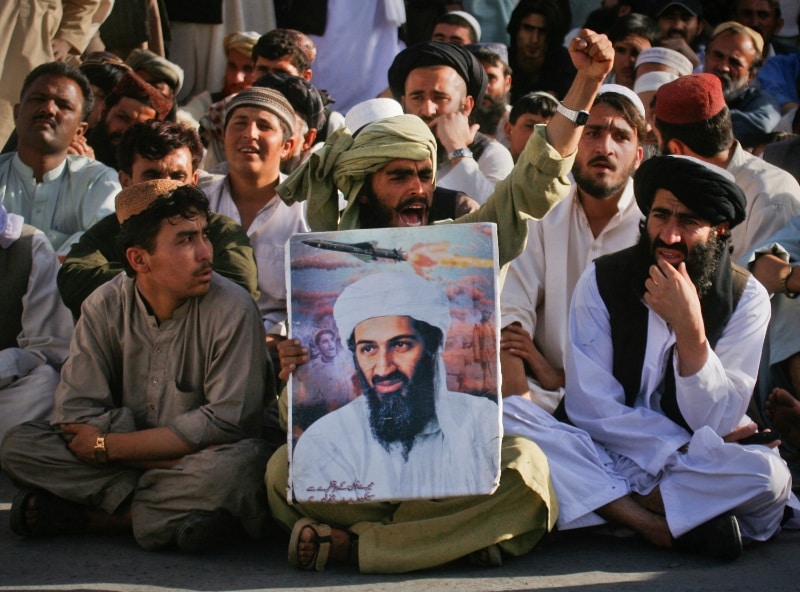
Sept 10 (Reuters) - In the 25 years since al Qaeda militants hijacked passenger jets and flew them into New York’s World Trade Center towers and the Pentagon, the group founded by Osama bin Laden has spawned affiliates and inspired attacks around the world.
While it has suffered setbacks, notably bin Laden’s killing in 2011 by U.S. forces and the emergence of Islamic State as a rival, experts say al Qaeda still serves as a source of support and inspiration for militants in many regions, particularly in Africa.
WHAT IS AL QAEDA?
Al Qaeda emerged as a transnational jihadist network in the late 1980s under the leadership of bin Laden, a wealthy Saudi-born militant who had helped recruit and funnel support to Arab volunteers fighting the Soviet invasion of Afghanistan after 1979 and fought there himself.
Al Qaeda became a magnet for militants who aspired to establish hardline Islamist rule and who shared common hostility to the United States, Israel and U.S.-allied governments in the region.
Bin Laden was stripped of his Saudi citizenship in 1994 and expelled from Sudan in 1996, taking sanctuary in Afghanistan.
He began organising attacks on U.S. interests long before arriving in Afghanistan. The first recognized by the United States was a 1992 al Qaeda bombing of two hotels in Yemen intended to kill Somalia-bound U.S. troops who had already left or were staying elsewhere.
In Afghanistan, he supported training camps and established an elite brigade of foreign fighters.
In 1996, he declared jihad against U.S. forces he described as occupying Saudi Arabia.
This was followed in 1998 by the announcement of a “World Islamic Front” for jihad against “Jews and Crusaders”, and a declaration that it was a duty for Muslims to kill Americans and their allies, whether civilian or military.
Later that year, al Qaeda truck bombings against the U.S. embassies in Kenya and Tanzania killed 224 people.
The September 11 attacks were carried out by 19 hijackers, 15 of them from Saudi Arabia. They hijacked four jets, the fourth of which crashed in a field in Pennsylvania after passengers stormed the cockpit. The attacks killed nearly 3,000 people.
WHAT HAPPENED TO AL QAEDA’S LEADERS AFTER 9/11?
The United States invaded Afghanistan in October 2001, toppling the Taliban and driving al Qaeda from its base of operations.
Anti-Taliban forces overran al Qaeda’s base in the Tora Bora mountains in December 2001, but bin Laden evaded capture for a decade, periodically releasing messages until U.S. special forces killed him in a raid on his compound in Abbottabad, Pakistan, in 2011.
The self-professed mastermind of September 11, Khalid Sheikh Mohammed, was captured in Pakistan in 2003. In 2007, Mohammed said he planned the attack ”from A to Z”, according to a transcript of a military hearing released by the Pentagon.
A judge recently ordered Mohammed, who is held in Guantanamo Bay, Cuba, and three co-defendants to stand trial before a military tribunal in June 2028, following two decades of legal deadlock.
Bin Laden’s successor, Ayman al-Zawahri, was killed by a U.S. drone strike in Kabul in 2022.
Egyptian militant Seif al-Adel is believed to be al Qaeda’s de facto leader today.
HOW DID ITS INFLUENCE SPREAD AFTER 9/11?
While al Qaeda’s leaders scattered, militants linked to al Qaeda or inspired by its ideology carried out numerous attacks.
The deadliest included a 2002 attack on a nightclub district in Bali that killed 202 people, bombings that killed more than 190 people on trains in Madrid in 2004, and suicide bombings that killed 52 people on London underground trains and a bus in 2005.
Al Qaeda affiliates sprang up in the Middle East and beyond. One of the most powerful was in Iraq, where al Qaeda fought U.S.-led forces following the 2003 invasion.
A branch emerged in North Africa in 2007 and another in the Arabian Peninsula in 2009. After 2011, al Qaeda’s Nusra Front became a force in Syria’s civil war.
In Africa, al Qaeda affiliates include Al Shabaab in Somalia and Jama’at Nusrat al‑Islam wal‑Muslimin (JNIM) in the Sahel region. Al Qaeda also has ties to Tehrik-e Taliban Pakistan (TTP), also known as Pakistani Taliban, which is waging an insurgency against Islamabad.
Antonio Giustozzi, a senior research fellow at the RUSI think-tank in London, said that while al Qaeda suffered losses and dislocation after the invasion of Afghanistan, its profile rose and it expanded massively in the years that followed. Its influence peaked around 2013 before its Iraqi branch broke away to form Islamic State, he said.
HOW WAS AL QAEDA AFFECTED BY THE RISE OF ISLAMIC STATE?
Islamic State founder Abu Bakr al-Baghdadi split from al Qaeda and declared a “caliphate” across large parts of Syria and Iraq in 2014, sparking conflict with the Nusra Front.
Though Islamic State was eventually beaten out of its territory in Syria and Iraq, in a reversal for jihadism, its rivalry with al Qaeda continues, particularly in West Africa where affiliates of the two groups regularly clash as they compete for territory and influence.
Another blow came in 2016 when the Nusra Front broke away. Its leader Ahmed al-Sharaa, then known by his nom de guerre Abu Mohammed al-Golani, went on to topple Bashar al-Assad in 2024. He became Syrian president and made Damascus a Western ally.
WHERE IS AL QAEDA MOST ACTIVE TODAY?
Somalia and West Africa’s Sahel region are the main theatres in Africa where al Qaeda-aligned groups are expanding their influence and governing across swathes of territory.
TTP has expanded its insurgency in northwestern Pakistan. It has received ideological guidance, training and support from al Qaeda, according to a U.N. report published last month.
Pakistan says the TTP leadership and many of its fighters are based in Afghanistan, where the Taliban returned to power in 2021 after the U.S. withdrew.
In February, another U.N. report said al Qaeda “continued to enjoy the patronage of the de facto authorities” in Afghanistan — a reference to the Taliban government — and that its “appetite for external operations” remained “undiminished”.
Kabul denies that al Qaeda operates in Afghanistan, or that it allows militant attacks on Pakistan from its territory.
Giustozzi said that while al Qaeda was past its peak “they’re still remarkably influential”.
It had evolved to be less dependent on specific individuals, relying instead on a cadre of low-profile operatives who are “much more difficult to target and identify”, he said.
(Additional reporting by Jonathan Landay, David Lewis and Rick Noack; Writing by Tom Perry; Editing by Aidan Lewis)