By Helen Coster
NEW YORK, Aug 6 (Reuters) - Progressive candidates continue to rack up wins in primary elections across the United States, propelled by a new left-wing media ecosystem allowing them to build a national profile on their own terms — and sidestep the traditional gatekeepers of the Democratic establishment.
For Pennsylvania state Representative Chris Rabb, a Democratic socialist who recently prevailed in a congressional primary against a more moderate rival, appearances on programs like “The Majority Report with Sam Seder” and “Breaking Points” played a key role in his political breakthrough.
“It helps me increase my visibility, validation and ability to raise money,” said Rabb, describing it as “a Venn diagram of success.”
This fast-growing world of left-wing websites, podcasters, YouTube hosts and livestreamers – many of whom blend opinion journalism and activism – affords candidates a sympathetic space to sharpen their message and mobilize grassroots support. But it also risks deepening the fissures in the Democratic Party, analysts say, and alienating moderates in the coalition.
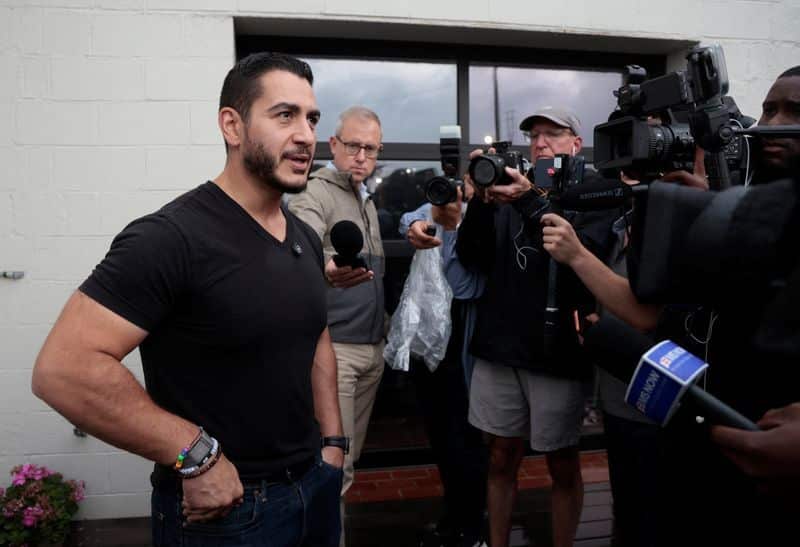
On Tuesday, progressive Abdul El-Sayed eked out a victory in Michigan’s Democratic Senate primary against Haley Stevens, the preferred candidate of the party establishment.
El-Sayed, a former state health official and a rising star in left-wing media, was massively outspent in television advertising — funded by tens of millions of dollars from pro-Israel and other outside groups — but still managed to win in a swing state carried by Republican President Donald Trump in 2024.
New media entrepreneurs say they are filling a void in mainstream political coverage and providing a platform for candidates with views that have long been underrepresented in Washington. They include advocacy for universal healthcare, abolishing ICE and cutting off military aid to Israel.
“There is an audience and a demand and a hunger for different viewpoints,” said Mehdi Hasan, a former MSNBC host who launched his own news organization, Zeteo, in 2024.
“The same energy that enabled us to be a success as a media entity has enabled a lot of political candidates to be successes.”
A GROWING AUDIENCE
The American left has long had its own constellation of shows and publications. But as the reach of, and trust in, traditional media declines and consumers look elsewhere for news, independent content creators are becoming political kingmakers.
While much smaller and less well-funded than right-wing media, the left’s growing network of podcasters, streamers and digital publishers is becoming an increasingly important force in Democratic politics, shaping primary campaigns, fundraising and activist organizing.
Zeteo has 700,000 Substack subscribers, up 50% from a year ago. “The Majority Report with Sam Seder” has more than 2 million subscribers on YouTube and roughly 75% of listeners are under age 55.
Progressive commentator and activist Hasan Piker has more than 3 million followers on Twitch.
For campaign strategists, the appeal of this new media environment is simple. Their candidates can have long, in-depth conversations on policy issues – the kind seldom seen on cable news – engage directly with voters and generate clips that can be blasted across social platforms.
“I think we help create early enthusiasm,” said Sam Seder. “Our audience in particular has a lot of activists and a lot of people who run activist organizations, and I know we have a lot of legislative staffer types.”
Candidates often move through the same circuit of shows and creators, allowing audiences to discover them through trusted ideological allies, said Jesse Lehrich, a Democratic operative and co-host of the political podcast “Nobody Knows Anything.”
In turn, rising stars on the left help emerging media figures build their brands.
“It’s interconnected,” said Hasan. “I don’t think one is necessarily leading the other.”
‘PREACHING TO THE CHOIR’
Most of the left-wing media personalities that have risen to prominence in recent years are unapologetic partisans.
“Breaking Points” co-host Krystal Ball took part in a livestreamed August fundraiser for El-Sayed and other progressive candidates in Michigan.
Piker canvassed last week for Francesca Hong, who is vying to be the first democratic socialist governor of Wisconsin, and took part in El-Sayed’s election night party in Detroit.
“The work is only beginning,” he posted to X as the last votes trickled in on Tuesday night.
Piker has voiced support for Hamas, used the word “cracker” to refer to white people and said that “America deserved 9/11,” a comment he later described as “inappropriate.” He did not respond to a Reuters request for comment.
He has built a deeply devoted following on his daily Twitch streams, where he hosts free-floating discussions about hot-button issues – similar to Joe Rogan, the influential right-leaning podcaster who endorsed Trump in 2024.
For Seder, the goal of “Majority Report” is less about persuading swing voters than educating and energizing those already in their corner.
“We may be preaching to the choir, but the choir is then going out and preaching to the independents,” he said.
Hans Noel, a professor of government at Georgetown University, said these creators and outlets “energize voters who find the party’s platform too lukewarm or uninspiring.”
“At the same time,” he added, “factional voices are not always interested in compromise,” which could pose a problem for candidates like El-Sayed as they seek to win over more moderate Democrats in the general election.
AN OPPOSITION PARTY
Jennifer Welch and Angie “Pumps” Sullivan, friends from Oklahoma City, started the “I’ve Had It” podcast in 2022 – a venue to vent about all the things that annoyed them, from the antics of reality stars to their own misbehaving children.
It wasn’t until the 2024 presidential campaign that they began to talk about politics, savaging Trump in typically irreverent terms.
Soon they were interviewing Democratic presidential hopeful Kamala Harris and attending the party convention in Chicago.
Their show now has more than 5.2 million subscribers and followers across YouTube, Facebook, Instagram and TikTok.
Listeners “are coming to us to get news and to get our opinion on the news,” Welch told Reuters.
El-Sayed appeared on the podcast twice, and Welch endorsed him on-air, a decision she described as a “layup”.
“I think that the Democratic base is so much further than what the establishment realizes,” she said, “and I think candidates like Abdul are the future of the Democratic Party if we are to be an opposition party.”
(Reporting by Helen Coster; Editing by Jesse Mesner-Hage and Alistair Bell)