By Erin Banco
WASHINGTON, Aug 13 (Reuters) - The U.S. has received several warnings from Israel over the past year that Iran intended to assassinate President Donald Trump, including before a secret Air Force One ruse in Turkey, that U.S. intelligence officials could not independently verify, according to a current U.S. official and two former officials.
The warnings, passed to U.S. intelligence agencies and in some cases relayed directly by Israeli officials to senior White House officials, included possible plots to shoot Trump with a sniper or recruit someone to attack him with a knife at a large public event, the sources said. The tips began in the lead-up to the 12-day war in June 2025 and intensified prior to the U.S. decision to go to war in Iran in February, the sources said.
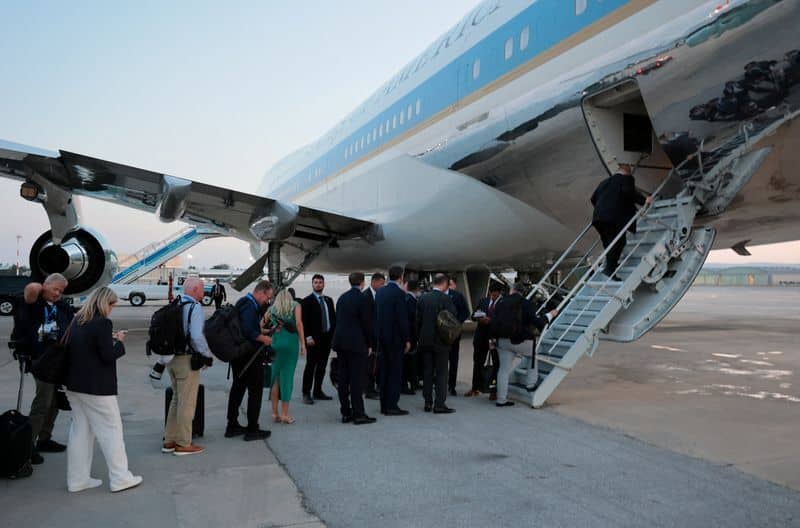
The most detailed warning came ahead of the NATO summit in Ankara in July, the U.S. official and the other person familiar with the matter said. Israeli officials briefed the White House about intelligence that indicated Iran may try to kill Trump, potentially with a shoulder-launched missile, while he traveled on Air Force One for the summit, the officials said.
The U.S. intelligence community has long assessed that Iran wants to retaliate for Trump’s killing of Iranian military commander Qassem Soleimani in 2020. But the Central Intelligence Agency has not been able to corroborate some of the specific threats against Trump’s life shared by Israeli intelligence since early last year, the officials said.
In the case of the NATO episode, a Turkish official said the country’s intelligence agencies also did not have any evidence to corroborate the Israeli claim about the threat to Trump’s life, an assessment the host country shared with Americans.
Despite the lack of verification, White House officials and the Secret Service have taken steps to mitigate the threats out of an abundance of caution, including an extraordinary deception operation during the Turkey trip that involved moving Trump from Air Force One to a different aircraft for his flight out of the country.
That episode underscores how Israeli intelligence is influencing the Trump administration’s decision-making about Iran at a time of heightened tensions with Tehran — and broader disagreement between U.S. and Israeli intelligence assessments on Iran’s threat overall.
Earlier this year, American intelligence agencies assessed that Iran was not actively building a nuclear weapon, even as Israel argued Tehran posed an urgent threat. Despite the reports from the U.S. intelligence community, Trump moved forward with strikes in Iran in February. Trump also took into consideration intelligence shared by Israel that Tehran had tried to assassinate him before launching the military campaign, Reuters previously reported.
A spokesperson for the Israeli embassy disputed that Israel was using its intelligence to influence U.S. policy on Iran.
“The same people who claim that Israel is trying to influence U.S. policy through alleged intelligence sharing would just as soon accuse Israel of concealing critical information if it benefited their own agenda,” the spokesperson said.
The White House and CIA both declined comment.
Secret Service spokesman Anthony Guglielmi declined to discuss specific intelligence matters but said the agency remains focused on Trump’s security amid recent assassination attempts and an increase in threats against the president.
“The U.S. Secret Service continuously analyzes a wide range of information to guide our protective operations in real time and across every location we secure,” he said.
CLOSE ALLIANCE
The U.S. has long relied heavily on Israeli intelligence on Middle East matters, particularly as they relate to Iran.
The current and former officials said Israeli intelligence on Iran typically flows to the CIA or the National Security Agency through formal channels and is subsequently analyzed, two former U.S. officials said.
The U.S. intelligence agencies often cannot verify Israeli intelligence but will use other forms of information to make judgment calls on its authenticity and accuracy, the officials said.
In several instances over the course of the two U.S. military offensives in Iran, the CIA assessed it had “low confidence” in the Israeli intelligence about the threats posed by Iran, including any plans to assassinate Trump, according to one former official and another person familiar with the matter.
It is unclear how widely those assessments have been circulated inside the administration.
The NSA declined to comment.
Two of the former U.S. officials described to Reuters several instances in which senior Israeli officials and representatives over the last year called the White House, including in the Situation Room, to brief senior Trump officials on Iranian threats directly.
The direct engagement comes amid a breakdown in U.S. intelligence sharing inside the Trump administration.
Last year, amid increased tensions with the Office of the Director of National Intelligence, the CIA stopped coordinating and sharing intelligence with the National Intelligence Council, the U.S. intelligence community’s elite analytical group overseen by ODNI, the former officials said. The CIA was the largest contributor to NIC assessments.
Now, there are fewer comprehensive intelligence community assessments produced by the NIC, including those focused on Iran, the officials and another person familiar with the matter said.
(Reporting by Erin Banco in Washington; additional reporting by Humeyra Pamuk; editing by Colleen Jenkins and Nick Zieminski)