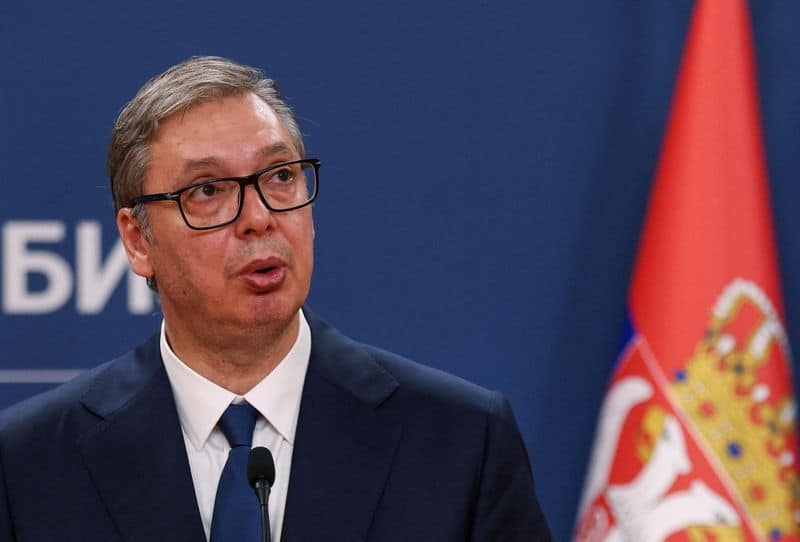
BELGRADE, Aug 28 (Reuters) - Serbian President Aleksandar Vucic accused a U.N. war crimes court on Friday of “uncivilised behaviour” for not letting former Bosnian Serb army commander Ratko Mladic die in Serbia and said Belgrade was still waiting to know whether the body would be returned.
Mladic, who was serving a life sentence after being convicted of genocide, crimes against humanity and war crimes committed during Bosnia’s 1992-95 war, died on Thursday in a U.N. detention facility in The Hague. He was 83.
“We have received nothing from The Hague,” Vucic told reporters, adding that Serbian authorities would help arrange a dignified burial for Mladic in Serbia if his family requested it.
The court denied Mladic’s request last month to be allowed to return to Serbia to die. It said his health condition was precarious but stable and well-managed at the detention centre.
“We have seen now that The Hague wanted Mladic’s death behind bars,” Vucic said. “They did not allow the general to die in Serbia, where he wanted to die. That is uncivilised behaviour, without precedent or justification.”
The U.N. body tasked with overseeing residual cases from the Yugoslav war crimes tribunal did not respond to Reuters questions about a possible transfer of Mladic’s remains to Serbia.
Serbian media reported that Mladic had expressed a wish to be buried at a cemetery in Belgrade beside his daughter Ana, who died in 1994.
COURT INVESTIGATING MLADIC’S DEATH
The court has opened an inquiry into the circumstances of Mladic’s death. A judge appointed to oversee the investigation spent about three hours at the detention facility on Friday but did not make a statement to reporters.
Vucic, a former ultranationalist who served as a minister under late Serbian strongman Slobodan Milosevic in the 1990s, has rebranded himself in recent years as a pro-European reformer while maintaining close ties with Russia and China.
Mladic was found guilty of genocide for his role in the 1995 Srebrenica massacre, in which about 8,000 Bosniak Muslim men and boys were killed after Bosnian Serb forces overran the U.N.-designated enclave.
He was also convicted over the 43-month siege of Sarajevo, during which about 10,000 people were killed.
However, Mladic remained a revered figure among many Serbs in Serbia and in Bosnia’s autonomous Serb Republic.
Survivors of the Srebrenica massacre had very different views.
“He should never have left prison,” said Meira Djogaz, whose husband, three sons and grandson were killed during the war and who returned to live in Srebrenica after the conflict.
“I wish he had lived even longer so that he could suffer in prison more,” she said.
(Reporting by Ivana Sekularac in Belgrade, Stephanie Van Den Berg in The Hague and Amel Emric in Srebrenica; editing by Gareth Jones)