By Miranda Murray
BERLIN, Sept 7 (Reuters) - The Alternative for Germany appealed on Monday to lawmakers from Chancellor Friedrich Merz’s conservatives to support its bid to rule Saxony-Anhalt after the far-right party surged into first place in the eastern German state’s election.
The anti-immigrant, pro-Russia AfD won nearly 44% of the vote, official results showed, an outcome that underlined the deep unpopularity of Merz’s ruling coalition and also triggered alarm among Germany’s neighbours, France and Poland.
However, the party — which wants to deport immigrants, halt support for Ukraine and ditch the euro — has fallen short of an absolute majority in the state legislature, winning 39 of the 83 seats, and hopes to win over individual conservative lawmakers.
The election result raises serious questions about the longstanding refusal of Germany’s mainstream parties, including Merz’s Christian Democrats (CDU), to work with the AfD, a policy known as the “firewall”. The AfD says this is undemocratic.
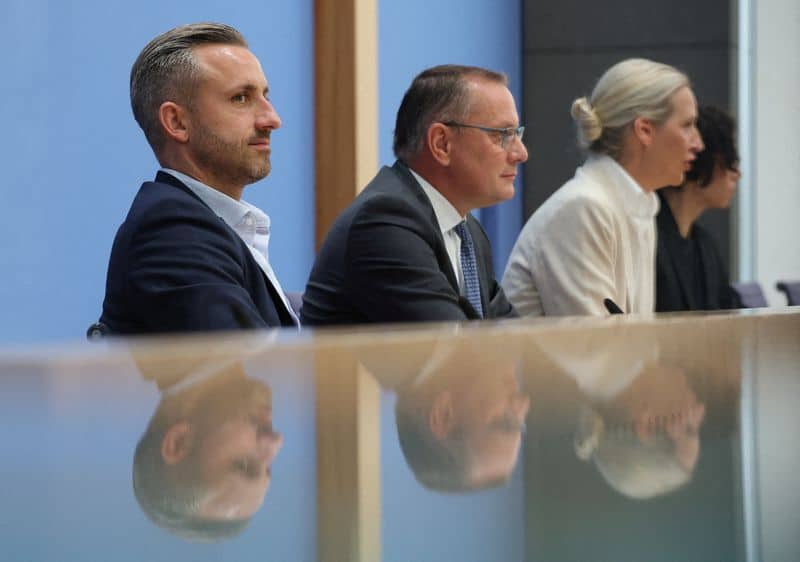
“Politics always means compromise,” national AfD co-leader Tino Chrupalla told German broadcaster ARD, appealing to CDU lawmakers to make a “centre-right conservative majority” in Saxony-Anhalt possible.
The CDU needs to ask itself what conclusions it draws from this disastrous election result, he added.
“Partisan games really ought to be a thing of the past,” he told German radio, referring to the firewall policy.
Ulrich Siegmund, the party’s lead candidate in the state, said he hoped to become Saxony-Anhalt’s state premier if the AfD could build a stable majority in the legislature, and said it would hold discussions with various parliamentary groups there.
‘AN AFFRONT TO VOTERS’
The only German party that has signalled readiness to work with the AfD is the populist left-wing BSW, which on Monday echoed Chrupalla’s criticism of the “firewall” policy.
“Even the mere attempt to forge another ‘firewall’ coalition (by the other mainstream parties to keep the AfD out of power in Saxony-Anhalt) would be an affront to the voters,” said Sahra Wagenknecht, the face of the left-wing populist BSW.
The BSW shares the AfD’s hostility towards mass immigration, which it says undermines local workers’ rights, and also advocates for ending Germany’s support for Ukraine and restoring ties with Moscow.
The BSW could help clear the way for Siegmund to become state premier by abstaining in a parliamentary vote. That could allow him to head a minority government, although Siegmund has previously rejected such a scenario.
Germany’s intelligence services have branded the AfD as “extremist”, allowing them to step up surveillance of the country’s biggest opposition party. The AfD strongly rejects the label.
Saxony-Anhalt is a relatively small state, and one of the poorest in Germany’s former communist east, but Alice Weidel, the AfD’s other national co-leader, hailed Sunday’s result as a milestone and said her party aimed to win at least 40% in the next national election, due in 2029.
‘VERY, VERY WORRYING SIGNAL’
In the first international reaction to the election result, French Finance Minister Roland Lescure told RTL radio it “sends out a very, very worrying signal”.
“This shows that we face a major challenge in the face of a populist wave which is spreading around the world today and which we must resist,” said Lescure, whose own country holds national elections next year that could see far-right veteran Marine Le Pen become president of France.
Polish Foreign Minister Radoslaw Sikorski also described Sunday’s outcome in Saxony-Anhalt as “a very worrying sign”.
The AfD won 43.8% of the vote, according to the official election results, more than doubling its support from the last state election in 2021. The CDU’s share almost halved to 17.2%, with about 83,000 former CDU voters switching to the AfD.
CDU state candidate Sven Schulze attributed part of his party’s poor performance to developments in Berlin, where Merz — the most unpopular chancellor in German history — is struggling to revive Germany’s sluggish economic growth. The euro was little changed in Monday trade but analysts are closely monitoring the surge in support for far-right parties across Europe, noting that the AfD wants to take Germany out of the common currency.
“This development is dangerous for the longer term stability of the single currency,” XTB research director Kathleen Brooks said.
“The next few years could see waves of political change in Europe and a shift to the right in the two largest economies. This may not be a problem for FX traders today, but it is a problem for tomorrow.”
(Reporting by Miranda Murray and Andreas RinkeEditing by Gareth Jones)