By Nancy Lapid
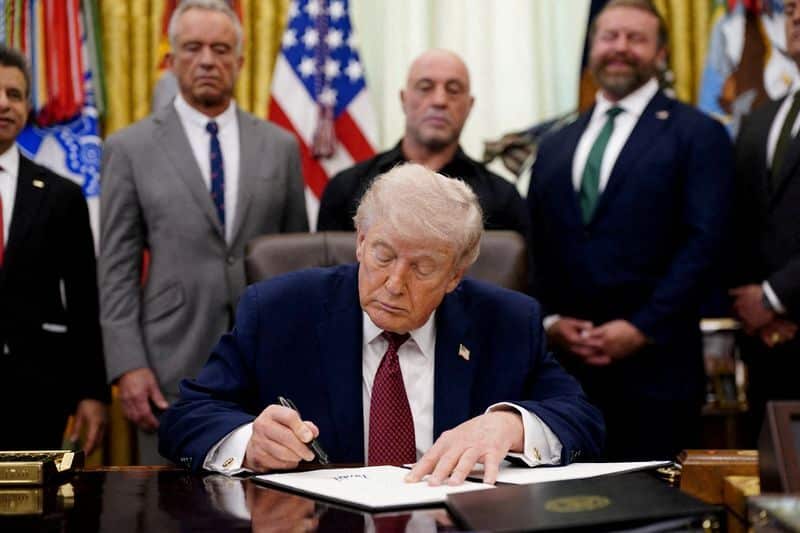
April 21 (Reuters) - U.S. President Donald Trump this week signed an executive order directing health regulators to speed reviews of psychedelic treatments and increase federal funding for research into their use in response to advocates for the drug ibogaine including influential podcaster Joe Rogan.
Presently almost all psychedelic drugs in the United States are considered Schedule I controlled substances, in the same class as heroin or ecstasy, meaning they are deemed to have no medical use and high risk for abuse.
Several treatments derived from psychedelic compounds are being tested by drugmakers. Here is what is known about these treatments:
WHAT ARE THE DRUGS BEING TESTED FOR?
The strongest evidence for use of the drugs so far has come from trials in patients with severe depression or post-traumatic stress disorder who have not responded to existing treatments.
Early-stage trials are also testing psychedelic drugs for substance abuse disorders, borderline personality disorder, obsessive-compulsive disorders, anxiety, self-harm behavior, chronic Lyme disease and fibromyalgia.
HOW DO PSYCHEDELIC TREATMENTS WORK?
Psychedelic treatments work primarily by activating proteins on the surface of nerve cells that regulate the brain’s ability to reorganize, form new connections, and repair damaged circuits. Unlike traditional psychiatric drugs that may be taken at home on a daily basis, these treatments are usually administered by medical personnel in a limited number of sessions to supplement intensive psychotherapy.
WHAT PSYCHEDELIC DRUGS ARE CURRENTLY AUTHORIZED FOR USE?
In Australia, the synthetic psychoactive drug midomafetamine (MDMA) is approved for PTSD, and psilocybin - a naturally occurring psychedelic compound in certain mushrooms – is authorized for treatment-resistant depression.
Switzerland allows limited use of psilocybin psychotherapy, while Jamaica allows psilocybin sales over the counter in chocolates, teas, and other products. Brazil and the Netherlands allow plant-based psychedelics found in ayahuasca and mushrooms.
In the United States and Europe, Johnson & Johnson’s esketamine nasal spray Spravato is approved for treatment-resistant depression and suicidal ideation. Esketamine is derived from one half of the ketamine molecule. Like ketamine, esketamine is technically an anesthetic but has been considered a non-classical psychedelic medicine because it produces mind-altering effects that can be therapeutic. Ketamine is authorized in the U.S. for anesthesia but is often used off-label for depression.
Mexico attracts patients, including U.S. veterans, seeking treatment with ibogaine, which can be legally administered there by medical professionals.
WHICH PSYCHEDELIC DRUGS ARE CLOSEST TO APPROVAL?
In the U.S. and Europe, the leading candidate for authorization is psilocybin for treatment-resistant depression.
In two late-stage trials, single oral doses of Compass Pathways’ experimental synthetic psilocybin, COMP360, reduced depressive symptoms within days, with responses lasting up to 6 months. Compass has said it expects to complete a new drug application submission to the FDA in late 2026.
Filament Health’s naturally derived psilocybin capsule, PEX010, is currently being tested in the U.S. and elsewhere for depression, PTSD, and cancer-related distress. In 2025, PEX010 became the first psilocybin drug to receive a compassionate use approval in the European Union.
Psychedelic drugs in the pipeline also include ibogaine, a compound found in the roots of the African shrub iboga. Based on small studies in military veterans with traumatic brain injuries and addiction, U.S. authorities have said they plan to accelerate research into ibogaine. Companies involved in production include Psyence BioMed and Optimi Health.
Also in clinical trials are a synthetic version of 5-MeO-DMT, a substance found in frog venom, being tested as a nasal spray for refractory depression and alcohol use disorder by Beckley Psytech in partnership with Atai Life Sciences, and psilocin, the active metabolite of psilocybin, being tested in intravenous form by Beckley.
In two large Phase 3 trials, roughly two-thirds of patients receiving an MDMA capsule from Lykos Therapeutics no longer met diagnostic criteria for PTSD at follow-up, twice that of patients in the control groups. While the effects persisted for months for many participants, the FDA declined approval in August 2024, citing problems with study methods, and requested another Phase 3 trial. Lykos has not made any public comments on plans for that study.
WHAT RISKS HAVE BEEN IDENTIFIED?
Risks of psychedelic-assisted therapy include acute anxiety, panic, and confusion during administration of the medicine, as well as short-term worsening of mood or distress. An estimated 10% to 15% of patients experience longer-term negative effects.
Psychosis or mania can also develop, especially in people with bipolar disorder or schizophrenia or a strong family history of those disorders.
Physical risks include nausea and headache with psilocybin, fatal cardiac arrhythmias with ibogaine, and transient increases in blood pressure, heart rate and body temperature with MDMA.
The risks of any of these effects are higher when the drugs are used outside of clinical settings.
(Reporting by Nancy Lapid; Editing by Bill Berkrot)