By Andrew Chung
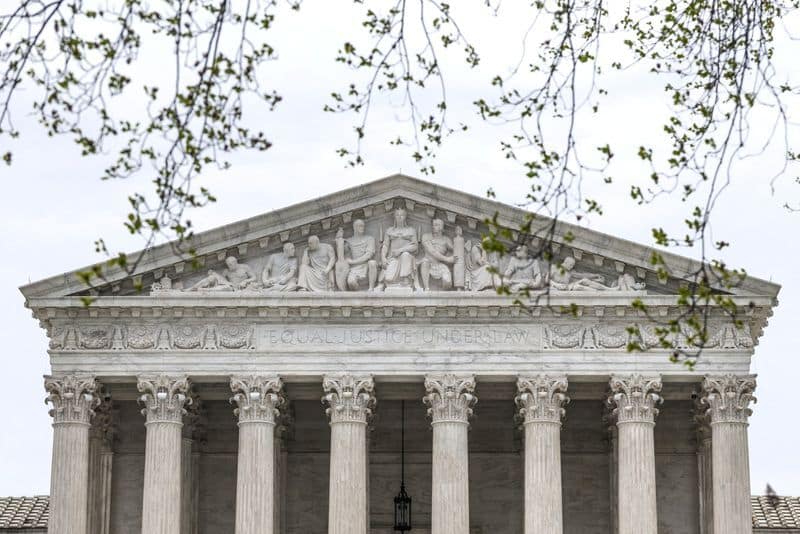
April 25 (Reuters) - Among President Donald Trump’s main arguments at the U.S. Supreme Court defending his moves to rescind humanitarian protections that shield hundreds of thousands of immigrants from deportation, one stands out: Courts cannot review his administration’s decisions in this area.
Federal judges in New York and Washington, D.C., barred Trump’s administration from stripping from more than 350,000 Haitians and 6,000 Syrians a legal status provided by the U.S. government that protects them from deportation. Citing widespread violence, crime, terrorism and kidnapping, the administration currently warns against traveling to either of these countries for any reason.
The justices are due to hear arguments on Wednesday in the administration’s appeals of those rulings as it defends former Homeland Security Secretary Kristi Noem’s actions to terminate Temporary Protected Status, or TPS, for people from Haiti and Syria.
Revoking TPS and other humanitarian protections is part of Trump’s broader crackdown on legal and illegal immigration since he returned to office in January 2025.
When it took up the matter, the Supreme Court did not act on the administration’s request to immediately end TPS protections for Haitians and Syrians while the case plays out. The court under similar circumstances last year let the administration end TPS for Venezuelans.
WARS AND DISASTERS
Under a U.S. law called the Immigration Act of 1990, TPS is a designation that allows migrants from countries stricken by war, natural disaster or other catastrophes to live and work in the United States while it is unsafe for them to return to their home countries.
The legal dispute could have wide implications, affecting 1.3 million immigrants from all 17 TPS-designated countries, according to the plaintiffs. Trump’s administration has sought to rescind the protections for 13 of those countries so far.
Lower courts have ruled against the administration’s TPS terminations, finding that officials failed to follow protocols required under the Immigration Act to assess conditions in a country before revoking its designation.
Trump’s Justice Department disputes those points and makes a broader argument that could doom challenges going forward, asserting that courts cannot second-guess its TPS decisions in the first place.
“The TPS statute unambiguously bars judicial review of claims that attack the secretary’s TPS determinations, including the procedures and analysis underlying those determinations,” the department said in a Supreme Court filing.
In this and other matters, Trump has asserted an expansive view of presidential powers and a limited view of judicial purview.
Ahilan Arulanantham, a lawyer for the Syrian TPS recipients who challenged the administration’s actions, said “a huge amount is at stake” in the legal fight. “If the government is correct, then they can terminate TPS without conducting any country conditions review at all - they can do it for reasons that are completely arbitrary,” Arulanantham said.
The administration’s actions overall do not reflect a federal agency’s reasoned decision-making but rather a concerted effort to end TPS entirely, Arulanantham, co-director of the UCLA School of Law’s Center for Immigration Law and Policy, told reporters during a conference call.
“This really is about a war on this congressional statute,” Arulanantham added.
The Supreme Court, which has a 6-3 conservative majority, has granted the Republican president’s requests to immediately implement various hardline immigration policies while legal challenges continue to play out in courts. For instance, it let Trump deport immigrants to countries where they have no ties and let federal agents target people for deportation based in part on their race or language.
FALSE CLAIMS
Trump, who sought but failed to rescind TPS protections during his first term as president, made clear while running for reelection he would try again. For instance, Trump vowed to revoke TPS for Haitian immigrants after making false and derogatory claims that they were eating household pets in Ohio.
Noem, a Trump appointee, moved quickly to act on TPS designations for countries, including on February 1, 2025, to end the protection for hundreds of thousands of Venezuelans.
TPS recipients, some of whom have been in the United States for years and could face separation from jobs and families, have said it is cruel to consider sending them back to countries where they risk danger and even death.
“Temporary Protected Status is, by definition, temporary. It was never intended to be a pathway to permanent status or legal residency, no matter how badly left-wing organizations want it to be,” White House spokesperson Abigail Jackson said in a statement to Reuters.
During Democrat Barack Obama’s presidency, Haitians were first given TPS in 2010 after a devastating earthquake, and Syrians in 2012 after the country plunged into a civil war. The U.S. government repeatedly extended the statuses amid continuing crises in those countries.
Noem moved to revoke TPS for Syria last September and for Haiti last November, stating the designations were contrary to U.S. national interest in part due to difficulties screening and vetting migrants from those countries. Noem’s TPS decisions were not at issue when Trump fired her in March.
Groups of Syrian and Haitian TPS holders filed class action lawsuits alleging the termination notices were mere pretext for the administration’s plan to end existing designations. The lawsuit said Noem did not comply with the TPS law’s procedural mandate to consult other federal agencies concerning conditions inside a country before revoking its protective status.
The plaintiffs said the consultation consisted of a State Department official replying to a Homeland Security Department official’s email to say there were “no foreign policy concerns” with ending the designations.
JUDICIAL REVIEW
Trump’s Justice Department has said rulings backing the plaintiffs in the cases are “an invitation for courts to referee interagency discussions, demand agency verbosity and gauge how much consultation is enough.”
But that defense would be unnecessary if the court accepts the Justice Department’s bolder argument that, in any event, the administration’s actions are shielded from scrutiny.
Leaning on a section of the 1990 statute that states there is no judicial review “of any determination” with respect to giving, extending or ending TPS, it said that includes not only final outcomes but also the decisions behind them. In a written filing, it warned against “installing district courts as the ultimate foreign-policy superintendents of temporary status.”
The argument that courts have no role in reviewing the legality of certain actions by a presidential administration is a familiar one for Trump. His administration has made it in numerous challenges to his policies, part of a broader push against the power of judges, according to a Reuters analysis.
The plaintiffs said the administration’s position would insulate even unlawful actions. They contend the statute lets courts scrutinize the compliance of federal officials with statutory procedural requirements.
They also cite a 2019 Supreme Court ruling that blocked Trump from adding a citizenship question to the national census, a move opponents called a Republican effort to deter immigrants from taking part in the decadal population count. The court decided that the stated reasons by administration officials for adding the question were pretextual and contrived.
‘HOSTILITY TO NON-WHITES’
In the Haiti case, U.S. District Judge Ana Reyes decided the administration’s action likely was motivated in part by “racial animus,” violating the U.S. Constitution’s Fifth Amendment promise of equal protection under the law.
Reyes referenced statements by Trump and Noem, including the former homeland security secretary’s social media post labeling immigrants killers and leeches.
“Plaintiffs charge that Secretary Noem preordained her termination decision and did so because of hostility to nonwhite immigrants. This seems substantially likely,” Reyes wrote.
The Justice Department disputes any racial discrimination, saying no statement by Trump or Noem mentions race. It said the Supreme Court should apply its precedents offering deference to the administration on immigration, foreign policy and national security matters.
The Supreme Court is expected to rule by around the end of June.
(Reporting by Andrew Chung in New York; Editing by Will Dunham)