By Deepa Seetharaman and Greg Bensinger
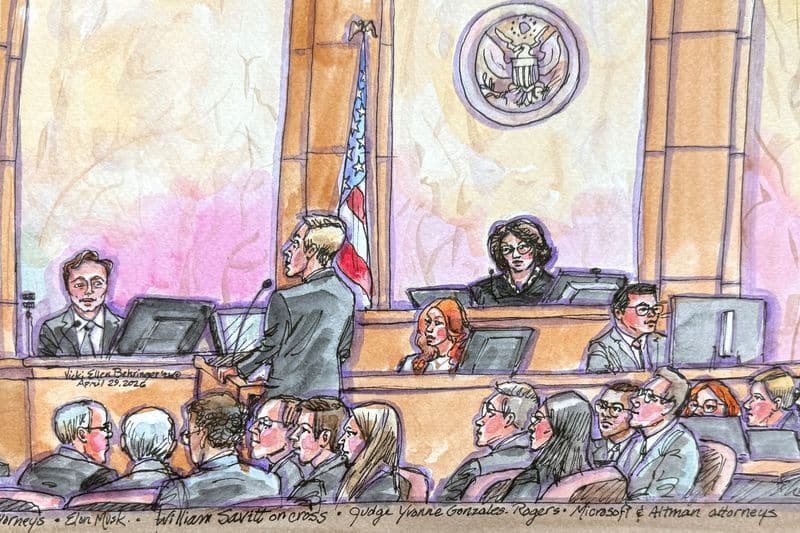
OAKLAND, California, April 30 (Reuters) - Elon Musk wrangled with Sam Altman’s lawyer on Thursday over the timing of his decision to sue OpenAI and whether he knew about discussions to turn it into a for-profit company, as he was cross-examined in a trial over his lawsuit that could determine the future of the ChatGPT maker.
The world’s richest person alleges OpenAI, its co-founder and CEO Sam Altman and its President Greg Brockman wooed his $38 million in donations and personal help by promising to build a nonprofit that would prioritize safe development of AI, before pivoting to create a for-profit entity to enrich themselves.
William Savitt, a lawyer for OpenAI, Altman and Brockman, pressed Musk on whether he had read a term sheet that Altman forwarded on August 31, 2017, relating to OpenAI’s shift from a nonprofit to a for-profit overseen by a nonprofit.
“My testimony is I didn’t read the fine print, just the headline,” said Musk, wearing a dark suit, dark solid tie and white shirt.
OpenAI has said that Musk, the CEO of Tesla and SpaceX, is driven by a compulsion to control OpenAI and is bitter about the company’s success after he left its board in 2018. They have also said he did not prioritize safety issues while with the company, and that he is trying to bolster his own AI company, SpaceX unit xAI, which lags OpenAI in user adoption.
OpenAI spearheaded widespread use of AI with its ChatGPT chatbot and has been raising billions of dollars from investors to build out its computing power ahead of a potential trillion-dollar IPO. Musk is seeking fundamental changes to the governance of the company as well as $150 billion in damages.
‘YOU CUT ME OFF’
At times, Musk expressed frustration with Savitt’s cross-examination.
“Few answers are going to be complete, especially when you cut me off all the time,” Musk said.
U.S. District Judge Yvonne Gonzalez Rogers later admonished Savitt for not letting Musk answer a question, but rejected Musk’s complaints that the lawyer was leading the questioning.
Musk was asked why he did not sue OpenAI earlier, as well as how and why he did not realize it was going to become a for-profit entity. Savitt repeatedly pointed to emails sent to Musk from other OpenAI founders that show them discussing making OpenAI’s technology closed-source at some point or making money from it.
“I was reassured by Sam Altman and others that OpenAI would continue as a nonprofit,” Musk said.
Under questioning, Musk also said his company xAI used OpenAI to train its own models, adding: “It is standard practice to use other AIs to validate your AI.”
Thursday’s exchanges echoed a tense cross-examination on Tuesday, when Savitt pressed Musk about text messages and emails showing that he at times expressed openness to creating a for-profit entity and that Altman kept him apprised of Microsoft’s investments in OpenAI.
Altman and Brockman were in the courtroom for much of Musk’s testimony, watching intently. Musk was dismissed after more than two hours of questioning, followed by his top aide Jared Birchall taking the stand.
$150 BILLION IN DAMAGES
OpenAI, founded in 2015, has evolved from a nonprofit research lab in Brockman’s apartment to a company worth more than $850 billion that is planning a potential initial public offering.
Musk is seeking the $150 billion in damages from OpenAI and Microsoft, one of its largest investors, with proceeds going to OpenAI’s charitable arm. Musk also wants OpenAI to revert to being a nonprofit, with Altman and Brockman removed as officers and Altman removed from its board. Musk’s claims include breach of charitable trust and unjust enrichment.
“I don’t think you should turn a nonprofit into a for-profit,” Musk said in response to questions from Savitt. “There’s nothing wrong with having a for-profit organization, you just can’t steal a charity.”
OpenAI has said it created a for-profit entity to allow it to accept private investments to help buy computing power and pay top scientists.
Musk has accused OpenAI of abandoning its mission to develop artificial intelligence for the benefit of humankind.
Steven Molo, a lawyer for Musk, argued in court that expert testimony about AI’s ability to end humankind should be admissible evidence, telling the court: “Extinction risk is a real problem. This is a real risk. We all could die.”
The judge responded, “I think it’s ironic that your client, despite these risks, is creating a company that’s in the exact same space,” referring to Musk’s AI venture xAI, which is now a part of SpaceX.
She did not allow the testimony, saying: “This is not a trial on the safety risks of artificial intelligence.”
The trial started on Monday and is expected to last several weeks. The next witnesses after Birchall are expected to be Brockman, and AI safety expert Stuart Russell.
(Reporting by Deepa Seetharaman, Greg Bensinger and Kenrick Cai in Oakland, CaliforniaWriting by Luc Cohen and Nia WilliamsEditing by Rod Nickel, Will Dunham and Nick Zieminski)