By Parisa Hafezi, Ahmed Tolba and Idrees Ali
DUBAI/WASHINGTON, May 4 (Reuters) - The U.S. military said two U.S. Navy guided-missile destroyers had entered the Gulf to break an Iranian blockade and that two U.S. merchant ships had transited the Strait of Hormuz, after Iran said it had prevented a U.S. warship entering the Gulf.
U.S. Central Command said its forces were supporting President Donald Trump’s “Project Freedom”, which aims to “guide out” commercial ships stranded in the Gulf by the U.S.-Israeli war on Iran, and were enforcing a blockade of Iranian ports.
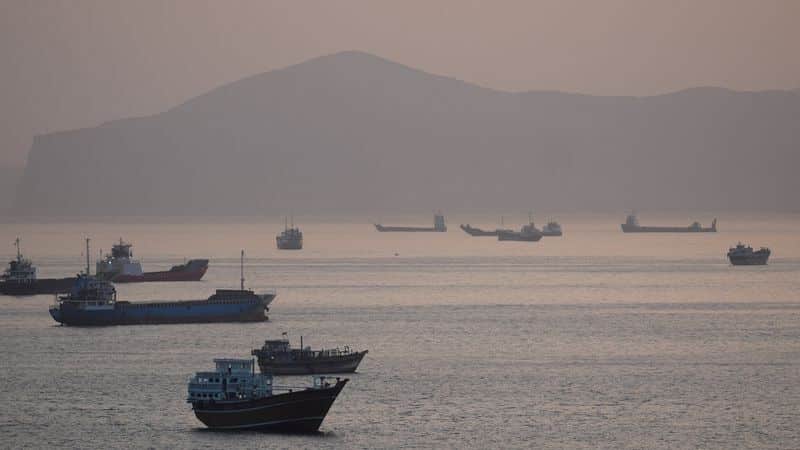
The intervention appeared to raise the risk of a direct confrontation between the U.S. and Iran in a waterway that usually carries a fifth of the world’s seaborne oil and gas but has been blocked for two months as a result of the war.
CENTCOM said two U.S.-flagged merchant vessels had crossed through the strait as the U.S. destroyers operated in the Gulf, adding: “American forces are actively assisting efforts to restore transit for commercial shipping.”
Earlier, Tehran said it had forced a U.S. warship to turn back from the Strait of Hormuz, although CENTCOM quickly denied a report by Iran’s semi-official Fars news agency that two missiles had hit the ship near the Iranian port of Jask.
A senior Iranian official told Reuters Iran had fired a warning shot and that it was unclear whether the warship had been damaged.
SHIPPING INDUSTRY AWAITS CLARITY ON SAFETY OF HORMUZ
Oil prices had jumped 5% on reports of the warship being turned back, but later gave up half of that. [O/R]
Treasury Secretary Scott Bessent told Fox News that the U.S. had absolute control of the strait.
But the shipping industry remains to be convinced that the vital oil route, whose closure has damaged global business and trade, is safe to use, with little sign of progress towards a negotiated resolution of Washington’s conflict with Iran.
Iran’s navy said it had prevented “American-Zionist” warships entering the Strait area with a “swift and decisive warning”.
Trump gave few details of his plan to aid ships and their crews who have been confined to the Gulf and are running low on food and other supplies.
“We have told these Countries that we will guide their Ships safely out of these restricted Waterways, so that they can freely and ably get on with their business,” he said in a post on his Truth Social site on Sunday.
In response, Iran’s unified command told commercial ships and oil tankers:
“We have repeatedly said the security of the Strait of Hormuz is in our hands and that the safe passage of vessels needs to be coordinated with the armed forces …
“We warn that any foreign armed forces, especially the aggressive U.S. Army, will be attacked if they intend to approach and enter the Strait of Hormuz.”
Iran has blocked nearly all shipping into and out of the Gulf apart from its own since the start of the war, sending oil prices soaring by 50% or more.
CENTCOM said it would support Trump’s “Project Freedom” with 15,000 military personnel and more than 100 land- and sea-based aircraft, plus warships and drones.
It was not immediately clear how the operation would work. It will not necessarily include naval escorts of commercial ships, Axios reporter Barak Ravid said on X.
The White House did not immediately respond to a request for comment. Trump said any interference with the U.S. operation would have to be “dealt with forcefully”.
HUNDREDS OF MERCHANT SHIPS STUCK IN GULF FOR MONTHS
However, the Joint Maritime Information Center, led by U.S. maritime forces based in Bahrain, told operators in a note that the U.S. had “established an enhanced security area to support Strait of Hormuz transits”.
It advised vessels to use Omani waters on the west of the strait to avoid mines, urging them to “carefully review risk assessments and routing ahead of transit”.
Hundreds of commercial vessels and as many as 20,000 seafarers have been unable to transit the strait during the conflict, the International Maritime Organization says.
The container shipping group Hapag-Lloyd said on Monday that it considered that transit through the strait was still not possible.
Shipping and oil executives have said they need an agreed and full end to hostilities because military convoys alone are not enough to allow normal traffic to resume safely.
The United Arab Emirates on Monday accused Iran of attacking an empty crude oil tanker belonging to the Abu Dhabi state oil firm ADNOC with drones as it attempted to pass through the strait.
In a rare piece of good news, Pakistan said the U.S. had handed over 22 crew from an Iranian container vessel that American forces seized last month.
Pakistan, which has been trying to broker a peace deal, described the move as a “confidence-building measure”.
IRAN REVIEWS U.S. RESPONSE TO PEACE PROPOSAL
The United States and Israel suspended their bombing campaign against Iran four weeks ago, and U.S. and Iranian officials held one round of face-to-face talks. But attempts to set up further meetings have failed.
Iranian state media said on Sunday Washington had conveyed its response to a 14-point Iranian proposal via Pakistan, and that Tehran was now reviewing it. Neither side gave details.
A senior Iranian official has confirmed that the proposal envisages ending the war on all fronts - including Israel’s attacks on Lebanon - and resolving the shipping standoff first, while leaving talks on Iran’s nuclear programme for later.
Washington wants Tehran to give up its stockpile of more than 400 kg (900 pounds) of highly enriched uranium, which the United States says could power a bomb.
Iran says its nuclear programme is peaceful, although it is willing to discuss some curbs in return for the lifting of sanctions. It had accepted such curbs in a 2015 deal that Trump abandoned.
Trump is under pressure to break Iran’s hold on the strait to try to prevent soaring gasoline prices causing a voter backlash against his Republican Party in midterm congressional elections in November.
(Reporting by Reuters bureaux; Writing by Andrew Goudsward, Lincoln Feast and Gareth Jones; editing by Clarence Fernandez and Kevin Liffey)