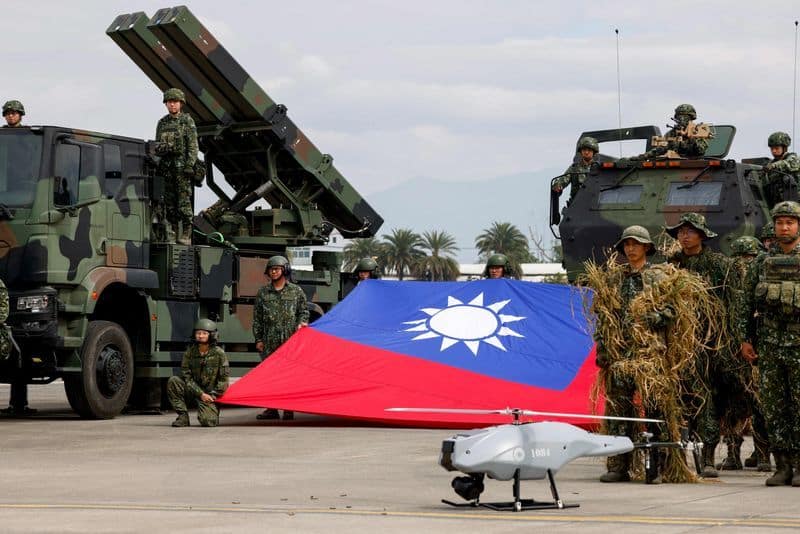
TAIPEI, May 9 (Reuters) - Further delays to Taiwan military spending are a “concession” to China, the U.S. State Department said, as Taipei’s defence ministry detailed the impact of projects excluded from a package passed by the opposition-controlled parliament.
Taiwan President Lai Ching-te had sought $40 billion in supplementary defence spending to better deter China, which views the democratically governed island as its own territory and has stepped up its military pressure.
But after repeated delays by opposition parties, who hold the majority of seats, parliament on Friday approved only two-thirds of the money requested, all for U.S. weapons rather than including other projects like domestically developed drones and missiles.
The opposition said that while it supports defence spending, it would not sign “blank cheques”, saying the proposals were vague in places and could open the door to corruption.
A State Department spokesperson said the U.S. supports Taiwan’s acquisition of critical defence capabilities “commensurate with the threat it faces” and consistent with the ongoing commitment of multiple U.S. administrations.
“While we are encouraged by the passage of this special defence budget after unhelpful stalling, the United States notes that further delays in funding the remaining proposed capabilities are a concession to the Chinese Communist Party,” the spokesperson added.
The U.S. is Taiwan’s most important international backer and arms supplier, despite the lack of formal diplomatic ties, and has strongly supported increased military spending. Beijing has repeatedly demanded an end to weapons sales.
In a statement late on Friday, Taiwan’s defence ministry said the approved spending completely excludes certain commercial purchases, which is highly likely to create “capability gaps”.
“Our country faces a severe and continuously escalating threat environment,” it said.
One plan not included is the Chiang Kung, or “Strong Bow”, anti-ballistic missile which is meant to form the backbone of Taiwan’s new “T-Dome” air defence system, the ministry added.
“Following its removal from the special budget, if it cannot be procured in a timely manner, air defence combat effectiveness will be severely impacted,” it said.
Lack of approval for drone systems like sea attack drones will significantly delay asymmetric warfare capabilities and affect projected economic growth and employment opportunities for domestic industry, the ministry said.
Lai said that while he appreciated the approved funding, which allows purchases of such items as the Lockheed Martin-made HIMARS multiple-launch rocket system to proceed, this was only the first step.
“Any gap will affect the integrity of the overall defence system. Any delay will increase the shared security risks borne by the people of Taiwan,” he posted on Facebook.
(Reporting by Ben Blanchard; Editing by William Mallard)