By Michael Martina and Lucy Papachristou
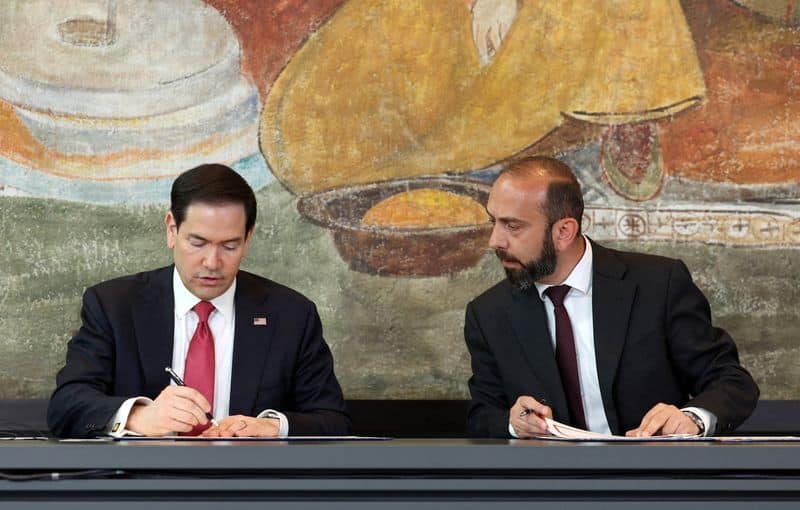
YEREVAN, May 26 (Reuters) - U.S. Secretary of State Marco Rubio and Armenian Foreign Minister Ararat Mirzoyan signed a strategic partnership agreement in Yerevan on Tuesday, less than two weeks before parliamentary elections in the South Caucasus country.
Rubio’s visit comes as Russia has threatened to exert economic pressure on Yerevan for its growing ties to the West by raising prices Armenia pays for Russian gas if the country turns away from integration with Moscow
On June 7, Armenia votes in an election pitting Prime Minister Nikol Pashinyan’s Civil Contract party against an array of opposition parties, many of which are pro-Russian.
Rubio and Mirzoyan also signed a framework agreement on critical minerals and another on cooperation on a proposed 43-km (27-mile) transit corridor across southern Armenia that would give Azerbaijan a direct route to its exclave of Nakhchivan and into Turkey, Baku’s closest ally.
Dubbed the “Trump Route for International Peace and Prosperity (TRIPP)”, the corridor is a key part of a peace agreement reached last August between Armenia and Azerbaijan, which have been at war on-and-off since the late 1980s. No formal peace deal has been signed.
The route would better connect Asia to Europe - bypassing Russia and Iran - at a time when U.S. President Donald Trump has expressed interest in critical minerals deals with resource-rich Central Asian countries to the east of the South Caucasus region. The mining of iron, copper and zinc and other minerals is also a major sector of Armenia’s economy.
STRAINED TIES WITH RUSSIA
“We are going to be able to work together to make sure that both of our countries, both of our economies, are going to have reliable access to these critical minerals,” Rubio said at the signing ceremony on Tuesday.
Under Pashinyan, Armenia has pursued closer relations with the West, including adopting a law last year to launch its accession process to the European Union. Yerevan drew Russia’s ire after it hosted a high-profile EU summit earlier this month.
Armenia is heavily dependent on Russia and Iran for energy supplies, and would be hard-hit by the increase in gas prices referred to by the Kremlin. Russia this week banned imports of Armenian flowers, mineral water and brandy in another signal of its displeasure at Yerevan’s warming ties with the West.
(Reporting by Michael Martina in Yerevan and Lucy Papachristou in Tbilisi; Writing by Lucy Papachristou; Editing by Kevin Liffey, Emelia Sithole-Matarise and Chiara Rodriquez)