By Marco Aquino and Lucinda Elliott
LIMA, June 4 (Reuters) - Left-wing congressman Roberto Sanchez is striking a more pragmatic tone ahead of Peru’s June 7 presidential runoff against conservative frontrunner Keiko Fujimori, after earlier plans to overhaul the mining sector rattled investors.
Official results show Sanchez won 12.03% of the vote in April’s first round, placing behind Fujimori’s 17.18%.
Opinion polls suggest the runoff will be closely fought.
A former cabinet minister under ousted and jailed former President Pedro Castillo, Sanchez is campaigning on sweeping changes to the state. But in recent weeks, the 57-year-old — running for the leftist Together for Peru party — has signaled a more cautious approach to economic policy.
“Insisting on something that is not viable, is not sensible,” he told journalists last week. He acknowledged global headwinds, such as the rising price of fuel due to the Iran war, were tempering his agenda.
Sanchez emerged as a surprise contender in a crowded first-round field, calling for a new constitution to establish a “plurinational” state and courting disaffected rural and Indigenous voters.
Central to his platform is a proposal to replace the 1990s-era constitution introduced under the late President Alberto Fujimori, the father of his runoff rival.
SANCHEZ COURTS THE RURAL VOTE
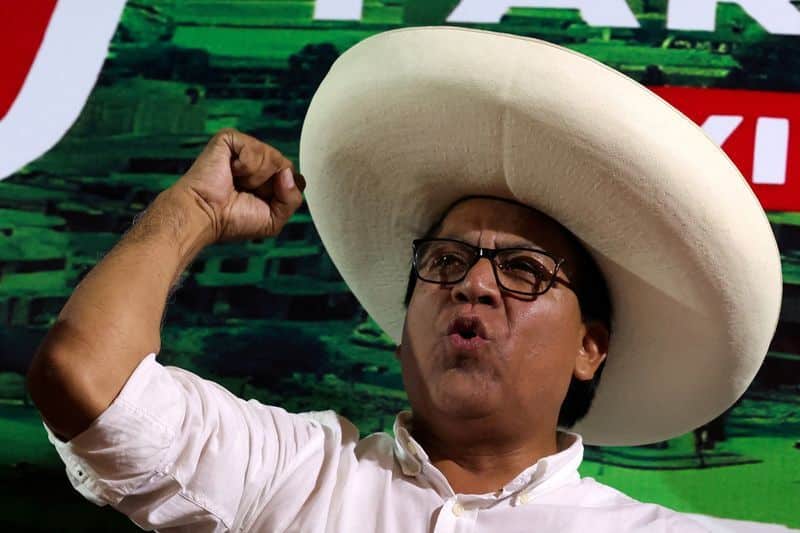
“The rural vote, the Andean vote, the Quechua, Aymara and Amazonian vote were never respected,” Sanchez said in the interview with Reuters in April at a party office in Lima, wearing a wide-brimmed straw hat that originally belonged to Castillo and is typical of those used in some Peruvian rural areas.
Peru is one of the world’s largest copper producers and mining accounts for roughly 10% of the country’s GDP.
Sanchez has pushed for greater state oversight of natural resources, including reviewing mining contracts, imposing windfall taxes and introducing a wealth tax - measures he frames as a “rebalancing” in favor of communities where extraction takes place.
“Thirty years of mining and the mining towns are still the poorest in our country,” he said.
If elected, his policies would face challenges in the legislature, where right-wing parties hold a majority.
Sanchez has begun moderating his message as the campaign enters its final phase — a shift underscored by his economic team.
A MODERATING VOICE
In May he appointed former economy minister Pedro Francke, who is seen as a more market-friendly voice, as a top advisor.
Francke, who served under Castillo, has moved quickly to reassure investors, saying a Sanchez government would promote private investment, respect existing mining contracts and preserve central bank independence.
“There will be no nationalizations,” Francke said during a televised debate. “We will respect contracts and maintain a macroeconomic policy of stability.”
Analysts say the pairing shows Sanchez is trying to win over centrist voters wary of economic change. But his past links to figures like Antauro Humala, a nationalist who was jailed for leading a rebellion against the government in 2001, highlight the challenge. Sanchez has tried to distance himself, but risks alienating parts of his base, said analyst Nicholas Watson of Teneo.
CASTILLO TIES
Sanchez’s close ties with jailed ex-president Castillo have also unsettled investors in Peru.
Castillo, ousted in 2022 after attempting to dissolve Congress, has endorsed Sanchez. He faces charges for rebellion and conspiracy against the state.
Sanchez said he would not transfer power back to Castillo if elected. He has, however, pledged to seek Castillo’s release.
A former minister of foreign trade under Castillo, Sanchez has argued Peru should remain open to international partners but on “just” terms.
RELIGIOUS ROOTS
Raised in an Indigenous family with roots in Peru’s south, Sanchez said he had a modest upbringing and once aspired to become a priest, tracing his origins in politics to church-based social work.
He has said that as a Catholic he supports abortion only in cases of rape or when the mother’s life is at risk, and opposes any form of discrimination based on sexual orientation, race or religion.
His party has proposed tougher anti-corruption measures, judicial reforms and greater military support to police to combat rising crime.
Sanchez himself faces financial crime allegations, with a prosecutor accusing him of falsifying statements and campaign funding information. His lawyer denies the claims. A judge is due to decide on June 4 whether the case will go to trial, local media report.
(Reporting by Lucinda Elliott and Marco Aquino, editing by Cassandra Garrison, Rosalba O’Brien and Nia Williams)