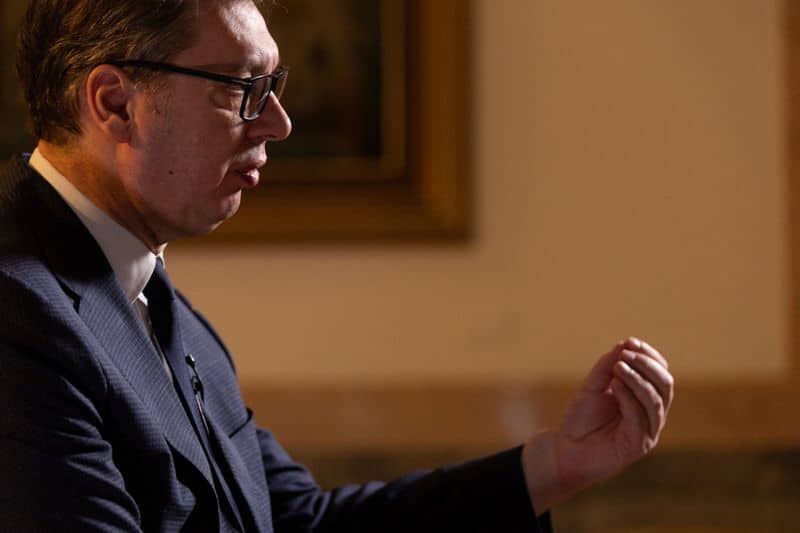
BELGRADE, June 4 (Reuters) - Serbia’s security agency warned President Aleksandar Vucic not to travel to Montenegro on Friday for a summit with European Union and Balkan leaders, citing security threats amid a diplomatic tit-for-tat between the two countries.
French President Emmanuel Macron, German Chancellor Friedrich Merz, and head of the European Commission Ursula von der Leyen are due to arrive in the coastal town of Tivat on Friday to meet leaders of the six Western Balkan countries and discuss progress towards EU membership.
Serbia’s Security and Information Agency (BIA) said in a statement late on Wednesday that a trip to Montenegro is a high security risk for Vucic due to “hostile activities of foreign secret services and a presence of a criminal clan there.”
Speaker of the Parliament Ana Brnabic said Vucic planned to travel to Tivat despite the warning and that he would have some important meetings there.
The warning came after media in the capital Podgorica reported that Montenegro on Wednesday turned back a plane with 87 men from Serbia that landed in Tivat, saying they represented a security threat ahead of the EU-Western Balkan Summit.
The Vijesti news portal said police had seized two buses that were supposed to transport the group.
Relations between Serbia and Montenegro have been strained over Podgorica’s ties with Kosovo, which Serbia does not recognise, and Belgrade’s influence over domestic political issues through church and political parties affiliated with Vucic’s Serbian Progressive Party.
NATO member Montenegro gained independence in 2006 following dissolution of its union with Serbia, and unlike Belgrade it had introduced sanctions against Russia, aligning its foreign policy with the European Union.
On Wednesday evening Serbia introduced a stricter control of its border to Montenegro, which created long lines at crossings, Serbian N1 TV reported.
(Reporting by Ivana Sekularac; Editing by Sonali Paul)