By Amanda Ferguson and Will Russell
BELFAST, June 10 (Reuters) - The family of a man who lost an eye in a knife attack appealed for calm on Wednesday after the incident triggered a wave of anti-immigrant violence in Belfast overnight, with masked men burning families out of their homes and torching vehicles.
The appeal came as a Sudanese man appeared in court charged with attempted murder and as British Prime Minister Keir Starmer and politicians in Northern Ireland condemned the violence by “masked thugs” that had targeted ethnic minorities.
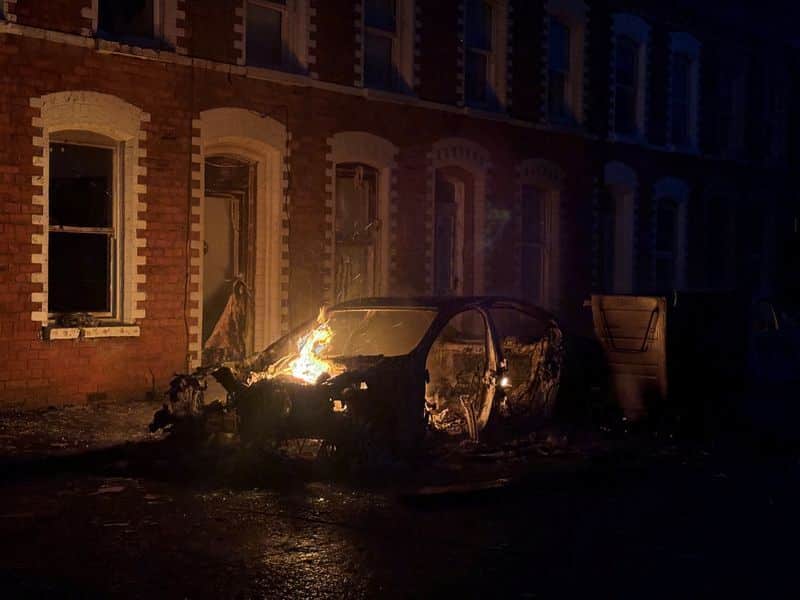
Hundreds of protesters, many with their faces covered, had attacked police and burned vehicles in a number of locations across Northern Ireland late on Tuesday after a video of the knife attack went viral.
“We want to make it absolutely clear that overnight unrest is not welcome, and peaceful protest is the only way forward,” the family of the victim, Stephen Ogilvie, said in a statement.
“We have many migrants who make a deeply valuable contribution to our country… We do not want this terrible tragedy to be used to divide people or fuel hostility,” it said.
Speaking in parliament in London, Starmer said the attack raised serious questions but that “driving people out of their homes is not… the right way to respond”, adding that all those involved in violence would face “the full force of the law”.
The suspect in the attack in north Belfast, a 30-year-old Sudanese national named as Hadi Alodid, appeared in court on Wednesday where he was remanded in custody.
Ogilvie, who is in his 40s, suffered significant injuries to his face and back, the court heard.
‘THAT’S MY PROPERTY’
Videos of the attack had circulated online all day on Tuesday, sparking calls on social media for violent protest.
Police had to help one family escape from a burning house. Several cars and a bus were set on fire and reduced to shells. Local politicians and a pastor said many of those who were targeted were Black.
Local resident Jamie Corry, 33, said he could only watch on as his house went up in flames.
“I was actually standing right there watching my whole house just go up, slowly but surely,” he told Reuters. “I told them and all, when they were lighting a car up on fire, that’s my property, that’s my property… and they still didn’t care.”
Northern Ireland’s First Minister Michelle O’Neill described the violence perpetrated by the masked men as “nothing less than disgusting cowardice”.
The attack, which is currently not being treated as terrorism, comes at a time of heightened tensions in Britain following the murder of a student who was handcuffed by police as he lay dying from stab wounds after his killer, a Sikh man, falsely alleged a racist attack.
It also follows repeated protests about immigration, with populist parties saying Britain’s asylum policy had allowed dangerous men into the country.
Tech billionaire Elon Musk reposted many messages denouncing the state of the United Kingdom following the Belfast incident.
‘BAD FAITH ACTORS’
Northern Ireland’s Justice Minister Naomi Long told Reuters that “bad faith actors” who would have previously struggled to find the province on a map had sought to weaponise people’s understandable fear and anger over the knife attack to target those who had the same skin colour.
Amid calls from Musk, anti-immigrant activist Tommy Robinson and others for more protests on Wednesday, Northern Ireland’s police chief said an extra 200 officers were being deployed on the streets.
“These idiots didn’t just target ethnic minority groups… they targeted society,” Chief Constable Jon Boutcher said.
Belfast pastor Jack McKee told the BBC that some members of his church, who had lived there for 20 years, were “getting put out just because they’re Black”.
The disorder in Northern Ireland is the latest violence to flare in the UK in response to a crime, often believed to involve a migrant, which has led to calls from some prominent anti-Islam and anti-immigrant activists for people to “take to the streets”.
Immigration has historically been low in Northern Ireland due to the three-decade conflict waged between mainly Catholic Irish nationalists seeking Irish unity and predominantly Protestant pro-British “loyalists” wanting to stay in the United Kingdom, and the British military.
However, migration has increased in recent years, and there has been a hardening sentiment against it in both Northern Ireland and parts of the Republic of Ireland.
According to the 2021 census, 96.6% of those living in Northern Ireland were white, while police statistics showed recorded numbers of racist incidents hit a record level in 2025.
Northern Ireland was also hit by anti-immigrant rioting last year amid anger over an alleged sexual assault. Charges against two boys were later withdrawn by prosecutors.
(Reporting by Amanda Ferguson, Will Russell and Isabel Infantes in Belfast; Conor Humphries and Graham Fahy in Dublin; Muvija M and Sam Tabahriti in London; Writing by Kate Holton and Michael Holden; Editing by Alison Williams and Gareth Jones)