By Philip Blenkinsop
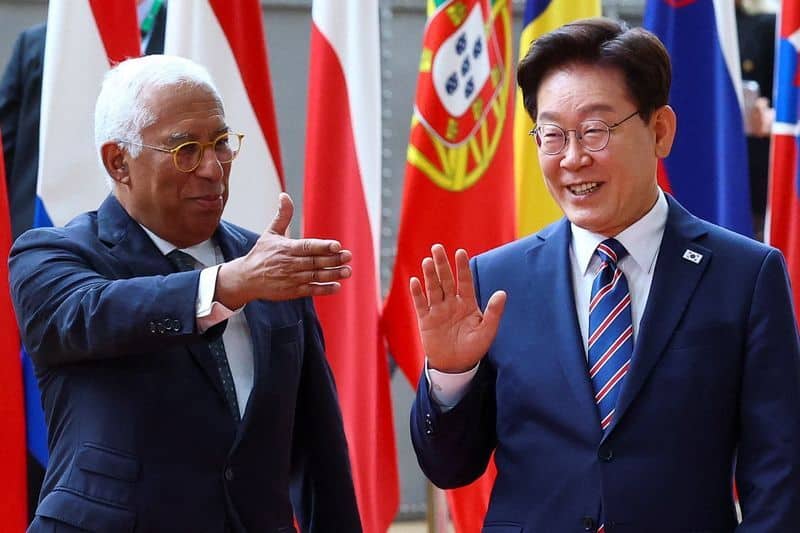
BRUSSELS, June 10 (Reuters) - The European Union and South Korea signed a digital trade agreement on Wednesday designed to make digital transactions easier and further cement economic ties between the partners at their first summit in three years.
The digital trade deal and other cooperation agreed at the summit, such as on exchanging classified security information and passenger name records, are part of both sides’ push to forge new alliances and deepen existing ones at a time of heightened geopolitical uncertainty, including U.S. tariffs, Chinese export curbs and conflicts in Ukraine and the Middle East.
The digital agreement, supplementing a free-trade accord that entered force in 2011, is designed to ease cross-border data flows, recognise electronic contracts and electronic signatures and sets rules on consumer protection.
It should also reduce costs for businesses, boosting services trade. The EU is South Korea’s third-largest partner in goods trade, while Korea is the eighth-largest partner for the EU.
The agreement reflects the EU’s aspiration to be a global standard-setter for digital trade, with a particular focus on the Asia-Pacific region. It already has a digital agreement with Singapore, digital parts of trade accords with Britain, Chile and New Zealand and a deal on cross-border data flows with Japan.
Digitally delivered services trade globally in 2025 was some five times higher than in 2005, with 10% increases in the past three years, far outpacing growth in trade of goods and other services, according to the World Trade Organization.
The EU is the world’s largest exporter of services, nearly half of which are digital. The agreement still needs to be approved by the European Parliament.
(Reporting by Philip BlenkinsopEditing by Bill Berkrot)