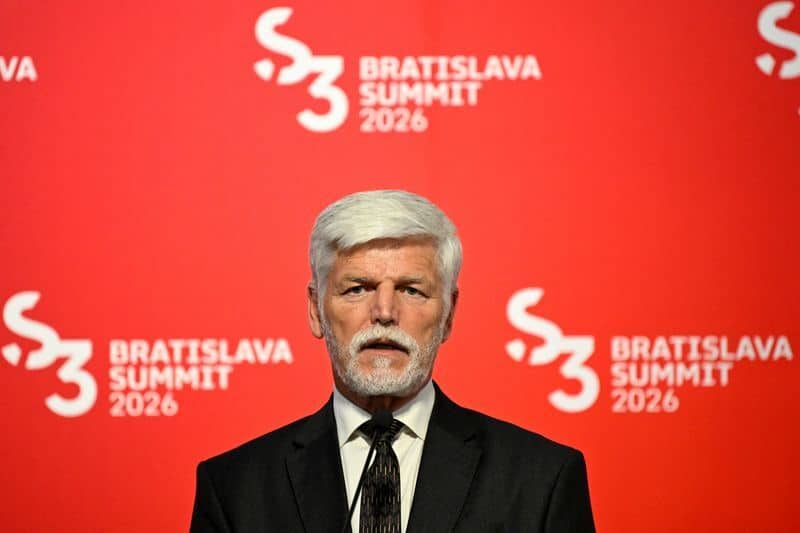
PRAGUE, June 22 (Reuters) - The Czech government said on Monday it would not include President Petr Pavel, a former senior NATO official, in the Czech delegation to the alliance’s summit next month, breaking with tradition and setting up a legal fight with the head of state.
Prime Minister Andrej Babis, head of the populist ANO party, who lost the 2023 presidential election to Pavel, said it was up to the government to defend its positions, including low defence spending.
“This is a very specific summit,” Babis told a news conference.
“It will probably not be very pleasant for our country but we have the responsibility to defend our position.”
Under the Czech constitution, presidents have limited powers and foreign policy is defined by the government. But since joining NATO in 1999, presidents have almost always led Czech delegations to NATO summits, sometimes together with prime ministers.
Pavel was a career general who led the Czech army and also served as the head of NATO’s military committee from 2015 to 2018. He has insisted that he take part in the July 7 to 8 summit in the Turkish capital, Ankara.
He has been a strong supporter of Ukraine in its defence against Russia, while Babis’ cabinet has scaled back support.
Pavel was due to comment on the delegation on Tuesday, his office said. He recently said he would see rejection as an attempt to clip his powers to represent the country abroad and would take the matter to the Constitutional Court.
Pavel has been in conflict with the government, mainly with the junior eurosceptic Motorists Party, since he refused to appoint one of its officials as foreign minister.
The Czechs are among the last in NATO in terms of defence spending, failing to meet the minimum 2% of gross domestic product last year.
Babis’ new government cut the defence spending budget versus from originally proposed levels, meaning that it will not meet the minimum again this year. He said the minimum level should be met from 2027.
NATO allies have agreed to raise annual core defence spending to 3.5% of GDP in 2035, plus an additional 1.5% to other defence-related programmes.
(Reporting by Jan Lopatka; Editing by Sharon Singleton)