By Gabriel Stargardter
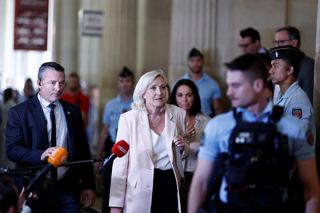
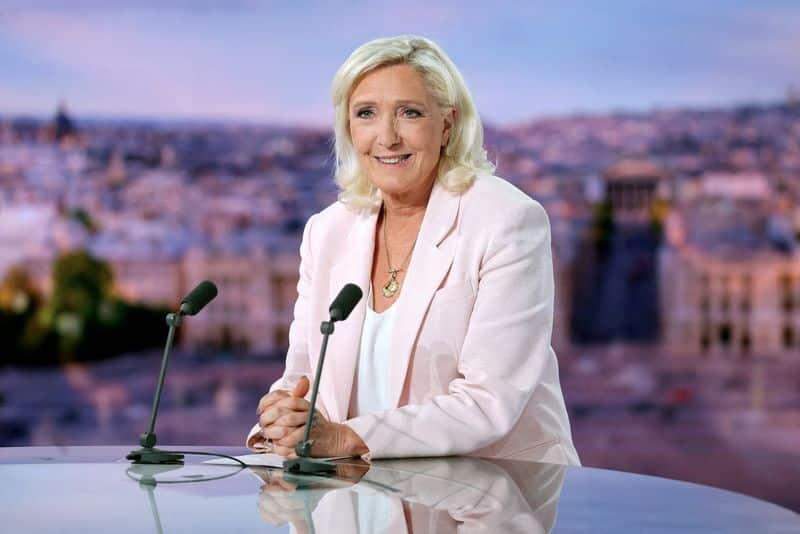
PARIS, July 8 (Reuters) - In launching her fourth bid for the French presidency, just hours after judges cleared her to run, Marine Le Pen portrayed herself as a fighter who had defied the odds to overcome a months-long legal battle that threatened to end her political ambitions.
“There are many French people who are going through hardships, and we too are going through hardships,” Le Pen said on a prime time interview on TF1. “These trials, I believe, have strengthened us.”
Many believed Le Pen’s presidential hopes were dead until a Paris appeals court on Tuesday shortened her electoral ban for having embezzled European Parliament funds to pay staff at her anti-immigrant National Rally (RN) party in France.
The ruling cleared her to stand in the 2027 election, even as it upheld her conviction. Le Pen said she plans to appeal the guilty verdict while also running for the top office.
Le Pen’s gamble is an audacious one.
Not only is she rolling the dice on whether France’s top court will rule in her favour in her last-ditch appeal against Tuesday’s judgement, she will also test French voters’ appetite for electing a figure two separate courts have now found guilty of embezzlement.
Le Pen believes it is a risk worth taking, betting that voters will overlook her legal woes to elect her as France’s first far-right leader in modern times.
“I think you should never impose anything on the French people; they must have the final say, and now the French people will have the final say,” she said.
Brigitte Barèges, a former lawmaker from a right-wing party allied with the RN, said she understood why the RN chief was running.
“I know her character and I’m a bit like that,” she said. “You want to show those who caused you this setback that you are not dead because of it, that you are still there.”
TANTALISINGLY CLOSE TO POWER
Le Pen’s decision to run comes as the nationalist RN has never been closer to power. Polls suggest Le Pen will easily make the second-round runoff in next year’s election, although victory is less certain.
Her presidential hopes had been in limbo since March 2025, when she received a five-year ban on running for office, but Tuesday’s ruling allows her to campaign as long as she wears an electronic tag.
Le Pen told TF1 she was confident she could run without a tag that would impose limits on her movement, and confirmed her 30-year-old protege, party president Jordan Bardella, will run alongside her to become prime minister if she is elected.
She rejected the idea that Bardella would harbour any resentment. He had been set to run as president if she were barred, and now polls more strongly than her for the top job.
“Jordan Bardella and I are fighting for France. We are fighting for the French people. This cause clearly goes beyond us,” she said. “And therefore our personal ambitions do not come into consideration at all.”
Barèges said the RN stood a better chance of winning with both Le Pen and Bardella in lockstep. Over the last few years, they have formed a formidable political tag team, fusing youthful enthusiasm with battle-hardened experience to transform a once-fringe party into a potential government-in-waiting.
“We have offered the French people a partnership, a partnership that I believe is complementary, balanced, coherent, and solid,” Le Pen told TF1.
POLICY CHALLENGES
Le Pen and Bardella have made much of their public displays of unity, and the rare examples of subtle divergence between them have arisen primarily over economic policy. Critics accuse the RN of lacking a solid economic plan to deal with France’s indebted public finances and weak growth.
As his boss grappled with legal headaches, Bardella began espousing a more free-market line than Le Pen on topics such as pension reform, and questions remain over how she can grow the party’s support among the pro-business right without alienating its blue-collar base.
One key question will be whether to stick with a pledge to lower the retirement age back to 62 or abandon a plan that some party insiders increasingly view as unaffordable.
A senior RN official said that some of the party’s major policy questions remain unsolved, leaving difficult choices ahead, including on pensions and taxation.
Gilles Ivaldi, a political scientist at Sciences Po, said overcoming tensions over how to define the RN’s economic offering will remain central to the party’s prospects.
“To govern and secure a parliamentary majority, the RN ultimately needs to win over right-wing voters and, at some point, reach accommodations with the mainstream right,” he said.
“A broad alliance of right-wing forces is a prerequisite for the RN to take power.”
(Reporting by Gabriel Stargardter; additional reporting by Michel Rose; Editing by Richard Lough and Sanjeev Miglani)