By Javier Andres Rojas
MARACAY, Venezuela, July 8 (Reuters) - Seated in his office alongside sketches of elegant dresses, fashion designer Efrain Mogollon starts the workday in Venezuela like any other.
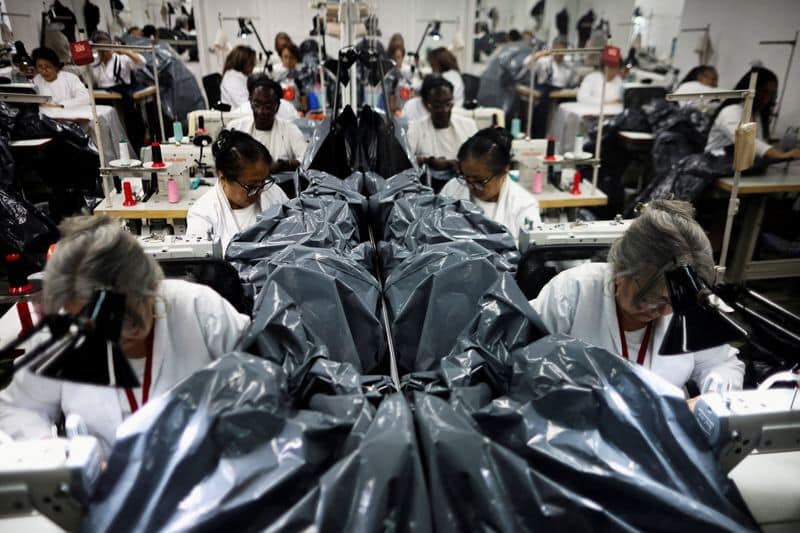
But the rows of workers bent over sewing machines are not stitching his usual playful, colorful creations.
With somber faces, they piece together dark sheaths of plastic to be used as body bags after earthquakes two weeks ago killed more than 3,500 people, overwhelming disaster response services. The only adornment is an embossed image of Jesus Christ, affixed to a zipper.
“It is a completely different feeling,” said Mogollon, as he loaded several plastic-wrapped sheaths into the back of an ambulance in Catia la Mar, a coastal neighborhood in La Guaira state near Caracas that was among the hardest hit in the June 24 tremors of magnitudes 7.2 and 7.5.
“At the same time it fills us with satisfaction to know that, from our small contribution and from our platform, we are helping,” Mogollon added, on a street where buildings were reduced to heaps of concrete, brick and rebar.
Civilians have led many of the rescue and recovery operations on the ground, with the help of professional rescue teams from around the world, firefighters and volunteers from the army.
Civilians also provided much of the in-kind aid such as food and clothing in the initial days after the quakes, especially in La Guaira. Global humanitarian organizations including the International Rescue Committee have said the response has not met the scale of humanitarian need.
Back in the tightly packed workshop, Mogollon’s team unfurls rolls of black polyethylene across a large table. Bolts of fabric in pinks, reds and blues rest against the wall; female mannequins have been set aside.
Mary Castillo, a seamstress, has now been sewing body bags every day for two weeks. She says the work has been painful but also given her a sense of purpose amid the tragedy.
“It is very sad. But we have to keep working and make the effort to move forward,” she said.
(Reporting by Javier Andres Rojas; Writing by Daina Beth Solomon; Editing by Alistair Bell)