By Ricardo Brito and Luciana Magalhaes
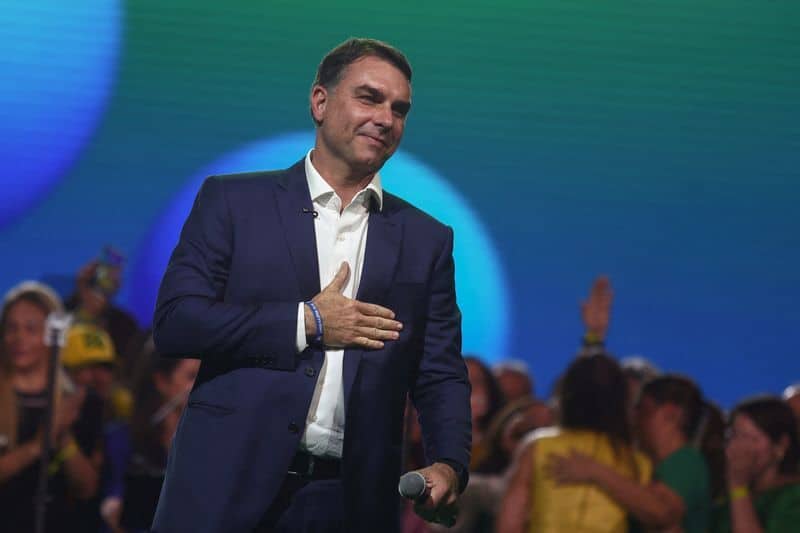
BRASILIA/SAO PAULO, July 28 (Reuters) - Former Brazilian President Jair Bolsonaro is under house arrest for plotting against democracy, but an AI-generated avatar allowed him to make a surprise appearance at the launch of his son Flavio’s presidential campaign on Saturday, raising questions about how artificial intelligence may reshape October’s presidential race in Latin America’s largest economy.
“No prison will silence the feeling of hope we have stirred,” the avatar said, after telling the audience it had been made with artificial intelligence. “It’s why I ask you to welcome with open arms the person I chose to replace me,” it added.
The stunt, promptly challenged in court by leftist parties, underscored a dilemma for Senator Flavio Bolsonaro’s campaign against President Luiz Inacio Lula da Silva, who is seeking a fourth non-consecutive term: how to capitalize on the enduring popularity of his father among conservatives when the former president is prohibited from communicating publicly.
The case also highlights a new concern about AI in elections. While debate has largely focused on deepfakes spreading misinformation, the Bolsonaro episode is testing whether the technology can serve as a political surrogate for leaders barred from communicating directly with voters.
But, whether the avatar’s appearance was a one-off stunt or the start of a larger role for a virtual Bolsonaro on the campaign trail remains unclear.
Critics argued the video violated Brazilian electoral rules because synthetic media can influence voters, while potentially offering a way around judicial restrictions imposed on Bolsonaro. The former president is barred from communicating publicly while under house arrest following his conviction for attempting to overturn the 2022 election, which he lost to Lula.
“The challenge with artificial intelligence is that it is virtually impossible to control,” Marco Aurelio Mello, a former justice who has also led Brazil’s Superior Electoral Court (TSE), told Reuters.
QUESTIONS ABOUT WHETHER RESTRICTIONS APPLY
In a petition filed with the electoral court on Sunday, a coalition of center-left and leftist parties argued that the rules “ban synthetic content capable of reproducing real people to influence voter intent,” citing the technology’s persuasive and manipulative potential.
But the court’s President Justice Kassio Nunes Marques, who was appointed to the Supreme Court by Bolsonaro, stopped short of condemning the video’s use.
“Using AI for campaigning is permissible, but what is forbidden is using it to harm someone,” he told newspaper O Estado de S. Paulo.
Nunes Marques said he could not comment on the case itself before it is reviewed by the court. He did not respond to a Reuters request for comment.
The court’s AI rule bans the use of fabricated or manipulated content in electoral advertising to spread false or misleading information that could undermine the fairness of the election or the integrity of the electoral process.
According to Ivar Hartmann, an associate law professor at Insper in Sao Paulo, Jair Bolsonaro is unlikely to face penalties because he can argue he neither recorded nor authorized the AI-generated message.
The most complex question, Hartmann said, is whether the video violated the electoral court’s AI rules, though the defense may argue those restrictions apply only to deceptive content that harms electoral fairness or integrity, an interpretation consistent with Nunes Marques’ remarks.
Senator Bolsonaro’s team did not comment on the AI video. Local newspaper O Globo reported that Jair Bolsonaro had not been informed in advance that the video would be shown and that the campaign had concluded that disclosing that the video was generated by AI provided sufficient legal basis for its use.
(Reporting by Luciana Magalhaes in Sao Paulo and Ricardo Brito in Brasilia, editing by Manuela Andreoni and Aurora Ellis)