By Ananda Teresia
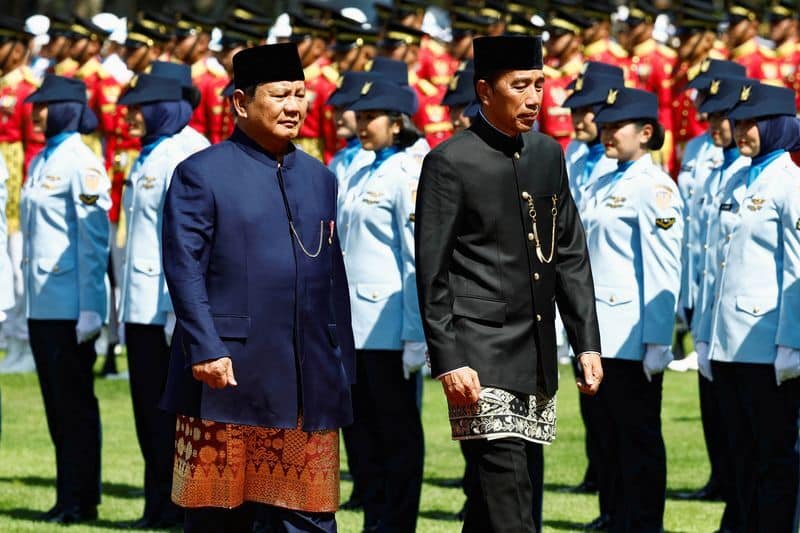
JAKARTA, Nov 6 (Reuters) - Accusations of police illegally wiretapping Indonesian President Prabowo Subianto and the possible impeachment of his vice president have exposed fresh tensions in the relationship between Prabowo and his influential predecessor.
Prabowo, a former general with a checkered past, shares a long and complex history with Joko Widodo, the former president better known as Jokowi.
HOW DID THEIR RIVALRY PLAY OUT IN ELECTIONS?
Jokowi defeated Prabowo twice in the 2014 and 2019 presidential elections.
He then appointed Prabowo as defence minister. That helped rebuild Prabowo’s reputation after accusations of rights abuses and ended a de facto ban on him travelling to the US.
Prabowo, who denies any wrongdoing, then won tacit support for his 2024 presidential bid from Jokowi, who was barred by term limits from running again. Key to that support was his promise to continue Jokowi’s legacy projects including building a new capital city, Nusantara, on Borneo island.
During that election, Jokowi faced allegations of breaching ethics and meddling ahead of the polls, including in a court’s last-minute decision to change election rules, which allowed his son to become Prabowo’s running mate.
Jokowi’s brother-in-law was head of that court at the time and was reprimanded by an ethics panel for intentionally allowing “intervention from an external party”.
Jokowi has rejected those allegations.
HOW HAS THEIR RELATIONSHIP DETERIORATED?
In addition to picking Jokowi’s son, Gibran Rakabuming Raka, as his running mate, Prabowo installed a number of Jokowi loyalists in his administration in what analysts said was a bid to tap into some of Jokowi’s huge support base.
But cracks in their relationship began to appear when he removed or reassigned Jokowi loyalists and technocrats in a series of reshuffles that began in September 2025.
Among those removed was Sri Mulyani Indrawati, who served as Jokowi’s finance chief for eight years.
More recently, Listyo Sigit Prabowo, a former police chief who became the president’s chief of staff in October, was sacked this week after he was arrested in the wiretapping scandal. Investigators have not said what they believe is the motive for the wiretapping.
Prabowo has also only approved 48.8 trillion rupiah ($2.7 billion) in funding for the Nusantara project until 2029, about 60% of what Jokowi spent between 2022 and 2024.
WHY MIGHT THE VICE PRESIDENT BE IMPEACHED?
In September, a group, including an election monitoring organisation, petitioned the Constitutional Court to review Gibran’s eligibility in the 2024 election, arguing that he did not have the appropriate credentials. There is no apparent connection between the group and Prabowo.
The court in October ruled that Gibran’s education diplomas issued overseas did not meet election requirements, but the judges also said he could not be removed from office.
In a separate complaint, the Supreme Court ruled last month that a key education document Gibran used during the election was invalid, according to local media reports. The court has not published its full ruling.
Lawmakers are looking at launching a parliamentary inquiry into the matter, which analysts believe to be the first step towards an impeachment.
According to two people with knowledge of Jokowi’s thinking, Jokowi was disappointed that neither Prabowo nor members of his coalition showed any support when questions were raised about Gibran’s educational credentials.
Jokowi’s assistant did not immediately respond to a Reuters request for comment.
Gibran also publicly apologised twice that Prabowo’s signature free meals for schools programme had resulted in cases of food poisoning — a position that ran counter to the president’s, the people said.
Jokowi felt his advice was not heeded as he had suggested a much smaller and less expensive programme that would be limited to very poor or remote communities, they added.
($1 = 18,130.0000 rupiah)
(Reporting by Ananda Teresia; Writing by Josh Smith; Editing by Edwina Gibbs)