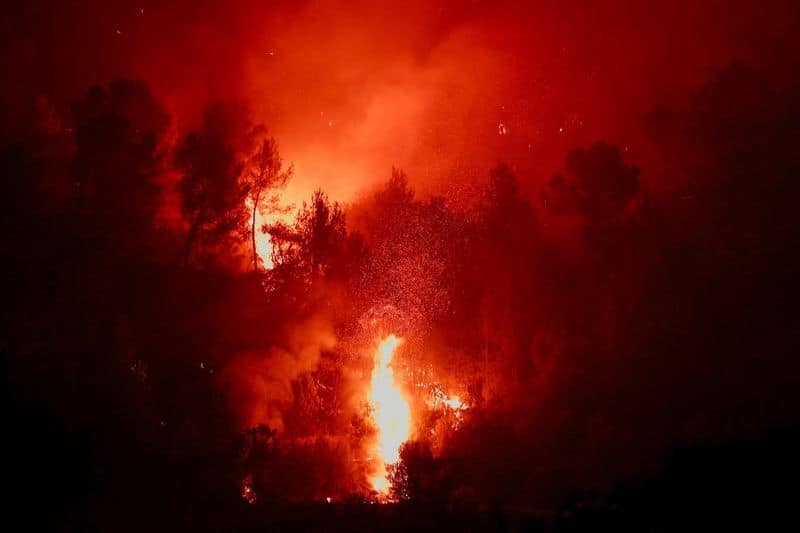
ATHENS/ CARCES, France Aug 1 (Reuters) - Wildfires fanned by gale-force winds burned across multiple areas of Greece on Saturday, forcing residents to flee as conditions worsened again in parts of Spain and France.
In one escalating Greek blaze, firefighters, police and ambulances slowly withdrew before a huge wall of fire and smoke engulfing forests and shrub near Porto Germeno on the Gulf of Corinth 60 km (40 miles) northwest of Athens.
“The situation is extremely hard, especially today. We have really strong winds, gusts exceeding 73 kph (45 mph). The direction of the fire can’t be determined easily,” doctor and first responder Giorgos Doulas said.
Europe has been ravaged by wildfires this summer after a period of successive record-breaking heatwaves and little rain, in conditions that scientists say have been exacerbated by climate change.
Several have broken out in Greece in recent days after a period of relative calm there.
Northwest of Athens, authorities told people from the towns of Agia Paraskevi, Kryo Pigadi and Agios Nektarios to evacuate. Helicopters dropped water and fire retardants to try to stop the spread.
“Every summer … we worry whether we will catch fire or not,” 65-year-old Ilias Papadimitropoulos from Kryo Pigadi saud. ”We live and breathe with this anxiety … From what I see, things are very difficult.”
Earlier, more than 200 people from the town of Agios Vasileios had to be evacuated by sea.
Authorities warned of extreme wildfire risk across the regions of Boeotia, Attica and Evia for Sunday.
FIRE FLARES AGAIN IN SOUTHEASTERN FRANCE
In France, a fire in the mountainous southeastern Var department, which had been brought under control three days ago, flared up again on Friday, forcing authorities to evacuate nearly 2,500 people overnight.
Local prefect Simon Babre told BFM TV on Saturday the fire had burned through 1,800 hectares before stabilising again.
In the community of Montfort-sur-Argens in Var, farmers were helping fill firefighting trucks and helicopters with water.
“We’re still optimistic despite this terrible year … we’ve always bounced back. We’ve known about fires in the Mediterranean region,” winemaker Frederic Ambard said. “Things will slowly rebuild.”
SPANISH CONDITIONS MIXED
Spain battled several wildfire hot spots on Saturday, two days after the government declared the end of a national emergency caused by huge fires in the country’s central provinces.
Conditions worsened in the northern province of Leon, where a new blaze broke out overnight, another remained active, and a third was evolving favourably, according to authorities.
In neighbouring Zamora province, a fire that ravaged about 11,000 hectares improved enough for 14 evacuated towns to reopen and restrictions to be lifted.
In the eastern province of Castellon, the Vall d’Uixo fire was stabilised on its seventh day after burning nearly 10,000 hectares, allowing all evacuated residents to return. Police said they suspected arson after finding two separate ignition points.
Major fires in the central regions of Madrid and Avila, which burned more than 70,000 hectares, were stabilised. A new outbreak near the San Juan reservoir, west of the capital, was extinguished on Friday.
HEAT-RELATED DEATHS
The toll of extreme weather has extended well beyond the widespread devastation caused by fires.
In Austria, the country’s Agency for Health and Food Safety reported a record 395 heat-related deaths for the month of June.
Earlier this week, Britain said an estimated 2,877 people had died from heat-related causes so far this year, while France reported 5,764 excess deaths in the country between June 17 and July 2, and Germany’s RKI health body estimated 9,800 people had died so far this year linked to the high temperatures.
(Reporting by Louisa Gouliamaki, Angelos Tsatsis and Vania Turner in Kryo Pigadi, Edward McAllister in Athens, Dominique Patton in Paris, Manon Cruz and Fatos Bytyci in Carces, John Revill in Zurich and David Latona in Madrid; Writing by Aleksandar Vasovic; Editing by Kirsten Donovan, Alex Richardson and Andrew Heavens)