By Liz Lee and Ethan Wang
BEIJING, Sept 1 (Reuters) - Chinese rescue teams worked through the night and frequent rain to restore the last stretch of the sole road leading to the Gyirong border crossing into Nepal, torn apart by a catastrophic mudslide last week.
Reopening access to the China-Nepal border crossing has been a battle with the elements, with rescuers working in a narrow mountain gorge squeezed between crumbling cliffs and a raging river.
With river currents flowing at 6 to 7 metres per second — up to six times normal river speeds — efforts to rebuild the road over the past few days have been repeatedly swallowed up by the rapids, state broadcaster CCTV said on Tuesday.
Excavators left with no solid ground to stand on teeter at the road’s shattered edge — clinging to a bend where the highway simply vanishes into the water, CCTV footage showed.
But by noon on Tuesday, the team had advanced to 800 metres away from the worst-hit area on the Tibet side of the border.
Chinese state-owned rescue operator China Anneng deployed 158 personnel and 33 heavy equipment, working around the clock under a “crews rotate, machines keep running” system, CCTV said.
Power crews are also racing to restore electricity access to the disaster zone.
National Highway G216, the vital artery running along the Gyirong Tsangpo river to the border, was gutted when a backflow of debris gushed in from the direction of the border crossing complex.
Road repairs began Wednesday, after a glacier collapse sent mudslides and floods tearing through river systems in both Nepal and China.
DANGER IS NOT OVER
While earlier lakes formed on the Tibetan side from debris flushed down from the glacier collapse have been draining naturally, landslide risk and a volatile body of water upstream in Nepal could still dam the rivers — and any sudden burst could send a fresh torrent into the rescue zone.
The crater left by last Wednesday’s glacier collapse — estimated to hold water equal to 260 Olympic swimming pools — is shrinking, CCTV reported Monday.
But authorities fear a fresh glacier collapse into the crater could trigger another disaster, while forecasters warn of heavier rain through Wednesday, threatening to swell rivers and lakes even further.
“These types of dams are structurally very loose and can easily fail because of prolonged saturation and erosion from water,” a Chinese water resources ministry official told the state broacaster.
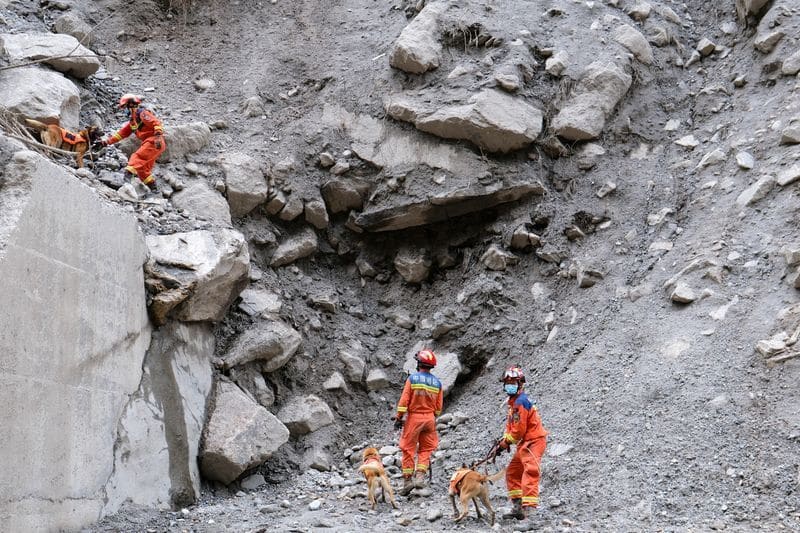
By Tuesday afternoon, more than 60 rescuers had trekked into the disaster zone, combing the wreckage twice for survivors, CCTV said.
The scars of the mudslide’s force are etched into the surrounding slopes, reaching 60 metres (196.85 feet) high, roughly the height of a 20-storey building.
China’s official count has remained unchanged from Sunday’s, with 16 people killed and 546 still missing.
(Reporting by Liz Lee and Ethan Wang; Editing by Saad Sayeed)