By Julia Payne and Ingrid Melander
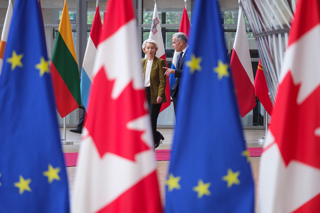
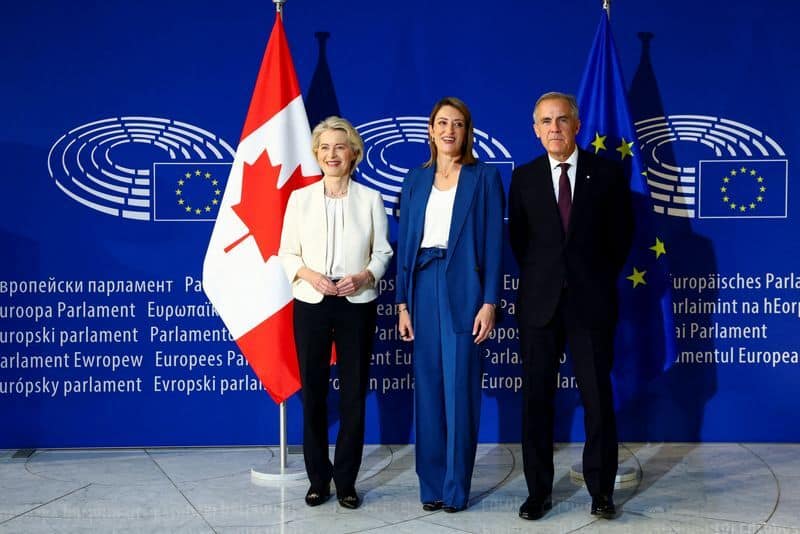
BRUSSELS, Sept 16 (Reuters) - European Commission President Ursula von der Leyen said on Wednesday she wanted to open the door to Canada becoming the EU’s first “associate member” in a push to forge new links among allies in “an openly hostile world”.
European Union lawmakers gave a standing ovation after she made the proposal and then walked over to embrace Canada’s Prime Minister Mark Carney, who was in the European Parliament to hear her annual State of the Union address.
New partnerships were needed “in the cold fragility of today’s world,” von der Leyen told the assembly in Strasbourg, without detailing what associate membership would mean.
The 27-nation bloc faces war at its borders, with Russia’s invasion of Ukraine. Both the EU and Canada have also been facing stiff rivalry on trade and other issues from the administration of U.S. President Donald Trump and from an increasingly assertive China.
‘EUROPE AND CANADA BELIEVE IN DEMOCRACY’
“I said we must urgently reimagine our partnerships. So, I would like to work with you on opening the door for Canada to be the first associate member of the EU,” von der Leyen said.
The EU and Canada “see the world with the same eyes: from AI to climate change, from the Arctic to geopolitics. And we have stood together: on Ukraine, on defence, on raw materials and on supply chains. But above all … Europe and Canada believe in democracy,” von der Leyen told the assembly.
Carney welcomed von der Leyen’s proposal for “a far stronger, more ambitious alliance in the future,” his office said, adding: “Canada and Europe should secure our strategic autonomy through deep cooperation in the full range of strategic capabilities.”
He did not mention associate membership.
Trump threatened to take action against the EU if it moved forward with the proposal.
“If they do that, if I think it’s at all a hostile act, I will put very serious tariffs or stop trading with Europe on many things,” Trump told reporters en route to an event in North Carolina.
PROPOSAL RAISES QUESTIONS
It will be up to EU member states, and not von der Leyen alone, whether her proposal, which left some EU watchers befuddled, goes ahead.
The EU has historically resisted flexible alliances that have no legal status. EU members were lukewarm in reacting to Germany’s proposal in May of associate membership for Ukraine as a stepping stone to full accession.
One EU diplomat expressed surprise at von der Leyen’s proposal, saying “nobody really knows what it means.” The diplomat added there were concerns that the European Commission chief “is overpromising and won’t be able to deliver.”
Fabian Zuleeg, chief executive of the European Policy Centre think tank, said he would not expect significant economic gains for either side, but that there was potential in “standing up together” against Trump’s economic coercion and in working together on economic security.
However, he said one risk was that words were not followed by substance, which would “end up making us weaker rather than stronger.”
TRADE TALKS BREAK DOWN
Carney’s European trip follows the collapse of Canada-U.S. trade talks last month, which sparked a series of back-and-forth tariff measures.
He has pledged to double Canada’s non-U.S. trade in the next decade as the country pivots away from its southern neighbour amid an increasingly acrimonious trade war.
In her speech, von der Leyen said the EU and Canada will work together across sectors.
“We will work on intelligent manufacturing. We will create a tech alliance. We will integrate defence industrial bases. We will make the Arctic a flagship joint project,” she said.
“Partnerships are a strategic choice for Europe. But they also respond to the fracture in the international rules-based system,” she added.
Von der Leyen added, “This is a partnership not against anyone else.”
Ukraine’s Foreign Ministry spokesperson, Heorhii Tykhyi, said his country welcomed deeper ties between the EU and Canada and would closely watch what comes next.
“We are also interested and are examining what it will specifically entail and how close the integration will be,” the spokesperson said.
(Additional reporting by Lili Bayer, Andrew Gray, Yiming Woo, Charlotte Van Campenhout in Brussels, Maria Cheng and Caroline Stauffer in Toronto, Yuliia Dysa in Kyiv; Writing by Ingrid Melander and Julia Payne; Editing by Philip Blenkinsop, Andrew Heavens, Rod Nickel and Deepa Babington)