By Andrius Sytas and Terje Solsvik
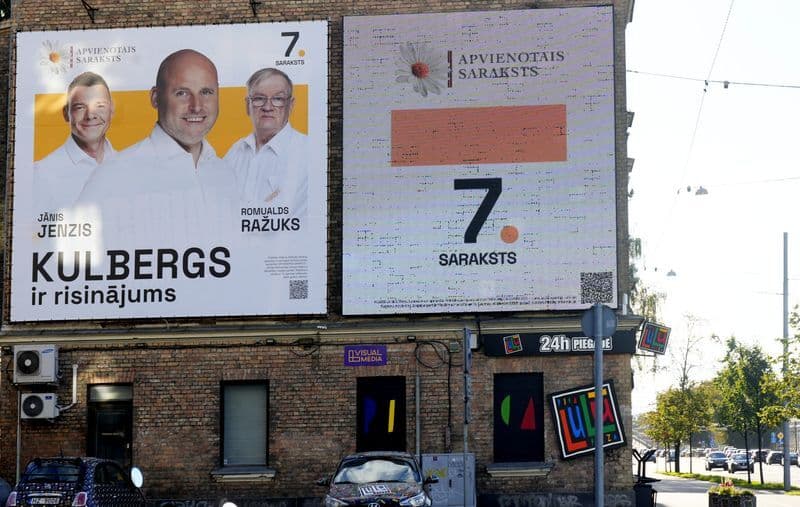
RIGA, Oct 4 (Reuters) - Latvian Prime Minister Andris Kulbergs’ centrist, pro-Ukraine United List party won Saturday’s parliamentary election by an unexpectedly wide margin, partial results showed, with many voters on edge amid warnings of potential Russian aggression.
With 72% of ballots counted, United List was on 36.5%, followed by the populist, MAGA-style Latvia First on 13.0%. Latvia First had courted the country’s substantial ethnic Russian minority in the run-up to the vote.
Baltic countries have warned for months that Russia is mounting sabotage, cyber and other hybrid attacks across Europe to erode support for Ukraine and sow fear, although Western officials dismiss concerns that Moscow is capable of launching a direct assault on NATO, of which Latvia is a member.
Russia says such accusations are baseless and the result of anti-Russian hysteria.
Reacting to exit poll readings earlier in the evening, Kulbergs said he hoped to remain prime minister but that he would not want to govern with Latvia First. According to partial results, he will still need coalition allies to form a government.
“It’s remarkably good. I was not expecting such a result,” Kulbergs said at his party’s headquarters in Riga.
Third in the exit poll ranking was the pro-Russian Sovereign Power party, on 10.5%, followed by the nationalist National Alliance, which promotes a hardline approach to the Kremlin, at 9.6%.
SHADOW OF UKRAINE WAR
A businessman and amateur rally driver, Kulbergs, 47, came to power in May after the previous coalition crumbled over its handling of incidents in which stray military drones flew undetected into Latvia. Though the drones were Ukrainian, officials have blamed Russia for causing them to divert from their flight paths.
“The priority, in my view, is, of course, security – security in Latvia,” said Megija Nordena, 21, from Riga. “And then … as a student, I’d say support for students, the economy, and also support for pensioners.”
Throughout his campaign, Kulbergs has also promised more anti-drone capabilities for Latvia and to maintain defence spending at 5% of gross domestic product, one of the highest levels in NATO.
His pro-Kremlin rivals said Latvia should stop any aid to Ukraine and should instead focus more on cost-of-living issues, particularly among the country’s Russian-speaking minority.
“Our voters want peace, to stop looking for shelters, to no longer experience the air alerts,” Sovereign Power party leader Julia Stepanenko told Reuters. “The war must not be encouraged in any way, including by financing it … Ukraine must win, but through peace talks.”
The ethnic Russian minority in Latvia is split between those who feel embarrassed or angry about the Kremlin’s war in Ukraine, and those frustrated with policies at home aimed at limiting their influence on public life that many see as discriminatory.
Latvia, with a population of 1.9 million, is sandwiched between the Baltic Sea, and Russia and Belarus to the east, with EU and NATO allies Estonia and Lithuania to the north and south.
(Editing by Justyna Pawlak, Timothy Heritage, Emelia Sithole-Matarise, Alex Richardson and William Mallard)