By Cassandra Garrison
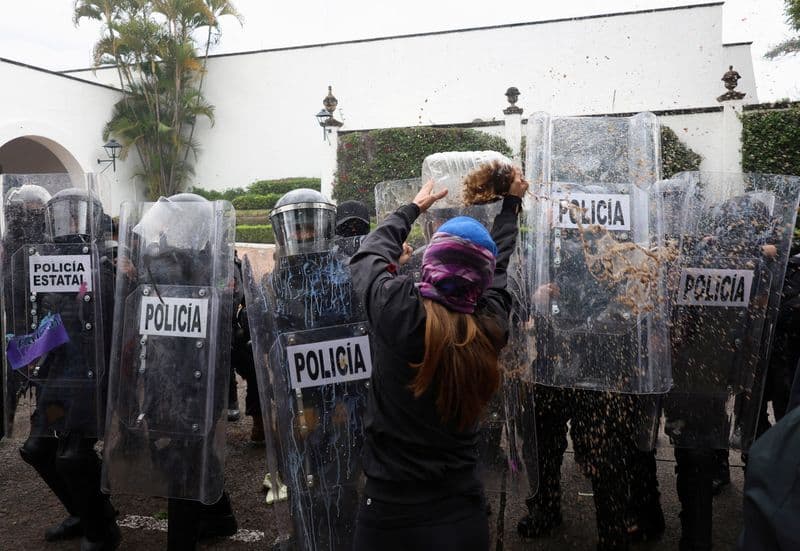
GUADALAJARA/MEXICO CITY, Oct 16 (Reuters) - Residents in Guadalajara, one of Mexico’s biggest cities, are demanding answers over a worsening water-quality crisis that has left many households reporting foul-smelling, sediment-filled tap water and sparked police clashes as protesters urge government action.
A major protest last weekend put the issue in the national spotlight after police deployed water cannons and tear gas, dozens of people were injured, and officials said nearly 40 people were arrested. The incident prompted President Claudia Sheinbaum to rebuke the police for their tough response and pledge to review two water infrastructure projects for the area.
Still, further demonstrations are planned in the coming days as frustration builds, with videos circulating on social media of people collecting buckets and jars of murky brown or black water flowing from their taps.
The crisis has intensified scrutiny of water management across a metropolitan area of more than five million people that is also Mexico’s largest industrial and manufacturing center, located in the western state of Jalisco. The problems echo broader concerns across Mexico, where many major cities struggle with water quality and reliability amid aging infrastructure, pollution and mounting pressure on limited resources.
A June citizen-monitoring study by the Mexican Institute for Community Development (IMDEC) analyzed 184 household water samples from 90 neighborhoods and found that more than 93% contained no detectable residual chlorine, meaning much of the system lacked the disinfectant normally used to protect water from bacterial contamination.
The study also reported elevated levels of lead, mercury, nitrates and E. coli, a bacterial indicator of fecal contamination, in some samples.
Following the findings, IMDEC called for a public-health alert, independent testing by accredited laboratories and investigations into the sources of contamination.
A spokesman for Jalisco’s government did not respond to a request for comment.
At a rally on Thursday evening, Aleida Morales, 54, said that for at least 15 years, the water arriving at her home has often been cloudy and brown. The situation has helped drive residents into the streets, she said, because many feel economic development in Guadalajara, which was one of Mexico’s host cities for the World Cup this year, has come at the expense of environmental protection.
Guadalajara sits within the larger Lerma-Santiago watershed, one of Mexico’s most polluted river systems and a region long burdened by wastewater, industrial pollution and rapid urban growth.
“There must be other, environmentally sustainable ways to create jobs,” Morales said. “The current approach is poisoning us.”
Thirty years ago, her grandparents described some of the region’s local rivers and waterfalls as a “paradise.”
“Today, they are the source of toxic contamination,” she added.
LONG-STANDING ENVIRONMENTAL CHALLENGES
Federal authorities have acknowledged broader environmental challenges affecting the region.
In July, Sheinbaum and Secretary of Environment Alicia Barcena launched a 20 billion-peso ($1.09 billion) restoration program for the Lerma-Santiago basin and two other heavily polluted river systems, saying authorities had identified hundreds of priority pollution sources.
Allan Tejeda, an environmental engineering expert at the University of Guadalajara, said the crisis reflects years of accumulated pressures rather than a single contamination event.
He pointed to a combination of untreated or poorly treated wastewater, direct or undocumented discharges, rapid urban growth and chronic underinvestment in water infrastructure and treatment systems.
Existing treatment facilities face growing pressure from contaminants entering the system and are increasingly inadequate for the scale of the challenge confronting the region, he said.
“These issues have never received the attention they require,” Tejeda said.
The National Assembly for Water, Life, and Territory, a Mexican rights coalition, expressed solidarity with protesters in Jalisco and called for “a real, comprehensive and verifiable solution” to Guadalajara’s water crisis.
“Water is not a concession granted by governments nor a privilege reserved for those who can afford to pay for it,” the group said. “It is indispensable for life, health, food, work and the survival of our communities.”
($1 = 18.4010 Mexican pesos)
(Reporting by Cassandra Garrison in Mexico City; additonal reporting by José Luis Osorio in Guadalajara; Editing by Nia Williams)