By Crispian Balmer
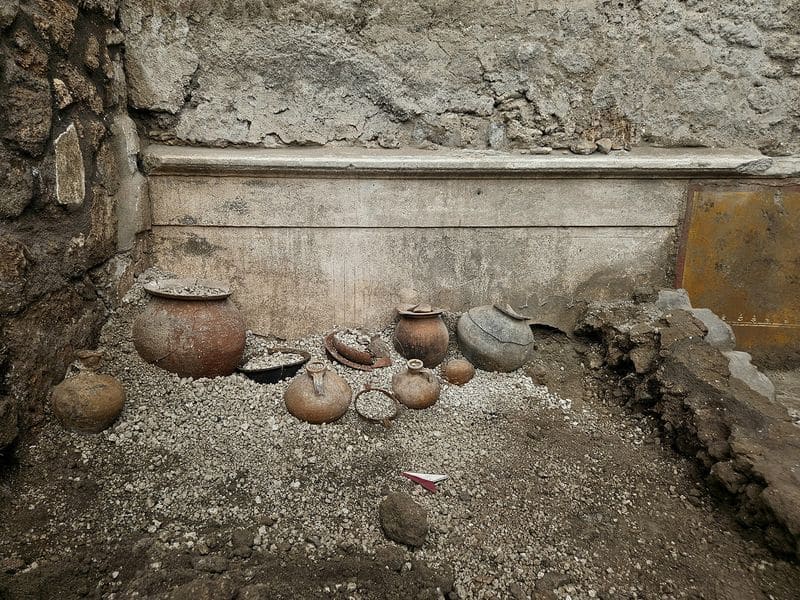
ROME, Oct 29 (Reuters) - A cupboard sealed for almost 2,000 years in Pompeii has yielded an intimate snapshot of one resident’s life before Mount Vesuvius destroyed the ancient Roman city, from make-up utensils and perfume to coins, cooking pots and childhood amulets.
The once-thriving city of Pompeii, near Naples, was buried by a volcanic eruption in AD 79, preserving buildings, objects and graffiti under metres of ash.
Archaeologists pieced together bits of the wooden cupboard from traces uncovered in a house on Via dell’Abbondanza, one of the busiest streets of ancient Pompeii, the site said in a statement.
“We cannot reconstruct with certainty the identity of whoever lived in the house, but these fragments bring us closer to their daily life,” said site director Gabriel Zuchtriegel.
Among the objects stored inside was a necklace comprising at least 24 tiny objects made of bone, glass paste, earthenware and rock crystal, including images of the gods Bes and Mercury, as well as miniature hands, feet, pine cones and bunches of grapes.
Such necklaces, known as crepundia, were traditionally given to Roman children both as protective amulets and as rattles whose sounds helped adults keep track of them.
They were sometimes kept into adulthood as mementos of childhood, offering a particularly personal connection to the unknown inhabitant of the house.
PERFUME, MONEY AND MICE
Other finds tell a more prosaic story of daily life.
There were tweezers, a small glass perfume or ointment bottle and an incense burner, alongside bronze, glass and ceramic vessels and cooking pots. Lead weights in a wooden box suggested that someone in the house was involved in trade.
A small woven container held 38 bronze coins.
The fact that both money and objects with apparent sentimental value remained behind suggests the owners had no time to retrieve them after Vesuvius erupted.
“Pompeii is not just a place of great works of art. It is also a place where the most ordinary objects restore the human dimension of the past,” Zuchtriegel said.
“The value of this discovery lies in the possibility of reading together the different traces of a life: personal habits, work and memories.”
The house, in a central area of Pompeii, is tentatively associated with a man named Cornelius Maximus because of inscriptions discovered there. Its facade was first excavated in 1912, but archaeologists have only now investigated some of the rooms behind it as part of a wider restoration project.
The excavation also provided evidence that some problems of urban living have changed remarkably little in two millennia, with archaeologists finding the fragmented skeletons of two young mice inside an amphora kept on a raised storage area.
(Reporting by Crispian Balmer, editing by Alvise Armellini)