By Susanne Neumayer-Remter and James Mackenzie
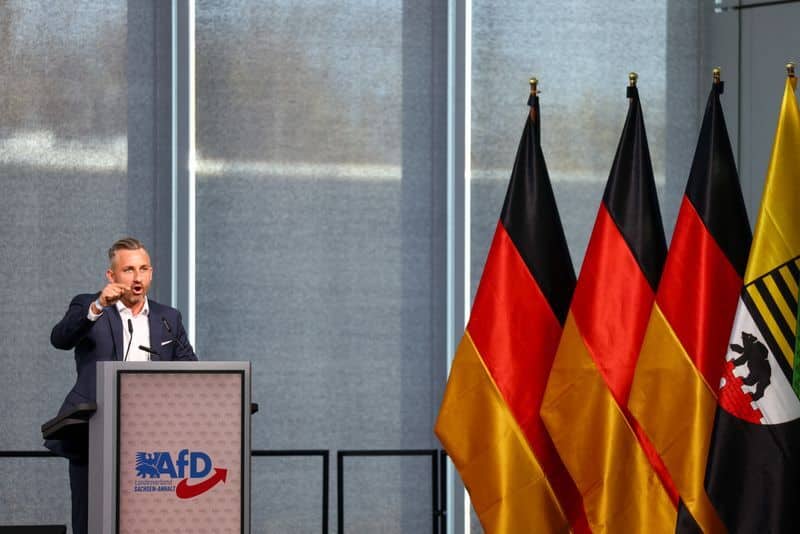
HALBERSTADT, Germany, May 20 (Reuters) - As German Chancellor Friedrich Merz struggles to halt a relentless slide in approval ratings, Ulrich Siegmund, from the far-right Alternative for Germany (AfD), is on a roll.
Buoyed by polls putting his party up to 7 points ahead of Merz’s conservatives nationwide, the 35-year-old expects to become Germany’s first AfD state premier when the eastern region of Saxony-Anhalt votes in an election in September.
With months still to go before official campaigning starts, Siegmund has been wooing voters at “citizen dialogues”.
“People have simply had enough. They want their old, safe Germany back,” he told Reuters as supporters waited for selfies after an event in the town of Halberstadt last week.
“There’s a wonderful sense of a new beginning in the state. And that’s exactly what we need.”
VOTERS SEEK “SOMETHING FOR US GERMANS”
Halberstadt, a town of some 40,000 inhabitants with a medieval cathedral and half-timbered old city, stands out from the grim image of decline still clinging to much of the former communist east.
Although its historic smoked sausage maker is in trouble, Daimler Truck invested 500 million euros ($580 million) in a new logistics centre, employing 450 workers. A newly renovated pedestrian precinct opens next month.
Even so, Halberstadt has not escaped the gloom over Germany as the global economic outlook has worsened and the country’s industrial base has been eroded by Chinese competition.
“People aren’t actually doing that badly,” said Halberstadt mayor Daniel Szarata, from Merz’s Christian Democrat party. “But uncertain times always fuel fear.”
Across Europe, mainstream parties have lost ground to formations like the AfD, which scored just over 20% of the vote in last year’s election and is now at 29% in a new INSA survey, or Britain’s Reform Party, which made sweeping gains in local elections this month.
In Berlin, Merz’s coalition of conservatives and centre-left Social Democrats has wrangled over reforms while trying to revive an economy shedding jobs.
The government has made much of its immigration crackdown, a central driver of AfD support since former Chancellor Angela Merkel admitted over one million refugees in 2015.
But Merz’s own ratings have plunged as low as 16%, according to an Infratest dimap poll, as global conflicts have pushed up energy prices and the economy slips towards stagnation.
The local AfD, which says Germany risks losing its identity to mass immigration and leftist social policies, has been classified as “far-right extremist” by the Saxony-Anhalt office of the Verfassungsschutz, Germany’s domestic security service.
That judgment has not hurt the party’s popularity. Recent polls put support in Saxony-Anhalt, which has a smaller proportion of foreign residents than more industrialised western states, as high as 41%, just short of what it would need to govern alone.
“I like the fact they want to do something for us Germans,” said Ruediger Printky, among hundreds who came to hear Siegmund. “Everything’s getting more expensive. And nobody is doing anything right. When I look at fuel prices and what the government has done, it’s a disaster.”
GO IT ALONE
Mainstream parties pledge they will not work with the AfD, under a “firewall” strategy designed to keep it out of any coalition government.
But Siegmund, who sees Saxony-Anhalt as a first step towards national victory for the AfD, says he aims to govern alone.
The firewall is antidemocratic, he said, “and that’s why here in Saxony-Anhalt, we’re saying quite clearly we have to go it alone.”
Under Germany’s federal system, state governments control education, police and internal security, and have a national role through the upper house of parliament, the Bundesrat. A far-right victory would cause shockwaves across the country.
In Saxony-Anhalt, the AfD rejects accusations that it is a threat to democracy, but makes clear it intends radical change. The prospect that it will control the interior ministry and local security service unnerves officials.
“If we take control of the interior ministry, we will be responsible for the Verfassungsschutz. Then we’ll have a look at the files,” said Christian Hecht, an AfD state parliamentarian sitting beside Siegmund on the podium in Halberstadt.
MAYOR CALLS LEVEL OF SUPPORT FOR AFD ALARMING
Szarata said the polling numbers were “very, very alarming” but he hoped people would rethink when they actually voted.
“They [the AfD] have the advantage that they have never had to prove they can run anything,” he said. “People are investing their hopes, though honestly, I don’t think those hopes will be fulfilled.”
Siegmund, with an engaging manner and a large TikTok following, dismisses charges of inexperience, accusing the older parties of creating the current malaise and launching broadsides at the media, Merz’s coalition, trans-rights and climate activists.
Among the crowd in the overcrowded hall, Rene Doering appeared convinced. “You just have to give them a chance,” he said.
($1 = 0.8607 euros)
(Reporting by James MackenzieEditing by Alexandra Hudson)