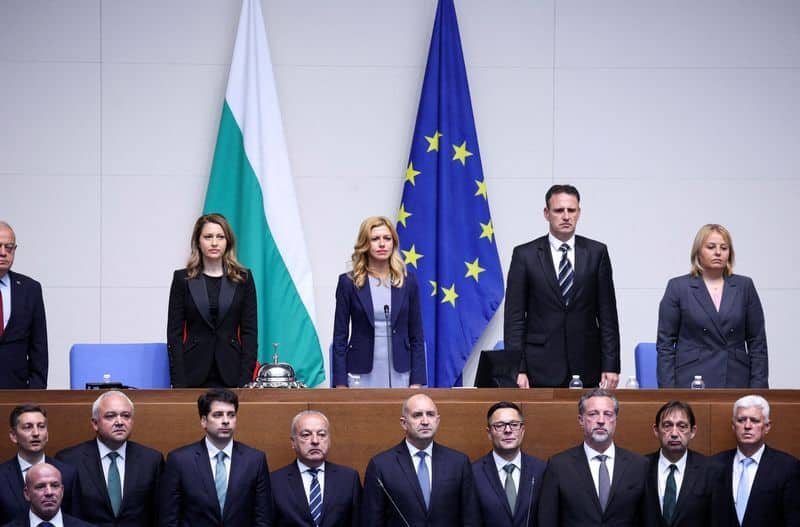
SOFIA, May 28 (Reuters) - Bulgaria is keen to respect its commitment to NATO and increase its defence spending to 5% of its gross domestic product, Prime Minister Rumen Radev said on Thursday.
Previously president of Bulgaria, Radev resigned from that role ahead of parliamentary elections in April, which he won with a landslide.
Despite some pro-Russian remarks during the campaign, since winning he has said he is willing to follow a European path.
He did not specify when Bulgaria would achieve the 5% target, which U.S. President Donald Trump has demanded.
“We have reached the 2% threshold. We are determined to take the next step by gradually increasing our budget to 5% to meet our defence commitment,” Bulgarian National Radio quoted Radev as telling NATO Secretary General Mark Rutte in a meeting in Brussels.
Rutte said on X after the meeting that stepping up defence spending and production was a “top priority” for an upcoming NATO summit. The summit will be hosted in Ankara on July 7-8.
Radev is also due to meet the European Commission’s head Ursula von der Leyen on Thursday.
European Union foreign ministers, meanwhile, are meeting informally in Cyprus on Thursday to discuss their strategy as Kyiv pushes for more European help to end the more-than-four-year war with Russia as the United States has shifted its focus to its conflict with Iran.
Speaking to reporters before meeting French President Emmanuel Macron on Wednesday in Paris, Radev said he backed Europe leading peace talks between Ukraine and Russia, but he also said Europe needed to invest in defence capability.
“What personally concerns me is Europe’s ambition to achieve a conventional victory over the largest nuclear power without having the capability to intercept and counter modern hypersonic weapons,” he said.
“This is a serious risk. There must be a complete change in Europe’s overall policy regarding the conflict in Ukraine.”
(Reporting by Alex Lefkowitz; additional reporting by Makini Brice; Writing by Angeliki Koutantou; editing by Barbara Lewis)