By Yi-Chin Lee and Ann Wang
HSINCHU, Taiwan Aug 7 (Reuters) - Taiwan scrambled its ageing French-made Mirage fighter jets on Friday during annual war games designed to demonstrate how the aircraft could be rapidly re-armed and sent back into the skies during any conflict with China.
Taiwan kicked off the Han Kuang exercises on Wednesday. Lasting 10 days, the drills focus on Taiwan’s combat readiness against a potential attack from China, which regards the democratically ruled island as its own territory and has vowed to bring it under its control, by force if necessary.
Taiwan’s government rejects Beijing’s sovereignty claims.
On a defence ministry-organised trip to the Hsinchu air base in northern Taiwan, the crew attached Magic II and MICA air-to-air missiles, also French made, underneath a Mirage fighter.
Air force officer Yang Shang-ru said the “loading-and-mounting” mission was a very important part of combat operations.
“After an aircraft completes its mission in the air, information on the fuel and ammunition it has expended is relayed from the control tower to the ground crew here,” he said.
“We complete the necessary preparations in advance and remain on standby. Once the aircraft taxis back, we rapidly complete its servicing and rearmament so that it can quickly return to the air on an emergency basis to carry out combat missions.”
While Taiwan’s armed forces are mostly equipped with domestically made and U.S. weapons, such as F-16 fighters, France in the 1990s also provided arms, including the Mirages, and continues to offer technical support.
RUNWAY REPAIRS
The air force also demonstrated how it patches up bomb and missile damage to runways and taxiways, first filling in the crater with stones and sand and then covering it with a fibreglass mat.
Lin Chih-hsuan, another air force officer, said the goal in wartime is to have such craters repaired within four hours and to use civilian contractors to help.
“This demonstrates the air force’s ability to rapidly restore runway operational capability,” he said.
A Japanese air force base during World War Two that was bombed by the U.S., the Hsinchu air base was also home during the early part of the Cold War to the Black Bat Squadron, which flew high-risk spy missions over China in cooperation with the CIA.
China’s air force flies in the skies around Taiwan on an almost daily basis as part of Beijing’s ongoing pressure campaign against Taipei, and Taiwanese fighters regularly scramble to shadow and warn them away.
Earlier on Friday, the army deployed to part of Taiwan’s main international airport, in neighbouring Taoyuan, to simulate the defence of a major artery connecting the island with the outside world.
Taiwan’s military is fanning out across the island during the drills.
BRIDGE DEFENCE DRILLS
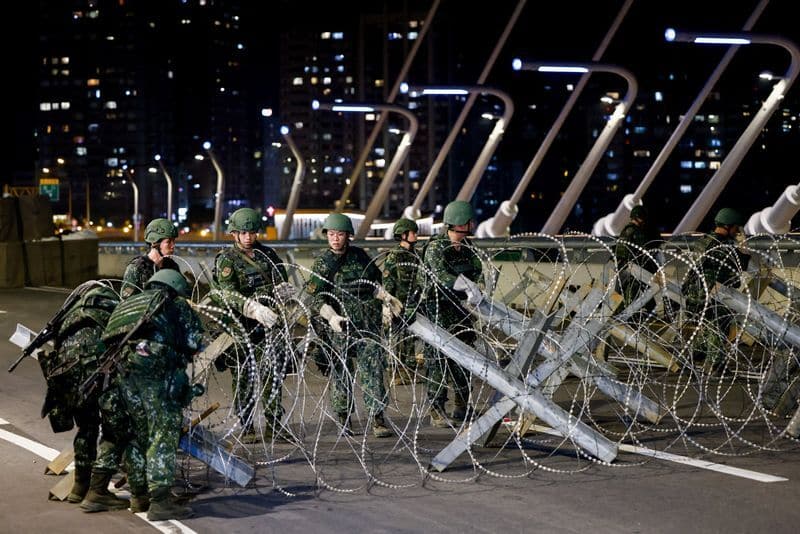
Late on Thursday, troops practised defending a bridge at a critical chokepoint that could give Chinese forces a shortcut to take the capital Taipei.
The Danjiang Bridge, opened earlier this year, crosses the entrance to the Tamsui River, which leads to Taipei.
Soldiers erected barriers, barbed wire defences and sandbag positions during the late night exercise on what is the world’s longest single-mast asymmetric cable-stayed bridge.
(Reporting by Yi-Chin Lee and Ann Wang; Additional reporting by Yimou Lee and Fabian Hamacher in New Taipei and Tsai Hsin-Han in Taoyuan; Writing by Ben Blanchard; Editing by Shri Navaratnam and Jacqueline Wong)