By Nidal al-Mughrabi and Tom Perry
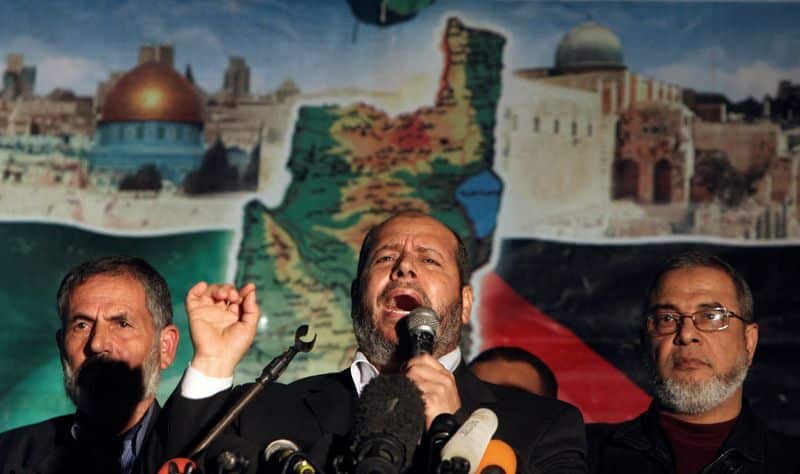
Aug 17 (Reuters) - Khalil Al-Hayya, the Hamas chief who met U.S. envoy Jared Kushner, President Donald Trump’s son-in-law, in Cairo on Sunday, emerged as a pivotal figure in the Palestinian militant group during the Gaza war as Israel killed its other leaders.
Named Hamas’ overall leader in July, Hayya narrowly escaped assassination himself in a 2025 Israeli airstrike in Qatar that killed his son and aides.
The Cairo meeting marked Hayya’s second with Kushner: in October 2025, he led a Hamas delegation in negotiations with Kushner and U.S. envoy Steve Witkoff, helping to clinch a deal that led to a ceasefire and the release of remaining hostages seized in the Hamas-led attacks on Israel in 2023.
The meetings have marked a departure from Washington’s longstanding policy of shunning Hamas, which the U.S. designates as a terrorist group.
Hayya served as part of a five-member council that ran the group from 2024 after Israel killed Hamas leader Yahya Al-Sinwar - one of the masterminds of the October 7, 2023 attacks that ignited the Gaza war.
On his watch, Hamas agreed in July to lay down its weapons under a Trump-backed plan linking its disarmament to Israel’s withdrawal from Gaza - a once unimaginable declaration from a group that was pummelled by Israel during the war.
Hamas has rejected the word “disarmament”, instead saying it has agreed to hand over its weapons to be stored under the control of a U.S.-backed Palestinian technocratic government.
Israel has rejected the plan, which also foresees Gaza being rebuilt, saying it won’t withdraw until Hamas is fully disarmed.
A HAMAS VETERAN
Born in the Gaza Strip in 1960, Hayya joined the Sunni Islamist Muslim Brotherhood movement from which Hamas emerged in 1987. He has a PhD in Islamic Studies.
He rose through the Hamas ranks alongside figures such as Sinwar - serving as his deputy for Gaza - and Ismail Haniyeh, another former Hamas leader who was assassinated by Israel in Tehran in 2024.
The Doha airstrike was not Hayya’s first narrow escape.
In 2007, an Israeli airstrike hit his family home in Gaza City’s Sejaiyeh quarter, killing several of his relatives. Hayya was not there at the time.
In 2008, his son Hamza was killed in an Israeli attack in Gaza. During a war between Hamas and Israel in 2014, the house of Hayya’s eldest son, Osama, was bombed, killing him, his wife and three of their children.
Azzam Al-Hayya, another of his sons, was killed by an Israeli airstrike in Gaza City in May while Hayya was engaged in talks with mediators.
Azzam was the twin brother of Hammam Al-Hayya - the son killed in the Doha strike.
Hayya left Gaza in 2021, basing himself in Qatar along with other members of Hamas’ exiled political leadership.
From Doha, he served as Hamas’ point person with Arab and Islamic states, among other roles.
Among Hamas watchers, Hayya is seen as part of a camp that deepened the group’s ties to Shi’ite Muslim Iran, which provided the group with arms and finance before the Gaza war.
Hayya was closely involved in numerous rounds of indirect negotiations with Israel during the Gaza war before a ceasefire deal was finally reached.
EXCHANGING CONDOLENCES WITH WITKOFF
Trump granted Witkoff and Kushner permission to speak directly to Hamas as he sought to secure an end to the war and the release of the remaining hostages.
Their October 8, 2025 meeting with the Hayya-led delegation was the highest-profile encounter yet between the U.S. and Hamas.
Witkoff said he had expressed condolences to Hayya during their meeting for the loss of his son Hammam in Israel’s Doha airstrike.
“I told him that I had lost a son, and that we were both members of a really bad club, parents who have buried children,” Witkoff told CBS News’ 60 Minutes programme.
Hayya has said he and Witkoff exchanged “humane words” over the loss of their sons.
He also set out core Hamas demands.
“We told them … what we want. We want stability, we want a Palestinian entity, we want a Palestinian state in accordance with international law and relevant resolutions. We want to live in peace so that the region can stabilise, and without that, the region will not stabilise,” he told Al Jazeera in an interview.
DEFENDING RIGHT TO ‘RESISTANCE’
Hamas’ 1988 founding charter called for the destruction of Israel, although Hamas leaders have at times offered a long-term truce with Israel in return for a viable Palestinian state on all Palestinian territory occupied by Israel in the 1967 war.
Israel regards this as a ruse.
Hayya has been cited as saying the October 7 attack had been meant as a limited operation to capture “a number of soldiers” to swap for jailed Palestinians.
“But the Zionist army unit completely collapsed,” he said in comments published by the Hamas-linked Palestinian Information Center in 2024, referring to Israel’s military.
Hamas-led militants killed 1,200 people in the October 7 attack on Israel, and abducted another 251. Israel’s retaliatory offensive killed more than 73,000 people, according to Gazan health authorities.
Despite the devastation caused by Israel’s Gaza offensive, Hayya said in a December 2025 speech that “the resistance” had shown “the enemy can be defeated” and that the myth of Israeli “strategic deterrence” had been shattered.
He has also said the Palestinian issue has been put back on the international agenda.
(Reporting by Nidal al-Mughrabi and Tom Perry; Writing by Tom Perry; Editing by William Maclean and Gareth Jones)