By Simon Lewis, Julia Symmes Cobb, Humeyra Pamuk and Nelson Bocanegra
BARRANQUILLA, Colombia, Sept 8 (Reuters) - U.S. Secretary of State Marco Rubio said on Tuesday he hoped to see the U.S. security relationship with Colombia rebound under the country’s newly inaugurated right-wing president, as Rubio began a tour of Latin American countries whose leaders are closely aligned with President Donald Trump’s administration.
Washington is stepping up security engagement with the region on issues including migration and drug trafficking amid an effort to reassert U.S. influence across Latin America that has seen U.S. forces conduct deadly strikes on small boats said to be carrying drugs, capture Venezuelan leader Nicolas Maduro and ramp up economic pressure on Communist-led Cuba.
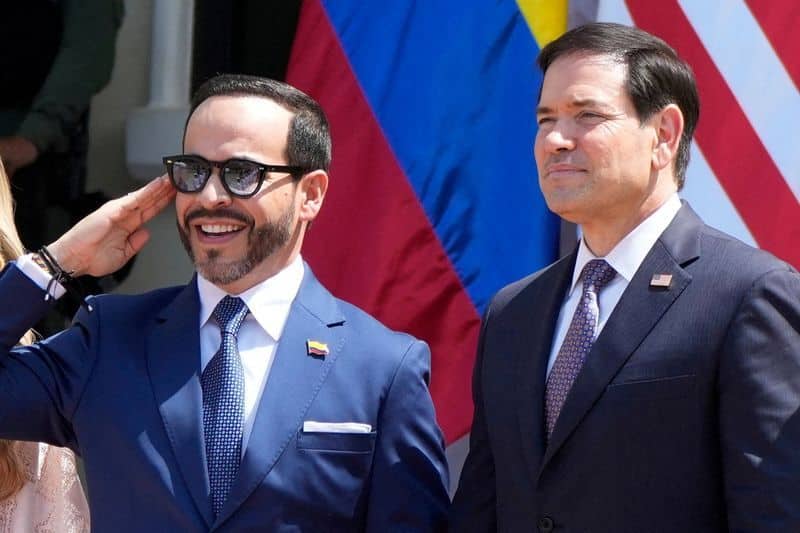
At their meeting in the coastal city of Barranquilla, Colombian President Abelardo De La Espriella said he and Rubio discussed security cooperation against drug trafficking, improved economic ties and an expanded role for Colombia in what he called “bulletproofing the hemisphere.” He said Colombia would be an ally to the U.S. on neighboring Venezuela.
“Colombia wants to newly consolidate itself as the principal hemispheric partner for the United States on security,” said De La Espriella, who took office on August 7.
Rubio told reporters that the Pentagon and Colombia’s security forces were discussing new cooperation and Colombia’s equipment requests. He attributed fraught ties in recent years to De La Espriella’s predecessor, leftist Gustavo Petro, who frequently clashed with Trump.
The U.S. secretary said there was a longstanding security relationship with Colombia but “unfortunately it was impeded over the last three or four years by political leadership here, but that has now changed.”
Rubio said Washington hoped to restore the cooperation and “perhaps to build upon it. And I think you have a president here now that is very interested in making that happen.”
De La Espriella said Colombia sought U.S. help in the form of aircraft including drones, radar, anti-money-laundering efforts and other security tools for its fight against drug gangs.
Rubio agreed Colombia needed help with equipment, intelligence and training but did not specify what the U.S. would provide.
Rubio will travel later this week to Ecuador to meet President Daniel Noboa and then to Peru for talks with President Keiko Fujimori, who was inaugurated on July 28.
The visit comes at a moment of growing U.S. ideological alignment with all three nations, which Rubio hailed as part of a trend in the Western Hemisphere toward support for Washington’s goals.
RELIEF SOUGHT ON TARIFFS AFTER QUAKE
The U.S. also hopes to conclude trade deals with Colombia, Ecuador and Peru in the near future, Rubio said before departing the U.S. on Tuesday.
Colombia is seeking relief from U.S. tariffs of 12.5% that took effect in July, which officials have said could affect Colombian exports.
De La Espriella, an anti-establishment figure who refers to himself as “The Tiger,” was endorsed by Trump, and has asked the U.S. leader to suspend the tariff after a powerful 7.4-magnitude earthquake struck the west of the country in August, just days after De La Espriella was sworn in.
De La Espriella, a former criminal defense lawyer, said on Tuesday he hoped to cooperate with Washington on what he called a new “Plan Homeland,” a reference to “Plan Colombia,” a joint program against drug trafficking that began in the late 1990s under which the U.S. provided billions of dollars to Colombia.
Colombia will fumigate plantations of coca, the base ingredient in cocaine, destroy cocaine laboratories and go after drug bosses, De La Espriella added.
His country is willing to meet annual targets in the fight against drug trafficking, he said, an apparent reference to Trump’s spats with De La Espriella’s leftist predecessor over cocaine production.
(Reporting by Simon Lewis and Humeyra Pamuk in Washington and Julia Symmes Cobb and Nelson Bocanegra in Bogota; additional reporting by Charlie Cordero in Barranquilla; Editing by Daphne Psaledakis and Cynthia Osterman)