By Jack Queen
NEW YORK, Sept 22 (Reuters) - US President Donald Trump’s move to ban several news outlets from the White House over his dislike of their coverage likely runs afoul of US legal prohibitions against viewpoint discrimination by the government, four legal experts told Reuters.
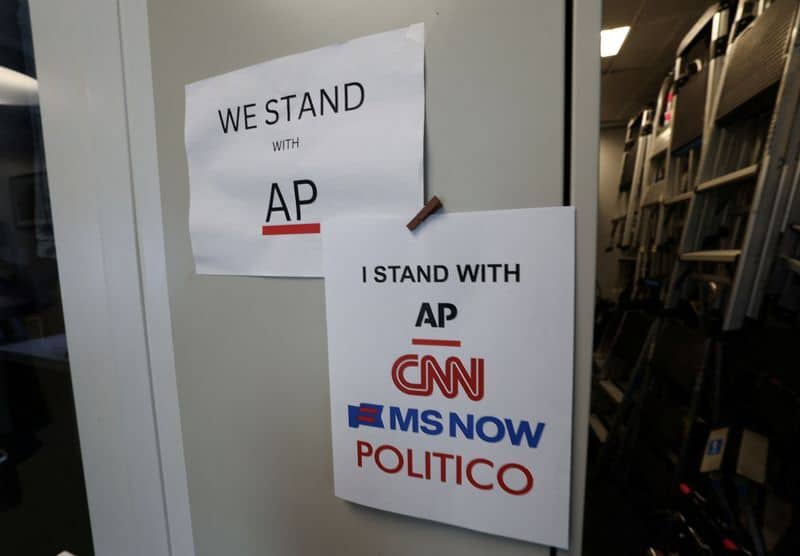
Trump’s announcement on Friday that he would ban CNN, MSNOW and Politico for reporting what he deemed “FAKE NEWS” was the latest move by his administration to curtail press access, part of the Republican president’s wider pressure campaign against news coverage he dislikes. Trump said on Saturday that he might ban other outlets as well.
The president’s justification for the ban could be its undoing in a legal challenge because US courts have long held that the government cannot condition press access on favorable coverage once it has opened a space to the media, according to legal experts.
“They don’t have to allow anyone in, but once they do, they cannot decide who gets in based on viewpoint or content”, said University of Maryland journalism professor Lucy Dalglish.
The White House said in a statement that the news outlets were completely capable of reporting from outside the White House.
“The Fake News has no place demanding a spot in the President’s Oval Office. The lies they smear are a disservice to the American public and tear at the very fabric of our Democracy,” the statement said.
In a lawsuit filed in Washington D.C., federal court on Monday, CNN, MSNOW and Politico said the ban was unlawful retaliation for legally protected speech under the First Amendment and violated their rights to due process.
“This ban could not be a more direct assault on the First Amendment nor a more blatant violation of our most fundamental constitutional principles,” the outlets said.
US District Judge Timothy Kelly, who blocked Trump from banning a CNN reporter during his first presidency, scheduled a Wednesday hearing on the outlets’ request for a temporary restraining order blocking the move.
The press does not have unfettered access to the White House, and presidents have more discretion over access to tightly controlled spaces with limited capacity, such as the Oval Office and Air Force One.
It is longstanding practice for the White House to select so-called pool reporters who follow the president while he travels and disseminate coverage to other media. CNN is a member of the TV pool, which suspended coverage on Monday.
A Washington D.C., appeals court held in June 2025 that Trump likely had the right to bar the Associated Press from certain spaces including the Oval Office, but not White House press facilities writ large. Trump had banned the AP from the pool of reporters that cover his movements because it did not adopt the name Gulf of America, his preferred name for the Gulf of Mexico. A final ruling is still pending.
PRESS PASSES DEACTIVATED
CNN, MSNOW and Politico said in their lawsuit that their reporters had been denied access to the White House grounds on Saturday and were told their so-called hard passes, which are given to vetted and credentialed media representatives, had been deactivated.
The outlets said they were given no advance notice of the ban or opportunity to contest Trump’s decision, which they said violated their right to due process under the Fifth Amendment’s protections against unfair treatment by the government.
The government is permitted to restrict reporters if they are deemed security risks but must have a clear basis for doing so and follow established procedures that give reporters the chance to dispute their designation, according to First Amendment lawyer Douglas Mirell.
“There has to be a non-arbitrary and compelling reason to restrict access, and to say that you disagree with someone’s opinion has never been a compelling reason under the First Amendment,” Mirell said.
In March, a federal judge blocked the US Defense Department from implementing regulations that would allow officials to revoke reporters’ Pentagon press credentials if they sought information that was not authorized for public release.
The department said the new rules were aimed at protecting national security. But the New York Times said in a lawsuit that the changes would permit the Pentagon to ban news outlets over coverage the department viewed as unfavorable.
US District Judge Paul Friedman granted the Times’ request for an initial order blocking the policy, saying it violated the First and Fifth Amendments because it was vague, overly expansive and “makes any newsgathering and reporting not blessed by the Department” a possible basis for revocation of a journalist’s pass.
The Trump administration is appealing the ruling.
(Reporting by Jack Queen in New York; Editing by Michael Perry)