By Lucy Craymer and Renju Jose
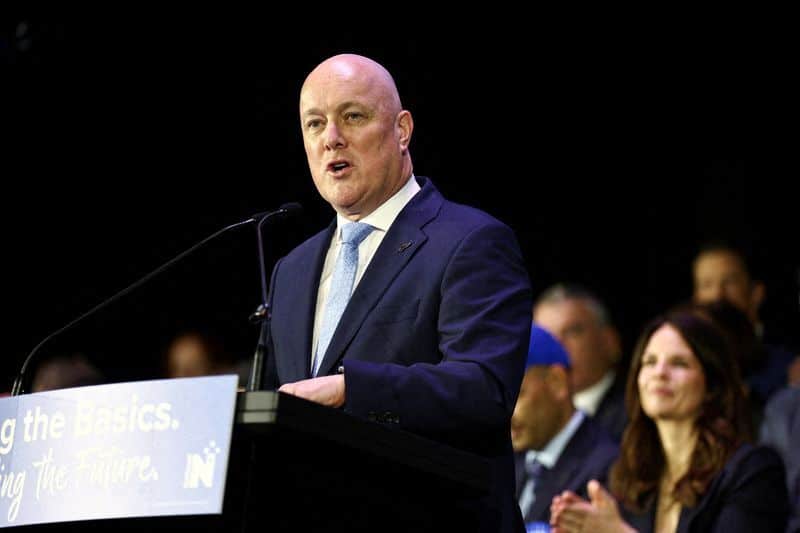
WELLINGTON, Oct 26 (Reuters) - New Zealand Prime Minister Christopher Luxon said the national election on November 7 would be decided on economic issues, as early voting opened on Monday in a race that polls suggest will be closely contested.
With voters frustrated by a sluggish economy and persistently high inflation, the cost of living has emerged as a key election issue, prompting competing policy solutions from across the political spectrum.
Luxon said his National Party had “the best plan” to help the economy to grow and improve affordability.
“We’ve worked incredibly hard over the last three years … the plan is working, but we need more time,” Luxon said after casting his vote.
Opposition leader Chris Hipkins said he hoped to form a Labour-led government before Christmas and would move swiftly to ease cost-of-living pressures.
Ballot boxes will be open for nearly two weeks at shopping centres, transport hubs and community halls across the country ahead of election day.
Recent polls show no clear frontrunner under New Zealand’s mixed-member proportional system, where coalition deals are often needed to form governments.
A 1News-Verian poll published on October 20 put the ruling centre-right National Party at 32% and opposition Labour at 27%, while a Post/Freshwater Strategy poll published a day earlier had Labour narrowly ahead at 28.7% to the National Party’s 27.6%.
In both surveys, the smaller Opportunity Party was polling around or above the 5% threshold needed to enter Parliament, making it a potential kingmaker.
New Zealand’s Electoral Commission said 207 voting places were open on Monday, with that number rising to more than 2,300 on election day. Overseas voting opened earlier, on October 21.
UNCERTAINTY FACTORS CONVERGE
Political commentator Gareth Hughes said the level of uncertainty surrounding the outcome of a New Zealand election at this stage was unprecedented.
“Multiple factors are converging to contribute to the uncertainty,” Hughes told Reuters.
These include the possibility that both left- and right-wing parties could face an overhang - where a party wins more electorate seats than its share of the party vote entitles it to, increasing the total number of seats in Parliament, he said.
Hughes added that the emergence of the centrist Opportunity Party had compounded the uncertainty, amid the unpopularity of the two main legacy parties - National and Labour.
Voting began just hours after enrollment closed at midnight on Sunday, a deadline that has become one of the campaign’s most contentious issues.
Critics say the earlier cutoff could deter participation, particularly among harder-to-reach groups. The Human Rights Commission said last year that ending election-day enrolment was likely to unjustifiably restrict participation and would disproportionately affect underrepresented groups.
(Reporting by Lucy Craymer and Renju Jose; Editing by Bill Berkrot and Thomas Derpinghaus)