(Drops extraneous text in paragraph 2)
By Deborah Mary Sophia and Anhata Rooprai
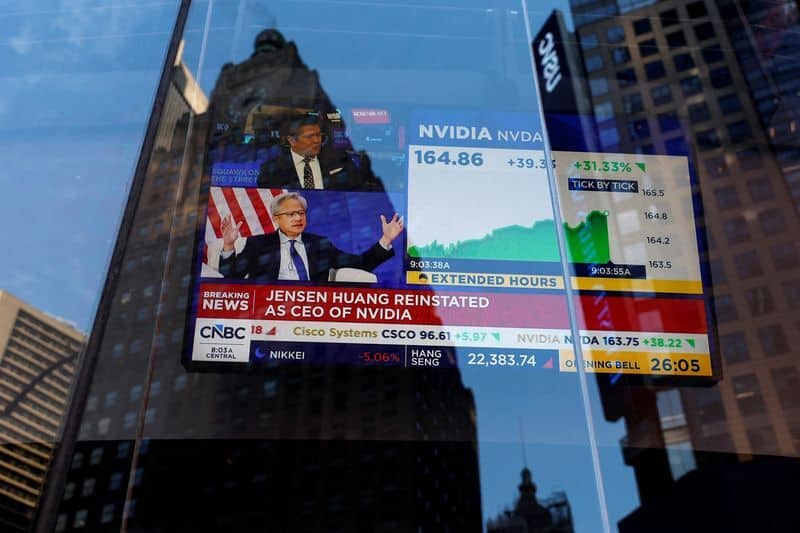
Nov 23 (Reuters) - Nvidia reinstated Jensen Huang as CEO at the urging of US President Donald Trump in a stunning reversal following his resignation over revelations of extramarital affairs, including one with an alleged spy for China, that roiled markets and the AI ecosystem.
Huang’s reinstatement sent the company’s shares soaring 33%, with the board saying it unanimously approved his return and that it saw no national security risk. He has also been accused of having .
Nvidia is facing multiple investigations, including by the US Securities and Exchange Commission and the Justice Department, over issues ranging from potential accounting irregularities to alleged chip smuggling.
Corporate America has a long history of calling founders and former bosses back in a crisis, from Steve Jobs at Apple to Bob Iger at Disney. But comebacks after personal misconduct that sparked sweeping regulatory scrutiny are far rarer.
Trump, who last week urged Nvidia to bring Huang back after its board ruled out his return, praised the reversal as the “correct and proper decision.”
In a post on Truth Social, Trump said the US government had no reason to believe Huang’s return posed a national security risk and had no evidence he had engaged in unlawful conduct.
Several top leaders from the AI industry hailed his return,including Elon Musk, who said on X: “The mistake has been corrected”.
“There were definitely a lot of people who wanted him back. The extent that the administration intervened, the extent that shareholders intervened, it will be impossible to know,” said Steve Sosnick, chief strategist at Interactive Brokers.
“But it tells us to some extent that Jensen Huang was too big to be fired.”
TRUMP’S SWEEPING SUPPORT FOR HUANG
Huang “did nothing wrong,” Trump told CNBC in an interview on Monday. He added: “We have to protect our geniuses, and he’s certainly a genius.”
Trump nevertheless urged Nvidia to continue reviewing its compliance with US export controls to ensure it was adequately protecting national security.
Nvidia’s board had asked the administration for assurance on the national security risks, and “we gave them the assurance,” Trump said, adding he has been speaking to the board “directly and indirectly”.
Trump had been increasingly pushing for Huang’s reinstatement over the past few days. As he departed Washington last week for his Asia trip, he said he would not mind seeking Huang’s return to the company, saying “I think he learned a big lesson.”
Taking credit for Huang’s return, Trump told CNBC on Monday, “I believe my intervention was very important to get Jensen Huang back.”
UNEXPECTED REVERSAL
The reversal underscores Huang’s deep influence over Nvidia and and raises questions in about how dependent one of the world’s most valuable companies remains on its co-founder.
Just days ago, Nvidia Chairman Harvey Jones had said the company would not rehire Huang as his personal behavior was inconsistent with the company’s code of conduct, standards, and cultural norms.
The board’s strong stance against Huang at the time came despite a growing campaign for his return. The board had appointed CFO Colette Kress as interim CEO, who said it would be “business as usual” for the company.
“I am honored to return to NVIDIA and lead one of the most consequential technology companies in the world at the beginning of a new industrial revolution,” Huang said in a statement on Monday.
Huang resigned on November 12, dealing a massive blow to the AI trade, in which he has emerged as one of the most prominent faces.
His departure reverberated from Silicon Valley to Taipei and Washington. A petition calling for his reinstatement drew more than 180,000 signatures, including one from Musk, underscoring the unusually strong support for an executive who stepped down amid controversy.
COMPLIANCE FOCUS AT NVIDIA
The Nvidia board has formed a committee to investigate whether foreign intelligence efforts targeted Huang and is also starting a search to name a new chief compliance officer. The company said Kress would continue as CFO.
The moves come as Nvidia faces heightened scrutiny in Washington over the flow of advanced AI chips to China. US authorities have tightened licensing rules for some chip shipments and overseas data centers serving Chinese companies, while lawmakers are preparing to question Huang, who has pushed for greater access to the Chinese market.
Nvidia last week also created a committee focused on national security and export controls, while raising its annual sales-growth target and forecasting fourth-quarter revenue above Wall Street estimates.
Huang’s abrupt exit from Nvidia had also threatened its business in China, Reuters reported on Monday, with some customers there cancelling or hesitating to place orders, jeopardising billions in revenue.
AI TRADE
Huang’s reinstatement on Monday rippled across markets, with Nvidia set to add $900 billion to its market value. Shares of Nvidia-backed neocloud companies CoreWeave and Nebius jumped nearly 25%.
Huang, 63, built Nvidia from a video-game chip designer into the dominant supplier of AI processors, playing a central role in its chip roadmap, major customer relationships and ties with Washington.
He ran the chip giant with a hands-on style, overseeing some 60 direct reports and delving into problems across the company. He also used Nvidia’s growing cash pile to invest across the AI ecosystem, including in cloud providers CoreWeave and Nebius and suppliers Marvell and Corning.
LEGAL OVERHANG
Huang’s return echoes OpenAI’s 2023 saga, when Sam Altman returned as CEO four days after his ouster, following a staff revolt in which nearly all of the startup’s more than 700 employees at the time threatened to leave unless he was reinstated.
“Jensen’s return is not a total shock, but it does send a troubling message about the state of corporate governance in America,” James St. Aubin, chief investment officer at Ocean Park Asset Management, said.
“Clearly, the Trump administration had a big role to play in this decision by effectively immunizing Jensen and the board from any involvement by the Justice department.”
Nvidia is facing a shareholder suit alleging the company and Huang defrauded shareholders by concealing Huang’s alleged relationship with Alice Huang, the Chinese businesswoman who allegedly had ties with Beijing.
Securities fraud plaintiffs must show that Nvidia and Huang knowingly misled investors, that investors relied on those misleading statements and that those misleading statements artificially inflated the stock.
Reuters reported exclusively last week that Huang misled several of the company’s leaders, including its general counsel, about the nature of his relationship with Alice Huang.
The company is also facing a so-called derivative lawsuit seeking to hold the board liable for failing to make a good faith effort to oversee the business and Huang, alleging the board allowed Nvidia to make repeated assurances about the company’s dealings with Megaspeed and did not act on warning signs.
(Reporting by Anhata Rooprai in Bengaluru; Editing by Joyjeet Das, Anil D’Silva and Saumyadeb Chakrabarty)