By Stine Jacobsen
COPENHAGEN, March 20 (Reuters) - Danish Prime Minister Mette Frederiksen’s Social Democrats are headed for their weakest result in more than a century in next week’s parliamentary election, yet she is favoured to stay in power after a vote shadowed by U.S. President Donald Trump’s push to take control of Greenland.
Trump’s repeated calls to annex Greenland, a semi-autonomous Danish territory, have injected a rare geopolitical charge into the campaign ahead of Tuesday’s election, even as voters remain primarily focused on welfare, inequality and the cost of living.
Opinion polls indicate that Frederiksen received a small boost when Trump’s Greenland rhetoric intensified earlier this year, particularly after the U.S. president refused to rule out the use of military force.
But the Greenland issue has since moved to a less heated diplomatic track and has been overtaken by domestic concerns over the cost of living, Frederiksen’s proposal for a wealth tax on the rich, and ongoing debates about immigration policy.
NO CLEAR MAJORITY SEEN FOR EITHER BLOC
Frederiksen, who has led Denmark since 2019, is seeking a third term, though her grand coalition government, the first to bridge the left-right divide in more than 40 years, is projected to lose its parliamentary majority.
Frederiksen herself has made clear she sees the election as a test of leadership as much as policy, promoting herself as a safe pair of hands at a time of war in Ukraine and the Middle East and to handle Trump’s pressure.
“To a large degree, this election is about Mette Frederiksen,” said Hans Engell, a veteran political analyst, adding that, while some voters view her as the right person at a time of crisis, others see her as too authoritarian.
Her Social Democrats, whose tough asylum reforms had alienated some traditional supporters on the left, have recovered in polls since the Greenland crisis, rising from a December low of 17% to around 21%.
But the left-leaning bloc is still expected to fall short of the 90 seats needed for a majority in Denmark’s 179-seat Folketing, with projections pointing to around 85 seats.
With left-wing allies expected to hold firm and the right bloc fractured, however, she remains the favourite to form the next government as parties reposition themselves along more traditional left-right lines.
“Everything points to something resembling a dead heat between the red and blue blocs,” Engell said. “But my immediate prediction is that Mette Frederiksen becomes prime minister, because the support behind her will be more stable.”
WEALTH TAX PROPOSAL MARKS POLICY SHIFT
Key campaign issues include Frederiksen’s proposal to reintroduce a wealth tax to fund investments in education and welfare, a move aimed at signalling a leftward shift. Critics, including Liberal Alliance leader Alex Vanopslagh, derided the proposal as “pettiness”.
In Denmark’s parliamentary system a government need not command a majority; it simply must not have one against it.
The right-leaning bloc is led by Defence Minister Troels Lund Poulsen of the Liberal Party, while the outcome could hinge on former Prime Minister Lars Lokke Rasmussen, leader of the centrist Moderates and current foreign minister, who is positioned to play kingmaker.
Rasmussen’s alignment either with Frederiksen’s bloc or a right-leaning combination could determine who forms the next government.
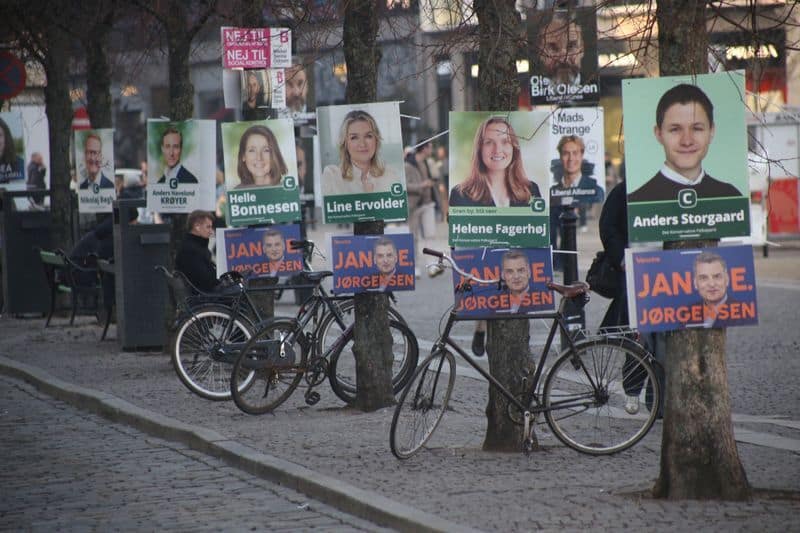
In all, 12 parties are contesting the election, with the crowded field complicating the post-election coalition landscape. Additionally, four seats allocated to candidates from Greenland and the Faroe Islands may prove decisive.
(Reporting by Stine Jacobsen and Soren Jeppesen in Copenhagen; Editing by Alex Richardson)