By John Irish and Elizabeth Pineau
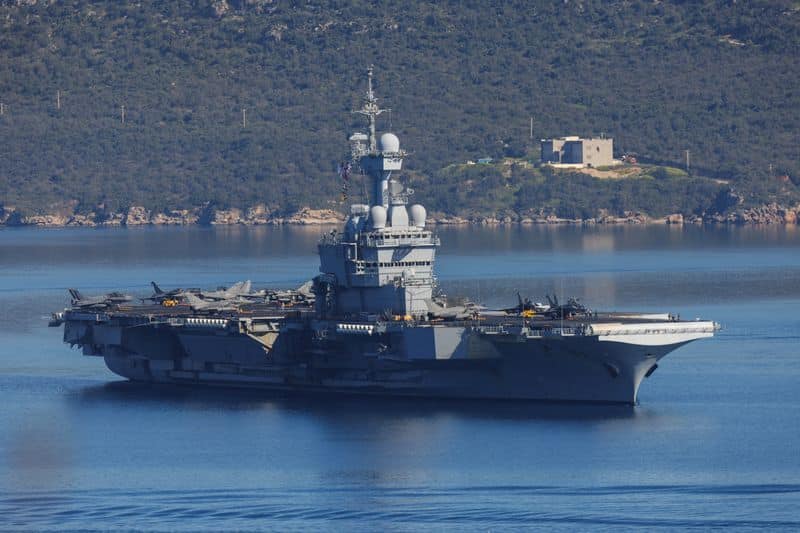
PARIS, May 6 (Reuters) - France on Wednesday deployed its carrier strike group to the Red Sea as part of planning for a potential mission to secure the Strait of Hormuz, urging Washington and Tehran to consider the proposal given the global economic impact of their competing blockades.
Fresh exchanges of fire on Monday underscored the stakes as the U.S. and Iran struggle for control of the narrow waterway, a vital artery for global energy and trade, shaking a fragile four-week-old truce and reinforcing rival maritime blockades.
“The reason why we must make a renewed effort today is simply that the blockade of Hormuz continues, the damage to the world’s economy is therefore becoming more and more pronounced, and the risk of a prolongation of hostilities is too serious for us to accept it,” a French presidency official told reporters in a briefing after the army announced the strike group’s deployment.
FRANCO-BRITISH PROPOSAL IN PLANNING
France and Britain have been working on a proposal for several weeks that aims to lay the groundwork for safe transit through the Strait once the situation stabilises or the conflict is resolved. It would need coordination with Iran and a dozen countries have indicated a willingness to take part in the mission following several preparatory meetings.
The French army said in a statement that the Charles de Gaulle aircraft carrier group, which is accompanied by an Italian and Dutch warship, was en route to the southern Red Sea.
The deployment aims to assess the regional operational environment, expand crisis‑management options to strengthen security, enable the integration of partner countries’ assets within a defensive framework consistent with international law, and help reassure maritime trade stakeholders, the military said.
“What we are proposing is that Iran gains passage for its ships through the Strait and in return commits to negotiating with the Americans on issues of nuclear materials, missiles, and the region, and we propose that the Americans, for their part, lift their blockade of the Strait of Hormuz and, in return, obtain Iran’s commitment to negotiations,” the French presidency official said.
“Under these conditions we could deploy the multinational force to secure the convoys crossing the Strait of Hormuz and this obviously requires that the Iranians not fire on the ships.”
HORMUZ IS IRANIAN LEVERAGE
It was not clear why Iran would consider such a proposal given its control over the Strait has been a key element of leverage in its discussions with Washington to end the war.
“We collectively want to send the signal that not only are we ready to secure the Strait of Hormuz, but that we are also capable of doing so,” the French official said.
“The question now will be to obtain Iranian consent, American consent.”
European states have been largely onlookers in the conflict between the U.S., Israel and Iran, but with shipping lanes in the Middle East impacted and the price of oil fluctuating around $100 a barrel, European powers are grappling with the issue of how to defend their interests.
Their refusal to support U.S. President Donald Trump’s blockade has drawn sharp criticism from Trump against countries he accused of failing to align with U.S.-led efforts and the move to send assets to the region may be a way to assuage those concerns.
(Reporting by John Irish;Editing by Sudip Kar-Gupta and Keith Weir)