BUCHAREST, May 13 (Reuters) - Russia’s repeated airspace violations of countries on the eastern flank of NATO underline the urgent need to consolidate the alliance’s air defences against missiles and drones, the leaders of 14 allies said on Wednesday.
They also called for greater cooperation in building up defence industry capacity in a joint statement, issued after a meeting of eastern flank allies in Bucharest hosted by Romania’s President Nicusor Dan and Polish President Karol Nawrocki.
“We condemn Russia’s highly confrontational actions against Allies and partners, including sabotage, cyberattacks, and a wide range of hybrid attacks and destabilising activities,” the leaders’ joint statement said.
“Repeated airspace violations on the Eastern Flank underscore the urgent need to continue strengthening NATO’s air and missile defence, including against unmanned aerial vehicle threats.”
Romania, Poland and Baltic states have had their airspace repeatedly breached by Russian drones. Russia has denied targeting NATO states.
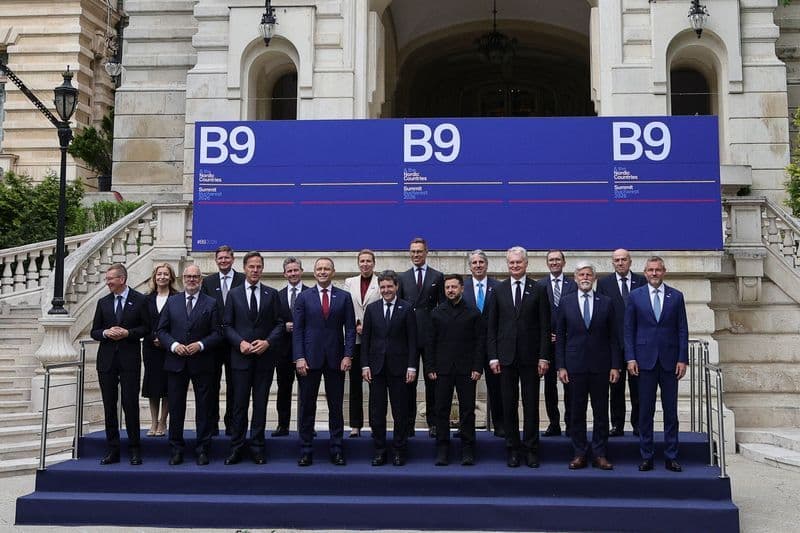
Ukraine’s President Volodymyr Zelenskiy, NATO Secretary General Mark Rutte and U.S. Under Secretary for Arms Control and International Security Thomas DiNanno were among those attending Wednesday’s one-day gathering.
BRIDGING TRANSATLANTIC DIVIDE
The meeting, which comes ahead of a NATO summit in Ankara in July, aims to find ways to mend a widening rift between U.S. President Donald Trump and Europe over the Iran crisis.
“Further scaling up the transatlantic defence industrial base, including through increased production capacity, more resilient supply chains, effective multinational procurement … is essential to meeting today’s security challenges,” the joint statement said.
It was signed by the so-called “B9” grouping, comprising nine central and eastern European NATO allies, launched in Bucharest after Russia annexed Crimea from Ukraine in 2014. They are Bulgaria, the Czech Republic, Estonia, Hungary, Latvia, Lithuania, Poland, Romania and Slovakia.
Wednesday’s statement was also signed by the five Nordic members of NATO - Denmark, Finland, Iceland, Norway and Sweden.
Zelenskiy told the gathering it was difficult to say what results the NATO summit in Ankara might bring but that it should send positive signals to the whole Euro-Atlantic community.
“At the same time, we should not be afraid to discuss more united and, in some areas, more self-reliant European military capabilities,” said Zelenskiy.
Ukraine is not a NATO member but it has received substantial military and financial support from the 32-nation alliance as it seeks to rebuff a full-scale Russian invasion that began in February 2022.
(Reporting by Luiza IlieEditing by Gareth Jones)