BRUSSELS, June 18 (Reuters) - Several EU leaders said on Thursday there was no point in rushing into talks with Russia after an EU official said on Wednesday the office of European Council President Antonio Costa had made “brief contacts at diplomatic level” with the Kremlin.
European leaders have recently stepped up discussions about the possibility of direct talks with Russia over the war in Ukraine after isolating Moscow diplomatically since it attacked Ukraine in February 2022. But there is no joint view.
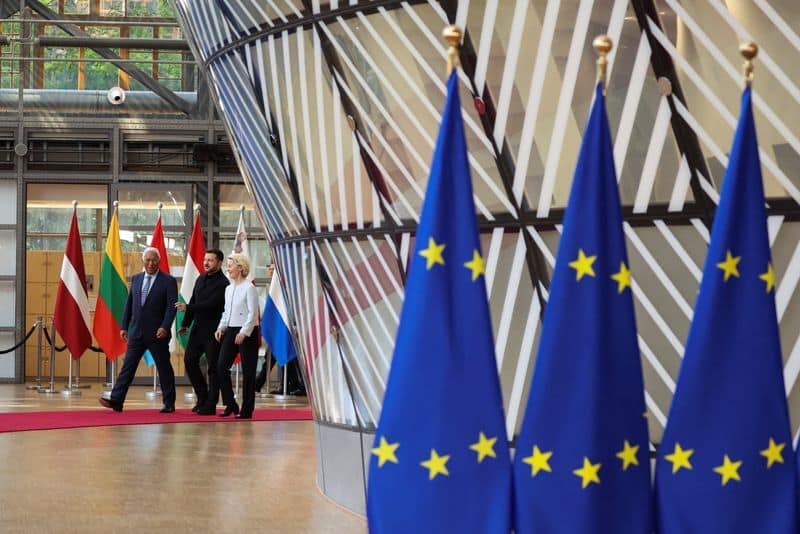
“First of all, there has to be someone on the other side willing for peace,” Latvian Prime Minister Andris Kulbergs said as he arrived at a European Union summit in Brussels. “Unfortunately no one wants peace on that side … there is no point for contact if the other party (Russia) doesn’t want (peace).”
“It is much better to step in if we see some positive signals from Russia, showing that Russia is willing to start the peace negotiations, or they are willing for a ceasefire,” Lithuania’s President Gitanas Nauseda told reporters. “So far I do not see any positive signals from Russia, so my question is what we want to achieve.”
Dutch Prime Minister Rob Jetten also said Russia was not showing any willingness to negotiate and said he did not believe peace talks could start soon.
“We do not have that impression at all from the Netherlands. We see that the Russians have not shown any serious interest recently,” Jetten said.
One EU official, speaking on condition of anonymity, said on Wednesday that the brief contacts made by the office of Antonio Costa were meant “to open communication channels” and “nothing was discussed on substance.”
Some, however, were in favour of engaging with Moscow.
Austrian Chancellor Christian Stocker said he wanted channels of communication open, no matter the level. But even he was skeptical about Moscow’s willingness to discuss peace.
“I do not have the impression that Russia, and Russia’s President Putin in particular, is coming to the negotiating table in order to negotiate a peace solution,” Stocker said.
Earlier this week, Italian Prime Minister Giorgia Meloni called for a single EU envoy to handle contacts with Russia over Ukraine.
Meanwhile, Ukrainian President Volodymyr Zelenskiy, speaking to reporters before meeting EU leaders at the summit, focused on welcoming the opening of the first phase of EU membership talks on Monday, a key step in Kyiv’s efforts to anchor itself in Western political structures as it fights Russia’s invasion.
(Reporting by Ingrid Melander, Charlotte Van Campenhout, Makini Brice; Writing by Ingrid Melander; Editing by Jan Strupczewski)