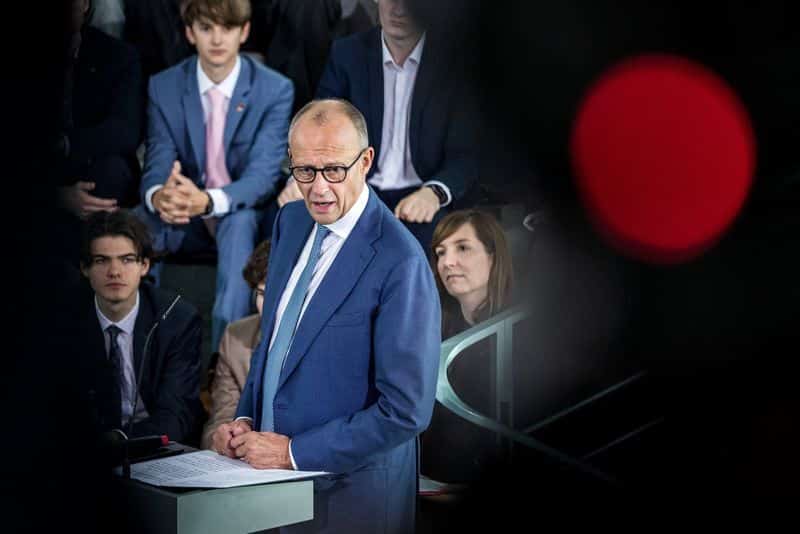
BERLIN, Sept 15 (Reuters) - Germany’s governing conservatives have called a special meeting for Sunday, where senior party figures are expected to discuss recent electoral setbacks and rally behind embattled Chancellor Friedrich Merz, a party source said on Tuesday.
Merz is under growing internal criticism following his Christian Democrats’ (CDU) poor performance this month in Saxony-Anhalt, where the far-right Alternative for Germany (AfD) came close to securing an outright majority in a state election.
PRESSURE ON MERZ INTENSIFIES
At the national level, the CDU and its Bavarian sister party, the CSU, are polling at between 18% and 20%, far below their result in last year’s federal election and significantly behind the AfD.
Confidence in the chancellor has also weakened within his own party. A weekend INSA poll found that a majority of CDU supporters no longer believe Merz is the right person for the job, while 78% of the wider public said the same.
According to the source, the aim of Sunday’s meeting is to coordinate the party’s response to two further votes taking place on Sunday in the states of Mecklenburg-Western Pomerania and Berlin, chart a course amid record low support - and demonstrate unity behind Merz’s leadership.
CLOSELY WATCHED ELECTIONS
After the setback in Saxony-Anhalt, some CDU critics have said another poor performance this weekend could intensify pressure on Merz.
Speaking at an event with business leaders on Tuesday, Merz said he was determined to serve out his full four-year term and pursue more reforms with his coalition partner, the centre-left SPD, to solve Germany’s problems.
“We have to prove that this can be achieved with this coalition,” said Merz, adding that he did not want to resort to a vote of confidence to push through his agenda.
The CDU is currently polling at 7% in Mecklenburg-Western Pomerania. In Berlin, it is tied for the lead with the Left party at 20%.
Merz has rejected attempts to tie his political future to individual state election results, arguing that Germany needs stability to push through an ambitious reform agenda and navigate European challenges including acts of hybrid warfare and support for Ukraine.
He has said there are no obvious alternative leaders or policies.
(Reporting by Andreas Rinke, Writing by Friederike Heine; Editing by Ros Russell)