By Maya Gebeily and Raghed Waked
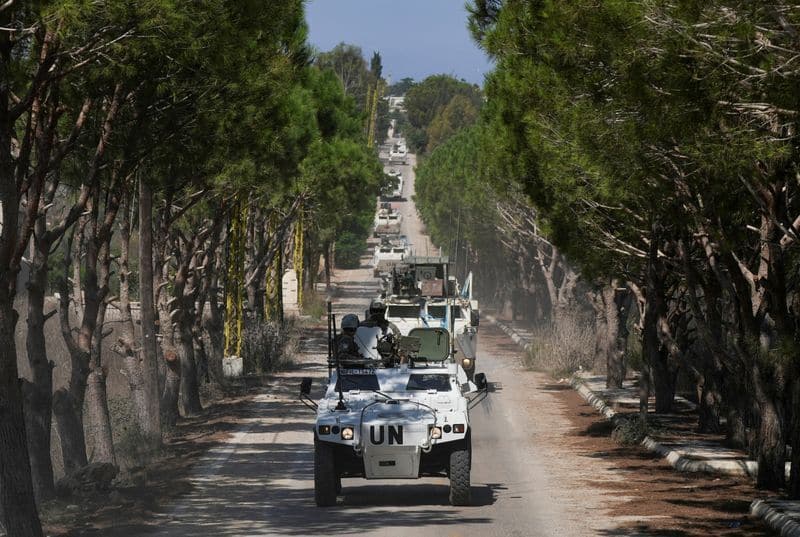
RMEICH, Lebanon, Sept 16 (Reuters) - Kicking up a column of dust, the United Nations peacekeeping vehicles were the only cars on the road as they passed bombed-out buildings on their way to Christian towns deep in southern Lebanon’s Israeli-occupied zone.
More than six months of Israeli bombardment and demolition, triggered by a Hezbollah rocket attack in early March, have left villages abandoned and residents forcibly displaced across swathes of land. Shrubs encroach on minarets and rusting metal gates mark where homes once stood.
Entry from the rest of Lebanon is controlled from newly established Israeli checkpoints. Beyond one, Israeli Merkava tanks were stationed halfway along the desolate road.
Reuters reporters embedded with French peacekeepers from U.N. force UNIFIL for rare access to the area and to Rmeich, one of three predominantly Christian towns whose residents stayed put as Israel’s military established a self-declared “security zone” in southern Lebanon.
Since Israel seized the zone, UNIFIL troops have been escorting convoys of food and other goods to the Christian towns. But nearly five decades after it was established, the U.N. force’s mandate will conclude at the end of the year — leaving residents of Rmeich fearful that their link with the rest of Lebanon will be severed.
“What’s going to happen to us? What’s going to happen to these shop owners and these merchants? If they want to bring goods from Beirut here, how are those goods going to arrive?” said George Ibrahim, a 45-year-old schoolteacher from Rmeich, where roughly 6,000 people still live.
It is the largest concentration of people in the Israeli-occupied zone, where Israeli bombing has destroyed predominantly Shi’ite Muslim villages from which Hezbollah, an Iran-backed Lebanese armed group, has historically drawn support.
“We consider ourselves to be living in a large prison, isolated,” Ibrahim told Reuters. “Without UNIFIL, I don’t know what the future is.”
GOODS IN CHRISTIAN TOWN START TO RUN LOW
In response to a request for comment, an Israeli military official said they did not consider UNIFIL’s role vital to humanitarian efforts and that Israel was working “to make things easier for the population”.
UNIFIL was established in 1978, days after Israel invaded southern Lebanon in response to attacks by Palestinian militants. Initially set up for six months to confirm Israel’s withdrawal, its mandate was repeatedly renewed, including after Israeli troops eventually withdrew in 2000.
Following a month-long war in 2006 between Israel and Hezbollah, its role was expanded to monitoring a new ceasefire across the Lebanese-Israeli border and ensuring humanitarian access for civilians.
It set up a hotline to defuse tension between the Lebanese and Israeli armies, which formally remained at war, and helped a U.N. cartographer in Lebanon map out the Blue Line, the de facto border between the two countries after 2000.
More than 300 peacekeepers have been killed in Lebanon, including seven in this year’s war, which has killed more than 4,300 people in Lebanon and left 300,000 still displaced.
The force has become part of the landscape. Near Rmeich’s church, boys playing football asked peacekeepers if they could jump inside their vehicles.
“Civilians need support from UNIFIL, and that’s what we are providing,” said Captain Julien, who heads a French reconnaissance company within UNIFIL, and asked to withhold his last name in line with security guidelines.
“What will happen after? I don’t know, but I hope that we find another way for the civilians to get through the Israeli lines and to live peacefully,” he said, adding that a security escort was needed to cross the many Israeli checkpoints in the occupied zone.
Last week, convoys of aid and goods carried by local traders and destined for Rmeich were canceled at the 11th hour without an established reason, including the one Reuters was meant to accompany.
Though UNIFIL made at least two trips into the Israeli zone, they did not escort supplies, and residents in Rmeich said stocks of fresh produce and fuel were beginning to run low.
Fruit and vegetable shops in the town center were closed. Others carried only non-perishables on half-filled shelves. A young man with a falafel shop used the last of his tomatoes for a sandwich, as booms from Israeli military activity elsewhere in the south echoed through Rmeich.
The Israeli military official said Israel was in the “security zone” to clear the area of Hezbollah, and did not want to stay in the long term or intend to establish permanent bases.
CONFLICT MONITORING ROLE
More than half of UNIFIL’s nearly 50 bases now lie within Israeli-occupied territory, including its headquarters at Naqoura, only accessible by crossing two Israeli military checkpoints.
If no extension is granted, UNIFIL will begin gradually closing its bases starting January 1, with more than 7,500 peacekeepers from nearly 50 countries leaving and handing positions to Lebanese troops.
As Israeli strikes on the south intensified, bases there became safe havens for Lebanese contractors providing services for them. Several told Reuters that UNIFIL’s withdrawal would leave them jobless and homeless.
With access to southern Lebanon restricted by Israel’s occupation, people close to the mission warn that the mission’s departure could also put an end to the “world’s eyes and ears” in the south.
During periods of war across the Blue Line, UNIFIL has monitored exchanges of fire and violations of international law.
“UNIFIL are the custodians of the Blue Line,” a senior U.N. official told Reuters on condition of anonymity. ”They have documents spanning decades, including minutes of meetings, cartographic works, measurements — there are questions about what happens to those records and to the Blue Line at such a sensitive time.”
This year, the force facilitated access to Israeli-occupied parts of southern Lebanon for U.N. staff investigating possible war crimes. Such access will likely become extremely rare, if not impossible, without a U.N. presence, two people familiar with the mission said.
Prime Minister Benjamin Netanyahu’s office did not immediately respond to a request for comment on UNIFIL’s looming withdrawal and Israel’s view of the Blue Line.
SCRAMBLE TO EXTEND MISSION
After U.S.-brokered talks, Lebanon and Israel agreed in June to a plan that would see Israeli troops gradually withdraw as Lebanese troops disarm Hezbollah and take control of southern Lebanon. But Hezbollah has refused to disarm in full while Israeli troops occupy Lebanese territory, and the plan has stalled.
Now, a last-minute scramble is underway to keep UNIFIL troops in Lebanon past the end of this year. Two-thirds of Lebanon’s parliament signed a petition last month to extend its mandate and Lebanese President Joseph Aoun said an extension was Lebanon’s “first choice.”
Diplomats privately describe an extension as unlikely. In June, U.N. Secretary-General Antonio Guterres outlined several options for a uniformed U.N. presence in Lebanon but the Security Council has yet to take action.
“We have a plan for withdrawal, and this will involve handing back positions to the Lebanese Armed Forces,” said UNIFIL spokesperson Kandice Ardiel.
“Of course, we will be looking at these in great detail given the situation at the time. We can’t speculate what the situation will be then, but the bottom line is we will have to hand these positions back.”
The U.S. and Israel last year both welcomed the U.N. Security Council’s decision to only renew UNIFIL’s mandate one final time. Israel said a gradual withdrawal was the “correct decision” after UNIFIL had failed to prevent Hezbollah’s military build-up in south Lebanon.
As the mission readies to draw down, residents of Rmeich see their prospects as bleak.
Najib Amil, a Catholic priest in the town who remembers when UNIFIL troops first deployed nearly 50 years ago, said that with their connection to the rest of the country increasingly shaky, locals feared being seen as “collaborators” by other Lebanese.
“Will Israel leave us here or kick us out? And if they let us stay, how are we going to be? Administratively, will we be with (Israel), or with Lebanon?” he said.
(Reporting by Maya Gebeily and Raghed Waked; Additional reporting by Maayan Lubell; Editing by Aidan Lewis)