By Maayan Lubell
JERUSALEM, Sept 29 (Reuters) - Prime Minister Benjamin Netanyahu is using the same campaign playbook that has served him for decades as he tries to retain power in an election next month, presenting himself as the only person who can keep Israelis safe in a hostile region.
But four weeks before the election, he is struggling to salvage his security credentials, shattered by Hamas’ surprise attack on southern Israel on his watch on October 7, 2023 — one of the country’s worst security breaches.
The October 27 election is Israel’s first since its single deadliest day and the worst attack on Jews since the Holocaust, masterminded by a Palestinian militant group that caught the Middle East’s most powerful military off guard.
“Netanyahu does not surrender” is the official slogan for Netanyahu’s right-wing Likud party, which most opinion polls predict will lose around a third of its parliamentary seats.
In speeches and short campaign videos, Netanyahu portrays his political rivals as weak leftists who lack the resolve to wage war on Israel’s enemies and the backbone to stand up to its critics abroad.
But whether Netanyahu, who turns 77 days before the election, can still present himself as best equipped to navigate Israel on matters of national security and diplomacy is a big question, said Yohanan Plesner, President of the non-partisan Israel Democracy Institute (IDI).
In recent weeks, Netanyahu has been forced to deny media reports that his Middle East partners warned him of a potential Hamas attack, allegations seized on by his political rivals.
“This is a new thing. Mr Netanyahu ran in elections, but never after overseeing such a dramatic security failure,” said Plesner.
“It’s in many ways a referendum on the incumbent, his responsibility for the failure, the government’s responsibility and the way they carried out the Israeli response.”
NETANYAHU TAKES ON THE WORLD
Hamas’ assault precipitated a multi-front war in which Israel’s military had some success against the Palestinian group and its allies Hezbollah and Iran, but made few strategic gains. Netanyahu says the conflict has, and still will, transform the region.
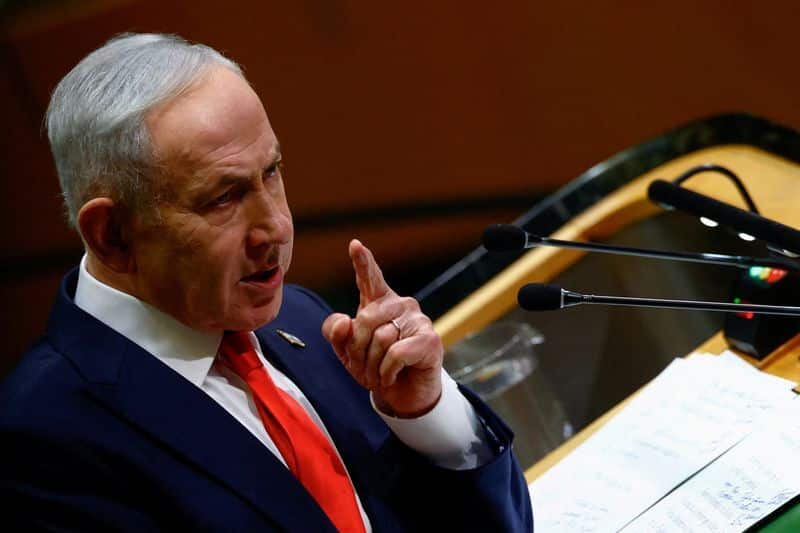
But Israel’s conduct in the war in Gaza, with tens of thousands of Palestinians killed and much of the enclave in ruins, has led to deeper diplomatic isolation. Dozens of delegates at the United Nations walked out of the hall when he began his speech to the General Assembly meeting of world leaders last week.
Support for Israel has fallen even in its most important ally, the United States.
Netanyahu’s last campaign in 2019 featured Donald Trump shaking hands with Netanyahu on election billboards. This time, the US president’s image has been absent from Likud’s campaign videos.
Nonetheless, Israel’s longest-serving leader - first elected prime minister in 1996 - has not strayed from campaign tactics that have kept him in power almost consecutively since 2009.
A source close to Netanyahu said the prime minister approaches all elections as though he is going to lose - and that this was one of the reasons he has often won, even when the odds were against him.
Another source briefed on his campaign said Netanyahu’s team appears focused, showing no sign of panic or disarray despite the opinion polls.
Netanyahu’s address at the UN in which he mounted a forceful defence of Israel’s actions in the region and berated critics, featured heavily on his Telegram channel, a platform largely used for political messaging.
He posted six teasers before the address, with one video saying he was “proud to represent you to the world, about to get on (podium) to fight for Israel against the UN,” and five excerpts of his speech.
The link to the full address was captioned in Hebrew: “Netanyahu takes on the world.”
ENDGAME STALEMATE?
Another familiar theme in Netanyahu’s campaign has stoked fear among parties representing Israel’s Arab minority by warning if his political rivals win the election, they will form a government with Arab factions that will be too soft on the Palestinians and compromise security.
Netanyahu’s main rival is Gadi Eisenkot, a hawkish former military chief who lost his son serving in Gaza and heads a new centrist party, Yashar, which is Hebrew for “straight” or “honest”.
Since Saturday alone, Eisenkot has featured in four Likud posts, including AI-generated images, portraying him with Arab party leaders.
“There is no straight. Yashar is a bluff. There’s either left or right. That is the essence of this election. Do you want a Palestinian state? (or) do you want a Jewish state?” Netanyahu said in a campaign video from September 18.
But Netanyahu’s use of familiar tactics against Eisenkot might be a long shot, said Amotz Asa-El, political analyst at Shalom Hartman Institute, given Eisenkot’s security background and centre-right party candidates.
Though election polls have often been inaccurate, Netanyahu knows he is unlikely to command a parliamentary majority allowing him to form Israel’s next government.
“It seems that Netanyahu’s strategy is to simply win enough to prevent the emergence of an alternative government and emerge with some kind of a stalemate that will leave him as an interim prime minister en route to another election,” said Asa-El.
(Editing by Rami Ayyub and Timothy Heritage)