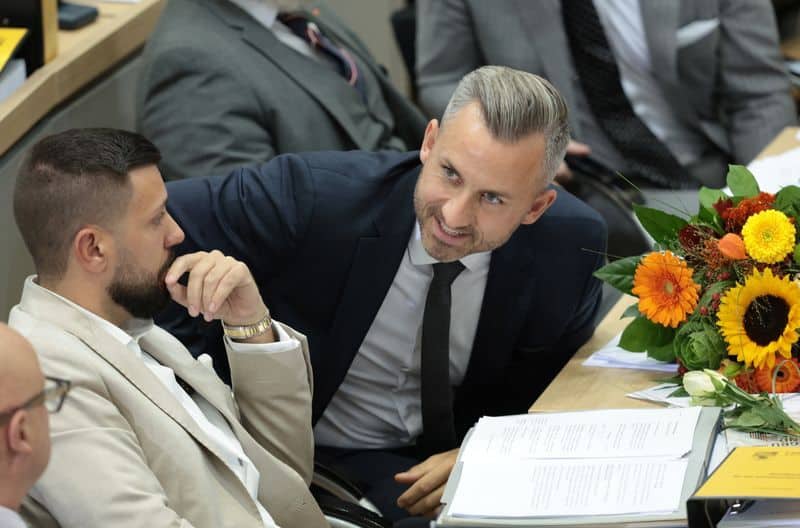
BERLIN, Oct 7 (Reuters) - Germany’s far-right Alternative for Germany (AfD) will launch a joint motion with the small far-left BSW party in a regional parliament calling for an end to military support for Ukraine, an AfD spokesperson said on Wednesday.
The motion, to be debated in the state parliament of Saxony-Anhalt next week, will have no immediate impact on Germany’s foreign policy, which is exclusively the responsibility of the federal government in Berlin.
But it underscores the AfD’s strong push for an end to German support for Ukraine and a restoration of ties with Russia, which have been largely severed since Russian forces launched a full-scale invasion of Ukraine in February 2022.
“This motion symbolises the desire for change,” Ulrich Siegmund, the AfD leader in Saxony-Anhalt, said in a statement.
Siegmund led the anti-immigration AfD to its best-ever election result last month, topping the state election in Saxony-Anhalt but falling just short of the majority he would need to form the first-ever AfD government.
He has since been exploring potential cooperation arrangements with the BSW, which like the AfD has long opposed German support for Ukraine.
Siegmund said the party would use every opportunity to press the government of Chancellor Friedrich Merz “to finally campaign for an end to the war rather than its prolongation” and to use the money spent in Ukraine “for the people in our country”.
In a message on the social media platform X, BSW founder Sahra Wagenknecht said Germany needed “a federal government that finally makes an effort to resume dialogue with Moscow”.
The motion comes some two weeks after German Foreign Minister Johann Wadephul spoke to his Russian counterpart Sergei Lavrov on the margins of the United Nations General Assembly in New York at a meeting that yielded no sign of any progress.
Lavrov was dismissive about the meeting in a press conference afterwards. Germany’s Foreign Ministry said the meeting had reinforced Berlin’s conviction that Moscow remains unwilling to negotiate either a ceasefire or an end to the war in Ukraine.
Merz visited Kyiv at the weekend to reaffirm Berlin’s support for Ukraine, while German authorities have accused Russia of carrying out a series of hybrid and drone attacks in Germany, something that Moscow denies.
(Reporting by James MackenzieEditing by Gareth Jones)