By Yuliia Dysa
KYIV/LONDON, Oct 8 (Reuters) - Trapped and facing starvation, residents of the Russian-occupied town of Oleshky in southern Ukraine risk their lives to travel for hours by foot and bicycle along mine-strewn roads to get food and water.
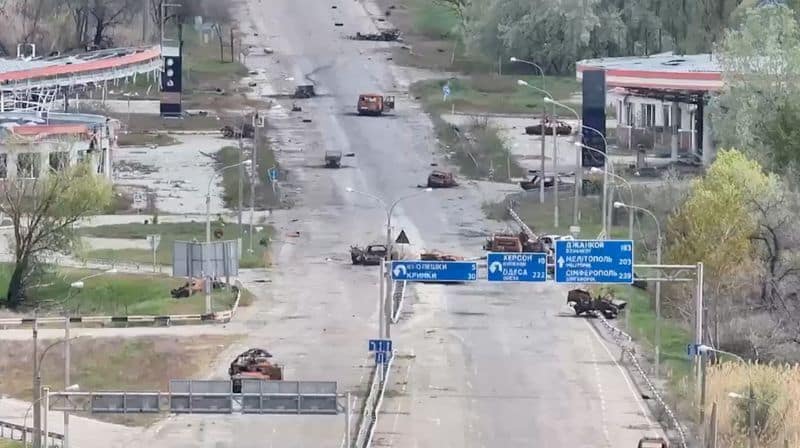
The main route out of the town, lying near the front line east of the Dnipro River, heads deeper into Russian-controlled areas. It is littered with burned-out cars and charred by blasts, according to witnesses, relatives, humanitarian groups and video footage verified by Reuters. Attack drones prowl overhead.
Residents say the last food deliveries to a local store took place in May.
“What on earth could possibly be left in your house when you haven’t been to the shop for half a year?” a woman living in the town told Reuters, asking not to be identified for fear of reprisals from Russian occupying forces.
She had recently attempted the trip to Radensk, some 20 km (12.5 miles) to the southeast. On her way back, she was injured by a landmine.
“There is no safe way out,” she said afterwards, adding that a few days earlier three people had been killed on the same route, which some locals call “the road of death”.
Reuters was not able to verify the woman’s account independently, although it chimes with those from other witnesses, officials and aid workers familiar with the humanitarian crisis in Oleshky.
That people are even attempting these journeys points to growing desperation.
“The choice Russia forces on civilians every day: to stay — and starve to death; or to leave - and risk being blown up by a landmine,” Ukraine’s human rights ombudsman Dmytro Lubinets said.
He also said Kyiv had offered a local ceasefire and evacuation routes to residents who wanted to leave but that Russia had rejected the proposal.
Russia has acknowledged critical problems with food and medical supplies in Oleshky and said its military was working to resolve them. It blamed Ukraine for the crisis, saying it was obstructing those supplies getting to the town.
‘THEY KNOW THEY ARE DOOMED’
Oleshky in Ukraine’s Kherson region, with a pre-war population of some 24,000, is still home to around 1,700 residents, including 47 children, according to Danielle Bell, head of the UN Human Rights Monitoring Mission in Ukraine.
Drone footage from the town shared by Ukraine’s 34th Separate Marine Brigade “Borysfen” and verified by Reuters shows residential and administrative buildings ruined and abandoned after more than four years of war and Russian occupation.
There is no stable power, water or heating. Movement in and out is more dangerous than ever.
Tetiana Hasanenko, head of the local military administration sitting in the Ukraine-controlled part of the region, keeps in regular contact with Oleshky locals.
“They know they are doomed. These are terrible words to say, but they know they will die either from hunger or from strikes,” she told Reuters in late September.
Ukrainian troops do not have direct access to the town. In recent days, the Ukrainian military said it had dropped food to residents using drones. Reuters could not independently confirm those claims and some residents expressed scepticism, saying they had seen nothing.
Andrii Sybiha, Ukraine’s foreign minister, said Russia, as the aggressor state, bore “full responsibility for this humanitarian disaster.”
Russia’s defence ministry and the Russian-installed authorities in occupied Kherson did not respond to requests for comment.
FEAR OF HUNGER
Oleshky residents said food supplies became unreliable late last year, but the situation deteriorated significantly after May.
Before then, Ukrainian volunteers were able to take in food and evacuate people. Since then, people have largely lived off the land, and that is becoming untenable as winter approaches.
Larysa, a Ukrainian woman who fled Oleshky shortly after Russia’s full-scale invasion in February 2022, told Reuters in London that her husband was still there and surviving on dwindling rations.
The 72-year-old, who declined to give her full name or that of her husband out of concern for his safety, said he was living on vegetables and homemade flatbread cooked on an open fire. He was using pre-invasion flour stocks that had gone bad long ago.
“He’s been living on this for the whole summer, ever since May. There are no eggs, no dairy, no meat – there’s nothing,” his wife said. He feeds their four cats and a dog with grass mixed with whatever grain is left.
Larysa said she had “forbidden” her husband from taking the road out of Oleshky to Radensk in search of food, describing the journey as a life-and-death gamble, or “Russian roulette”.
The Ukrainian brigade footage shows dozens of burnt-out and abandoned vehicles along the route. The buildings on either side have been badly damaged.
Larysa is sure her husband hides the full extent of his difficulties when they speak briefly by phone twice a week.
As winter sets in, homegrown staples like cucumbers, courgettes and tomatoes are running out and fear of starvation grows.
“There really isn’t anything left to swap. We’ve used it all up,” the woman injured by the mine said.
The only way to boil water is over an open fire because gas cylinders are impossible to get. Medicines are out of date and she eats just once a day - a thin piece of flatbread with tomato and salt or honey.
(Reporting by Yuliia Dysa in London; Additional reporting by Dan Peleschuk and Yurii Kovalenko in Kyiv and Edward James Carron in London; Editing by Mike Collett-White and Philippa Fletcher)