By Julie Steenhuysen, Sriparna Roy and Siddhi Mahatole
Nov 17 (Reuters) - The United States lost its hard-fought measles elimination status after 26 years, the Pan American Health Organization said on Tuesday, as the country failed to curb the continuous spread of the highly contagious virus for more than a year.
Bolivia and Mexico have also lost their measles elimination status, the Americas arm of the World Health Organization said.
“While this is a significant setback, countries are already taking action to bring their outbreaks under control. Bolivia, Mexico, and the United States are implementing measures to strengthen vaccination, surveillance, and outbreak response,” PAHO Director Jarbas Barbosa said in a media briefing.
Measles elimination status is more than just a public health designation, he said. It signifies that the virus has circulated for a prolonged period, putting people at risk of preventable illness, hospitalization, and death.
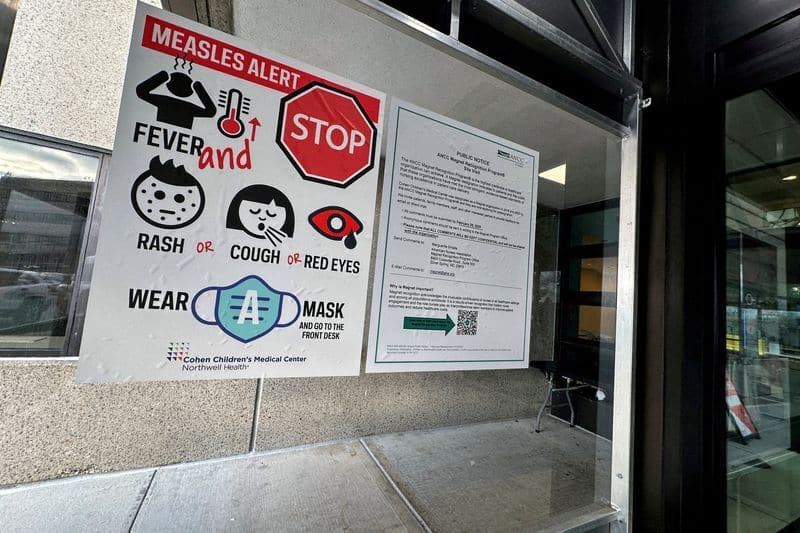
The United States is battling the highest number of measles cases it has seen in more than three decades. Some 7,700 people in the US have been infected with measles and 13 have died since 2025. The overwhelming majority of cases have been among people who were not vaccinated.
To regain its measles elimination status, PAHO officials said the US must submit a corrective action plan that outlines the strategies and measures it will implement and then prove it is free of the virus for a period of 12 months.
The US is expected to submit its plan in the coming weeks, said Dr. Daniel Salas, executive manager of PAHO’s Special Program for Comprehensive Immunization.
CASES RISE UNDER US HEALTH SECRETARY
The sharp increase in US measles cases has coincided with declining immunization rates and rising vaccine hesitancy under US Health Secretary Robert F. Kennedy Jr., who has for years spread doubts, without scientific evidence, about the safety of measles vaccines.
As of November 12, the US Centers for Disease Control and Prevention has confirmed 5,412 measles cases and 6 deaths. So far this year, states have reported a total of 10 deaths from the highly contagious virus.
The CDC in a statement on its website said it was committed to stopping measles outbreaks to protect Americans and plans to work to regain the elimination status, including by equipping states with the tools they need and providing sustained national leadership.
“The measles elimination designation is not what protects Americans, vaccination does,” CDC Director Erica Schwartz said in a statement.
Pennsylvania has been the hardest-hit US state, with seven measles-related deaths. Wisconsin has reported two deaths, while New York state recorded its first measles-associated death in more than 30 years, involving a child.
“For most people, losing measles elimination status may seem like something that doesn’t affect them. But if you’re a parent of a baby under a year old, your life is going to change,” said Daniel Jernigan, former director of the CDC’s National Center for Emerging and Zoonotic Infectious Diseases.
“You’ll need to be more cautious of being in crowds or traveling on a plane to grandparents since the risk of your baby coming in contact with someone with measles will be getting increasingly higher.”
(Reporting by Sriparna Roy, Siddhi Mahatole in Bengaluru, and Julie Steenhuysen in Chicago, Editing by Franklin Paul and Bill Berkrot)