By Andrew MacAskill, Kate Holton and Alistair Smout
LONDON, March 4 (Reuters) - Britain’s cautious response to the escalating conflict in the Middle East and its hesitancy in defending its allies from attack have renewed doubts among partners about its military effectiveness when the U.S. is demanding widespread rearmament.
Trump lashed out at Prime Minister Keir Starmer on Tuesday, suggesting he had helped to “ruin” the countries’ historically close relationship after London blocked the U.S.’s use of British bases to launch pre-emptive strikes on Iran.
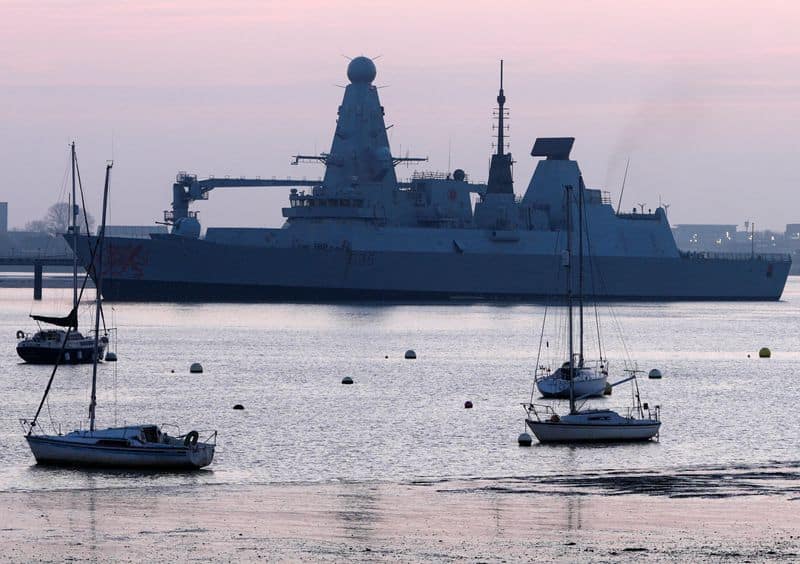
Cypriot officials have also criticised London after an Iranian-made drone hit one of Britain’s military bases on the island, prompting France, Greece and others to send support. A British destroyer is not expected to sail until next week, and will likely take around a week to get to the region.
BRITISH MILITARY HAS FACED YEARS OF CUTS
Starmer has defended his actions, saying British personnel would only get involved in military action that was legal and well planned. British jets have since brought down Iranian drones, Britain has resupplied allies’ air defence systems and its bases are now being used by the U.S. for defensive operations.
But the initial response has sparked alarm about the state of Britain’s military preparedness after years of cuts.
Simon Diggins, a former British defence attaché who worked with U.S. troops in Afghanistan, said if he had to summarise the situation he would say: “The Brits are not serious”.
He said Trump was “vulgar, brash, rude, and undiplomatic” but Britain had made itself “operationally and strategically” irrelevant, despite its nuclear weapons and advanced fighter jets such as F-35s.
BRITAIN STRUGGLES TO SET OUT HIGHER DEFENCE SPENDING
The latest spat follows months of growing tensions between Washington and its traditional allies.
But the shrinking of Britain’s armed forces has undermined London’s efforts to be seen as the U.S.’s most reliable military partner in Europe, when mounting geopolitical tensions mean Britain is facing requests to bolster positions in Ukraine, in the Arctic, and now in the Middle East.
With a little over 70,000 full-time trained soldiers, Britain’s army is its smallest since the Napoleonic wars.
According to the International Institute for Strategic Studies think-tank, Britain has fallen behind the rearmament of other European countries with gaps in armoured vehicles, ships and ground-based air defence systems.
Starmer, who has blamed previous Conservative governments for a lack of military investment, plans to spend 2.5% of GDP on defence by 2027 and aims for 3% after 2029.
But his government has delayed the release of its defence investment plan for the next decade.
Trump has said that Germany and France are now challenging Britain as Washington’s most valued partners in Europe.
LACK OF PREPAREDNESS
Starmer’s caution is explained in part by the spectre of the Iraq war, when previous Labour Prime Minister Tony Blair’s decision to join the 2003 U.S.-led invasion proved deeply divisive in the country.
Analysts also said that, while Britain could defend its hesitancy on the use of its bases due to legal concerns, the lack of military preparation while the U.S. amassed warships and fighter jets in the region was a strategic failure.
Tom Sharpe, who commanded four British warships during a 27-year naval career, said the failure to have a warship in the region was one of the worst British military decisions he had seen.
“You have the wafer-thinness of our forces and that increases the imperative to make good operational decisions and we can’t seem to do that either,” he said.
That lack of readiness has been brought home by the drone attack on the British Royal Air Force’s Akrotiri base in Cyprus.
Cypriot officials told Reuters they were infuriated that Starmer had not stated publicly that the U.S. would not use Akrotiri, shortly before it was hit by a drone thought to have come from Hezbollah.
TRUMP’S OUTBURST MAY NOT ALTER CO-OPERATION
Former diplomats, a current official and analysts said although Trump was clearly angry with Britain, they did not see his latest outburst - when he said Starmer was “no Winston Churchill” - as a fundamental shift in policy.
Michael Martins, who worked at London’s U.S. embassy in Trump’s first term, said he did not expect the two countries to “decouple meaningfully” when they work closely on intelligence.
A U.S. official said he saw the criticism as “a moment, not a shift”, and Starmer himself said the U.S.-British “special relationship” was reflected in their deep levels of cooperation, not in the latest words of the president.
But the widening conflict in the Middle East means it is not just the U.S. which is looking for Britain to do more.
Bader Al-Saif, an associate fellow at Chatham House based in Kuwait, said European countries needed to show they could support their Gulf allies when needed.
“I’m not saying that they should join the war effort, but I think they have vested partners in the region, including the Gulf states, which they can offer support to,” he said.
(Additional reporting by Michele Kambas in Nicosia and Michael Holden in London; Editing by Alex Richardson)