By Chantha Lach
PHNOM PENH, April 3 (Reuters) - Cambodia’s parliament on Friday passed the first law dedicated to targeting scam centres accused of bilking international victims out of billions of dollars, as pressure mounts on governments to tackle the illicit businesses.
Justice Minister Keut Rith said the law aimed to enhance the “cleaning operation” taking place across the country, as well as to ensure the centres do not return after the crackdown.
“This law is strict like the fishing net, strict to ensure we don’t have the online scams anymore in Cambodia, strict in order to serve the interest of the Cambodian nation and people,” he told reporters, adding the problem had also impacted the economy, tourism and investment.
The new law will eventually go to Cambodia’s king for final signature.
It lays out punishments of two to five years in prison and fines of up to $125,000 for those convicted of online scams.
Sentences for those convicted of scams conducted by gangs or against many victims can be up to 10 years in prison and as much as $250,000 in fines. It also outlines penalties for those convicted of money laundering, gathering victims’ data, or recruiting scammers.
Cambodia has not previously had legislation specifically targeting scams, though suspects have been charged with offences like recruitment for exploitation, aggravated fraud and money laundering.
The moves come after widespread condemnation from rights groups, and sanctions and indictments by governments around the world, with Cambodia among the countries accused of being hotbeds of cyber scams.
On Thursday Britain sanctioned the operators of what it described as the largest fraud complex in Cambodia and an online crypto marketplace used to trade stolen personal data, part of what it called a fast-growing network of scam centres in Southeast Asia where workers are confined in guarded compounds and forced to commit online fraud.
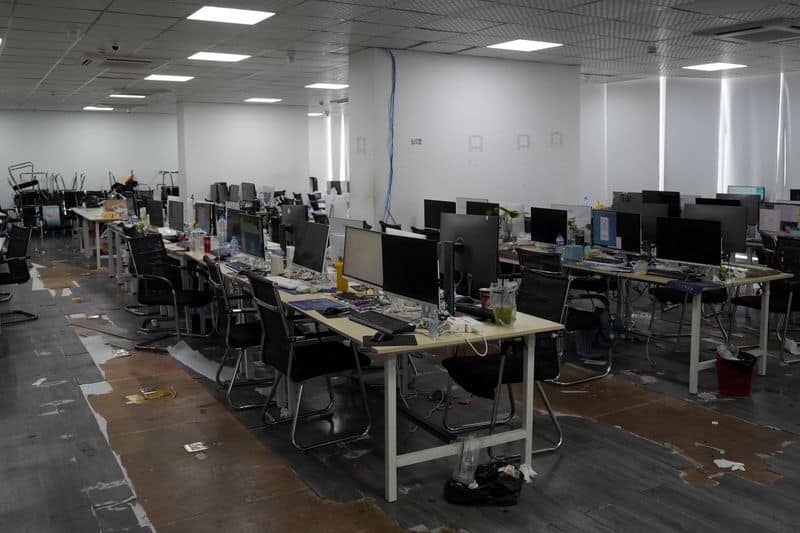
The Cambodian government long played down the existence of scam compounds, and previous crackdowns have done little to stop their spread. Officials say the latest campaign is broader in scope, with a focus on closing hundreds of sites and detaining senior figures.
On Wednesday Cambodia said it had extradited Li Xiong, a former leader at a Cambodian financial conglomerate accused of laundering money for crime organisations, to China.
In January Chinese-Cambodian businessman Chen Zhi was arrested in Cambodia and also extradited to China, marking a stunning fall for a young tycoon accused of running a brutal online scam and money laundering operation.
(Reporting by Chantha Lach; Writing by Josh Smith; Editing by Martin Petty)