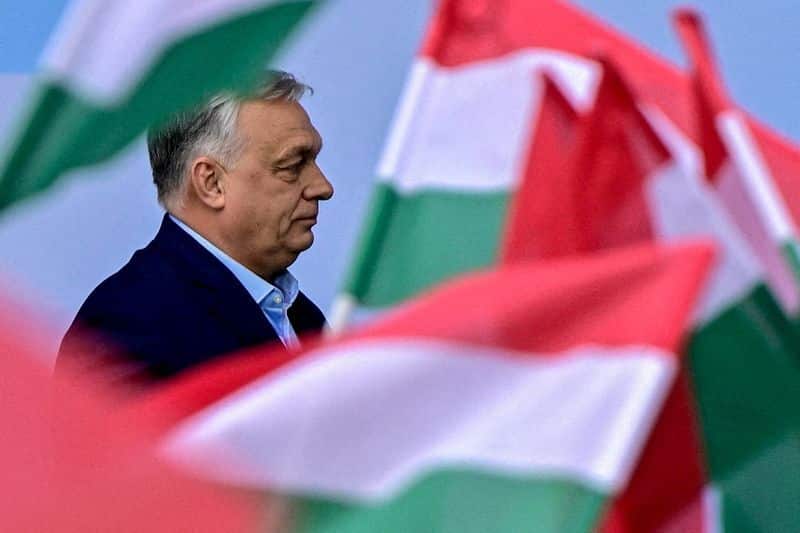
BUDAPEST, April 10 (Reuters) - Hungarian Prime Minister Viktor Orban and his Fidesz party face their first closely contested election on April 12 after four consecutive landslide victories since 2010.
During his 16-year rule Orban has faced international criticism over issues including democratic standards, media freedom and LGBTQ rights.
Following is an overview of his top policies.
CHECKS AND BALANCES, FREEDOMS
Armed with a two-thirds majority, Orban passed a new constitution in 2011 and changed hundreds of laws.
During its first term, Fidesz made hundreds of judges retire under laws that the EU said violated its rules. Hungary’s Constitutional Court later annulled parts of that legislation.
Critics say new electoral rules have helped cement Fidesz’s power by favouring large parties, redrawing electoral districts and granting the right to vote to ethnic Hungarians across central Europe, most of whom tend to support Orban.
Orban loyalists also hold top posts in key institutions.
Since 2022, he has frequently governed by decree, empowered by a state of emergency declared after Russia invaded neighbouring Ukraine.
His government has cracked down on some non-governmental organisations and tightened controls over academic institutions. As a result, Open Society Foundations, founded by Hungarian-born billionaire George Soros, shut its Budapest office in 2018 and moved to Berlin while the Central European University, a leading liberal school also founded by Soros, moved to Vienna in 2019.
Orban rejects accusations of undermining democracy, saying that he received clear mandates from voters to rewrite laws.
RIGHTWING CONSERVATIVE MODEL
Orban has cast himself as a defender of Hungary’s cultural identity against Muslim immigration and as a protector of Christian values against a so-called “gender and LGBT ideology” and Western liberalism.
His government has redefined marriage as the union between one man and one woman in the constitution, and it has limited gay adoption and transgender rights.
In March 2025 parliament passed a law that created a legal basis for police to ban Pride marches, arguing that they could be harmful to children and that protecting children should supersede the right to assemble.
Hungary built a fence on its southern border after the 2015 migration crisis and imposed some of Europe’s toughest asylum rules. Rejecting immigration as a remedy for Hungary’s demographic decline, Orban has sought to boost declining birth rates through generous family tax incentives.
CONTROL OVER THE MEDIA
Orban has transformed Hungary’s media landscape, leading to accusations from the European Union and pro-democracy groups that press freedoms are being curbed, a charge his government denies.
His government tightened its grip over state media, including broadcast media, turning them into a pro-government mouthpiece, critics say.
Advertising revenues channelled to pro‑government outlets have helped foster loyal coverage in private media, while several other outlets have been shut down or taken over by owners close to the government.
EAST AND WEST
Under Orban, the EU and NATO member has pursued an “Eastern opening” to Russia and China, promoting business investments in Hungary from those countries — along with German car plants — and he has advocated Moscow’s interests within the EU.
Orban condemned Russia’s war on Ukraine that started in 2022 and criticised but supported EU sanctions against Moscow. He strongly opposes banning Russian energy shipments, however, saying that would wreck the domestic economy.
Tensions between Hungary and Ukraine have deepened over several issues including energy shipments, and Hungary has blocked a 90 billion euro European Union loan to Ukraine.
ECONOMY
Hungary repaid in 2013 all outstanding debt owed to the International Monetary Fund following a bailout during the global financial crisis, and its debt regained investment grade status three years later.
Orban’s government reined in fiscal deficits and public debt until the coronavirus pandemic reversed the trend. Late last year, the government raised its budget deficit targets to 5% for 2025 and 2026 as well to make way for pre-election spending.
Europe’s highest tax on banks, a nationalisation of some private pension funds and a tax on telecoms, energy and retail companies - mostly foreign-owned - helped bolster government finances but also led to clashes with Brussels.
With businessmen and oligarchs close to Fidesz acquiring large chunks of these strategic sectors, Hungarian ownership has increased, with Orban saying earlier this year that the banking, media and energy sectors had become majority Hungarian-owned.
The economy has been stagnating for three years.
(Reporting by Krisztina Than and Anita Komuves; Editing by Hugh Lawson)