By Gram Slattery, Humeyra Pamuk, Steve Holland and Nandita Bose
WASHINGTON, April 10 (Reuters) - When JD Vance arrives in Islamabad for talks on Saturday with Iranian officials, it will fulfill a wish for Tehran’s remaining leaders, some of whom have quietly sought the U.S. vice president to take a lead role in negotiations to end the war, according to several sources familiar with the matter.
Iran views Vance as one of the most anti-war figures in President Donald Trump’s inner circle, said one regional official and four people familiar with the talks.
That reputation, long a fixture of his political brand, has led Tehran to believe Vance is the most likely among Trump’s close associates to seek a deal in good faith, said the sources, who requested anonymity to discuss sensitive diplomatic matters.
There is no indication Vance would adopt a more accommodating negotiating stance than any other representative sent by Trump, who has threatened to renew the U.S. bombing campaign if talks fail.
A White House official said it was Trump’s decision alone to send Vance to Pakistan for the talks, and that the president will make the final call about what deal is acceptable.
But the vice president’s presence - and whether Tehran’s instincts about him are right - will nonetheless be one factor determining whether the first face-to-face talks since the war broke out on February 28 have a shot at succeeding.
The stakes are high for Iran and the Trump administration, which is seeking an off-ramp to an unpopular war seven months before competitive midterm elections in November.
RISK AND REWARD FOR VANCE
Vance, an early frontrunner for the 2028 Republican presidential nomination, stands to benefit politically if talks succeed. But he also risks becoming further associated with a foreign quagmire that has killed thousands of civilians and pushed up gas prices and inflation if talks drag on or fail altogether, analysts say.
“If this peace negotiation goes well and the result is one that’s popular, it could help Vance’s image,” said Stephen Wertheim, a historian and senior fellow at Carnegie Endowment. “But I think there’s also some danger for Vance that he becomes more the face of the war.”
Vance will be joined by Trump’s son-in-law, Jared Kushner, and U.S. special envoy Steve Witkoff. Iranian leaders view both men with distrust after previous talks with them on two occasions failed, leading to U.S. strikes, the sources said.
In response to a request for comment, a second White House official denied the Iranians preferred to negotiate with Vance and said no one in his orbit was thinking of the political ramifications of the talks.
“It’s laughable for the mainstream media to buy the clearly coordinated propaganda campaign that Iran wants to negotiate with the vice president,” the official said.
A third White House official, however, said the Iranians had in fact indicated they wanted Vance to get involved in the talks, but they did not offer a reason.
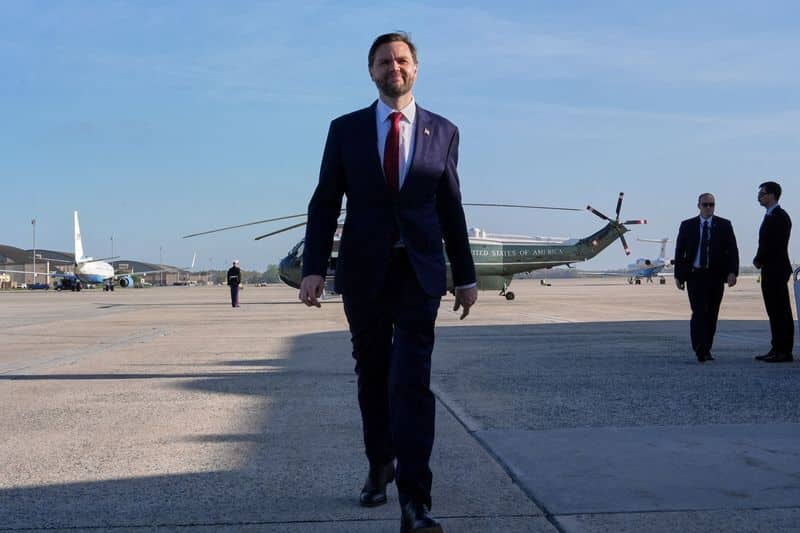
Departing for Pakistan on Friday morning, Vance said he would negotiate in good faith - but only if Iran did the same.
“We’re certainly willing to extend the open hand,” Vance said.
NEW NEGOTIATORS, SAME CHALLENGE
Among those who have advocated for Vance to take a leading role, according to a senior regional diplomat, was Iranian parliamentary Speaker Mohammed Bager Qalibaf, who will be representing Iran in Islamabad alongside Foreign Minister Abbas Araqchi.
Some White House officials had themselves in recent weeks identified Qalibaf as a preferred interlocutor, sensing that the former Tehran mayor had a pragmatic streak that could make him amenable to seeking a deal, two sources familiar with administration discussions said.
The regional diplomat said from Tehran’s perspective, Vance brought more political weight as a top-ranking elected official than Witkoff and Kushner.
Both sides will be dealing with their preferred counterparties.
But that is perhaps one of the only reasons for optimism going into Saturday’s talks, analysts say, with the publicly stated U.S. and Iranian positions miles apart.
For instance, the U.S. has said further uranium enrichment by Iran is a non-starter, while Iran has not publicly indicated it has any interest in abandoning its nuclear program.
The mood inside the White House is one of skepticism, another senior White House official said. Trump appears in recent conversations with advisers to have conceded the Strait of Hormuz, a hub of global commerce that remains effectively shut despite a fragile ceasefire, is unlikely to completely reopen soon, the official said. Trump said in a social media post on Thursday that oil would be flowing again quickly, without elaborating.
That wide gulf between the parties raises questions about whether Vance has been handed an opportunity - or a poisoned chalice.
Senior White House officials have been eager to portray Vance as a central player in talks with Iran.
“Vice President Vance has played a very significant and a key role in this since the very beginning,” White House press secretary Karoline Leavitt said at a Wednesday press conference. ”He’s been involved in all of these discussions.”
Vance himself has been more circumspect.
“I mean, you know, my key role was I sat on the phone a lot,” he said on Wednesday while traveling in Hungary. ”I answered a lot of phone calls. I made a lot of phone calls.”
Asked if Iran had specifically requested that he join the talks, Vance responded: “I don’t know that. I would be surprised if that was true.”
(Reporting by Gram Slattery, Humeyra Pamuk, Steve Holland and Nandita Bose; Editing by Colleen Jenkins, Rod Nickel)