By Gopal Sharma
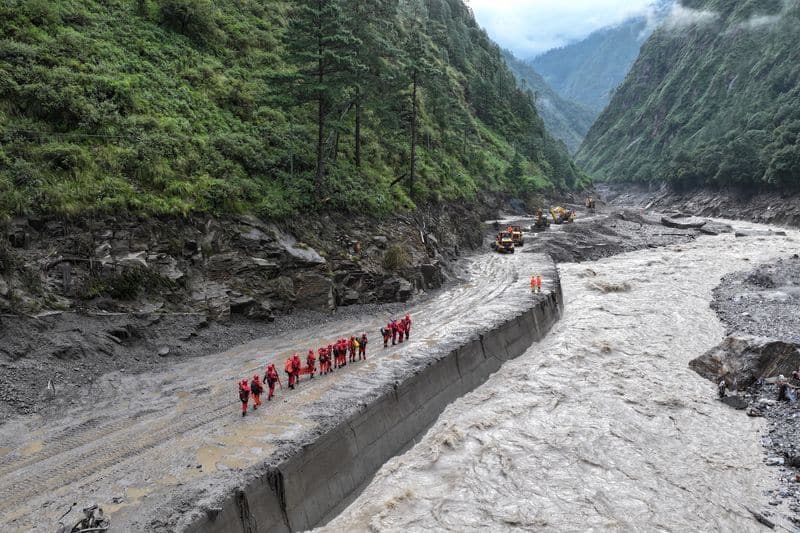
KATHMANDU, Aug 28 (Reuters) - Nepal does not need foreign assistance for search-and-rescue operations following the devastating flash flood that swept through several towns on Wednesday, its foreign ministry said, despite offers from several countries with nationals missing.
The flood tore through areas including Rasuwa district near the Chinese border, levelling entire towns, damaging hydropower plants and killing close to 500 people.
Hundreds of foreign nationals are still missing, including from South Korea, which said it has already sent a response team to Nepal and will also dispatch a disaster relief team.
But Nepal’s foreign ministry said on Friday that it was managing the rescue efforts itself.
“The offer for help is natural. Our security agencies are doing the search-and-rescue operation. For now we don’t require such help,” Lok Bahadur Chhetri, spokesperson for the foreign ministry, said on Friday.
The Kathmandu Post reported that India, China, the United States, Britain, Japan, South Korea, Sri Lanka and Bangladesh had asked the government to allow their search-and-rescue teams to assist in the operation.
South Korea’s foreign ministry said Nepal had indicated it was not yet planning to accept foreign rescue teams.
“South Korea will keep negotiating with Nepal over the matter,” the ministry added.
Seoul has pledged $1 million in humanitarian assistance through international organisations, its foreign minister said on X. Nine South Koreans working in a hydropower plant were missing and 10 were stranded, its foreign ministry said on Wednesday.
SENSITIVITY OF TIBET REGION
Dinesh Bhattarai, a former Nepali ambassador to the United Nations in Geneva, said the government’s reluctance to accept foreign search-and-rescue teams may be linked to the location of the flood-hit Rasuwa district, which borders China’s Tibet, one of Beijing’s most sensitive territorial issues. Nepal has long walked a tightrope in diplomatic relations with its much bigger neighbour.
“They may have thought about the locational sensitivity of the region and decided not to accept foreign teams,” Bhattarai told Reuters.
Nepalese foreign ministry spokesperson Chhetri said the decision had nothing to do with China’s sensitivity but was because Nepal’s own rescue teams were handling the operation.
China’s No. 2 official, Premier Li Qiang, visited the disaster-stricken site in Gyirong on Thursday afternoon, state-run Xinhua reported on Friday.
“So long as there is even the slightest hope, the utmost effort must be made,” Li said, according to Xinhua.
He further directed rescue command to “strengthen coordination and communication on emergencies involving foreign nationals or foreign parties” and work with foreign authorities to determine those missing and to handle the aftermath.
The Foreign Ministry of China did not immediately respond to a request to comment on why Nepal was refusing to accept foreign search and rescue assistance.
Chinese state media reported that Chinese President Xi Jinping extended condolences to Nepal’s president on Friday.
(Reporting by Gopal Sharma in Kathmandu and Heejin Kim in Seoul; Additional reporting by Joe Cash and Xiuhao Chen in Beijing; Writing by Shilpa Jamkhandikar and Anil D’Silva; Editing by Christian Schmollinger, Saad Sayeed, Rick Noack and Conor Humphries)